
Healthcare professionals can work with artificial intelligence without coding by learning how to interpret AI outputs, understand healthcare data, and use AI-powered tools to support clinical and operational decisions effectively.
Healthcare professionals today face the challenge of making quick, accurate decisions while managing an ever-growing volume of medical information. Patient records are becoming more detailed; diagnostic tools are more complex, and clinical data continues to expand, yet the time available to review it all remains the same. This gap between information and decision-making is where AI in healthcare is beginning to play a role.
For example, wearable AI devices are already helping manage chronic conditions, such as cardiac patients using ECG recordings to detect arrhythmias like atrial fibrillation often identifying these issues before they become fatal.
AI helps organize complex information, highlight potential risks, and bring attention to what matters most so professionals can focus on judgment and patient care instead of searching through data. As medical artificial intelligence becomes part of everyday healthcare systems, many professionals are asking a practical question: do you need coding skills to work with it, or is there another way to get started?
This blog explains how beginners can enter AI-powered healthcare environments without a technical background and what skills actually matter in real-world settings.
Do You Need Coding Skills to Learn AI in Healthcare?
No. Most healthcare professionals who work with artificial intelligence do not need coding skills. Learning AI in healthcare usually means understanding how AI tools are used in real environments and how to interpret the information they generate, rather than building algorithms or writing software.
Artificial intelligence systems are designed and developed by technical teams such as data scientists, engineers, and software developers. These professionals build models, manage data pipelines, and maintain the technical infrastructure that allows AI systems to function. Healthcare professionals enter the process at a different stage. Their responsibility begins once the system is already in use, where the focus shifts from development to application. They review alerts, risk scores, summaries, or recommendations generated by AI and evaluate whether those insights make sense within the clinical or operational context.
They review alerts, risk scores, summaries, or recommendations generated by AI and evaluate whether those insights make sense within the clinical or operational context. This is how artificial intelligence in healthcare works in practice: technology produces signals, and professionals determine their meaning.
A helpful way to understand this distinction is to compare AI with technologies that healthcare professionals already use every day. Electronic health record systems, imaging platforms, and diagnostic software are complex technologies built by technical teams, yet clinicians and administrators use them confidently without needing to understand how they were programmed. AI operates in a similar way. The system performs analysis in the background, while professionals focus on interpretation, validation, and decision-making based on the information presented.
What often creates confusion for beginners is the assumption that learning AI automatically means learning programming languages or advanced mathematics. In reality, most healthcare roles involving AI require awareness rather than technical development. Professionals need to understand what the system is designed to do, what its limitations might be, and when its outputs should be questioned or verified before action is taken.
The key point for beginners is straightforward. Coding is necessary for building AI systems, but it is not necessary for working effectively with AI in healthcare environments. The value healthcare professionals bring lies in understanding patients, workflows, safety requirements, and clinical context. When these strengths are combined with a clear understanding of how AI tools function, professionals become essential participants in AI for healthcare without needing to write a single line of code.
What Do Healthcare Professionals Actually Do When Using AI?
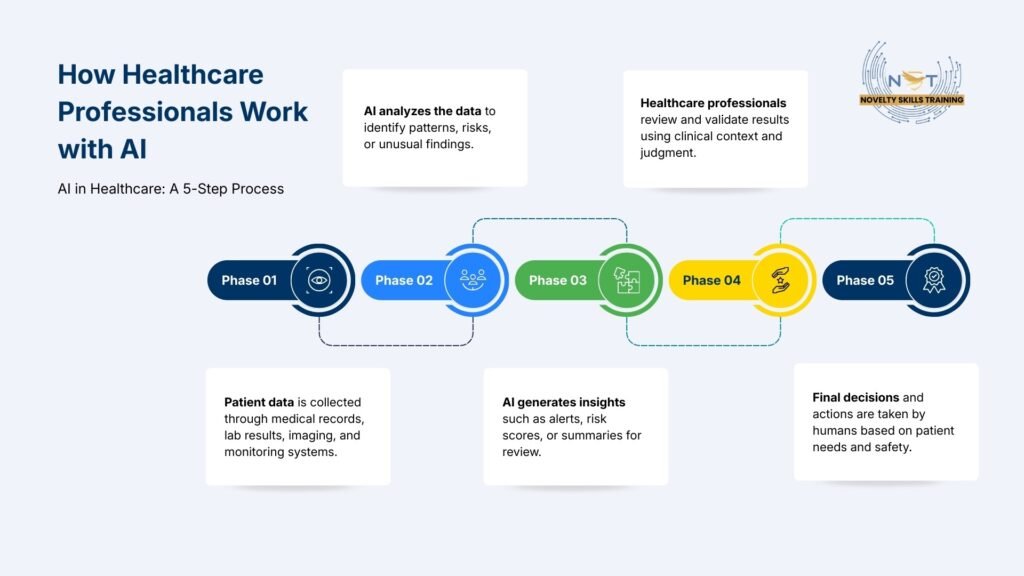
Healthcare professionals are not expected to build artificial intelligence systems or understand how algorithms are programmed. Their role begins after the technology has already been developed and introduced into a clinical or operational environment. In everyday practice, working with AI means understanding what the system is showing, evaluating whether it makes sense in the real-world context of patient care, and deciding how that information should influence the next step.
Interpreting AI Outputs in Clinical Context
One of the most common responsibilities involves interpreting AI-generated outputs. AI systems often present information in the form of alerts, probability scores, highlighted findings, or summarized insights. These outputs are not final answers but signals that something may require attention. A healthcare professional reviews this information alongside patient history, symptoms, ongoing treatment, and clinical observations to determine whether the output is relevant or requires further investigation.
In many AI medical diagnosis situations, the system highlights possibility, while the professional confirms meaning.
Using AI as Decision-Support Rather Than Decision-Making
AI is frequently used in decision-support environments where the goal is to strengthen human judgment rather than replace it. In clinical practice, these systems can identify patients at higher risk of deterioration, prioritize cases requiring urgent review, and flag inconsistencies in medical documentation. Healthcare professionals interpret this information within clinical guidelines and real-world constraints before taking action. Responsibility remains human because healthcare decisions involve risk, accountability, and ethical considerations that technology alone cannot manage.
Working With Large Volumes of Healthcare Data
Another important area where professionals interact with AI is in managing large amounts of information. Modern healthcare generates extensive records, including imaging reports, laboratory data, medication histories, and continuous monitoring data. AI systems help organize and summarize this information so that professionals can focus on understanding the patient’s condition rather than searching through fragmented records. In areas such as AI medical imaging, this support can significantly reduce review time.
Supporting Workflow and Operational Efficiency
AI also affects how daily workflows operate. Documentation support, patient triaging, scheduling optimization, and operational planning increasingly involve AI-enabled tools. Healthcare professionals guide how these tools are used within real environments because workflows differ across departments and institutions. Technology may suggest efficiency, but professionals ensure that efficiency does not compromise patient safety or quality of care.
Why Human Judgment Remains Central
In practice, AI handles scale and speed, while healthcare professionals provide interpretation, context, and responsibility. The effectiveness of AI in medicine depends less on programming knowledge and more on the ability to understand outputs, question limitations, and apply insights safely.
If Coding Is Not Required, What Skills Do You Actually Need to Work with AI in Healthcare?
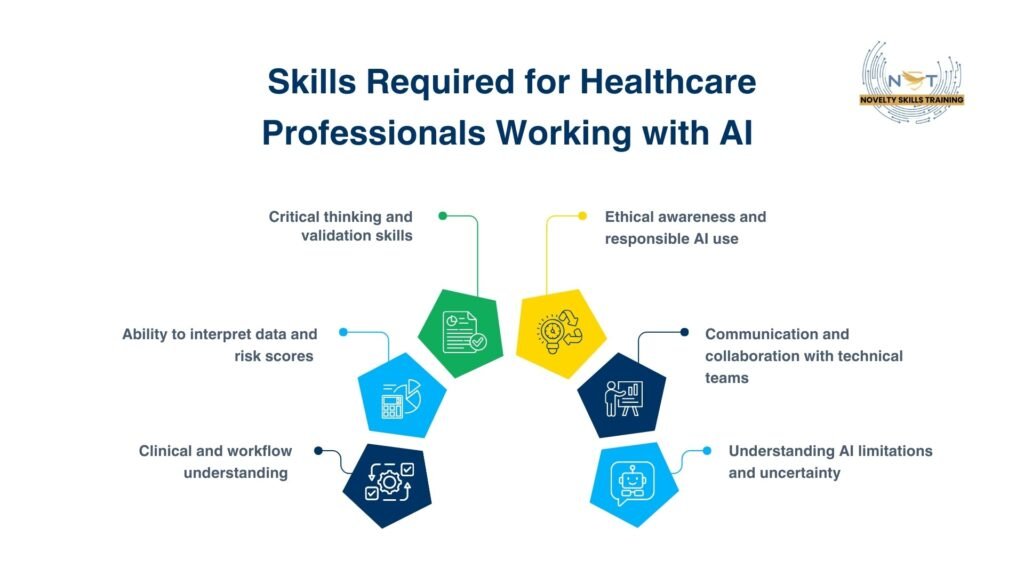
When healthcare professionals begin exploring artificial intelligence, the most common question after coding is what skills actually matter. In practice, working with AI in healthcare depends far more on understanding context, making informed judgments, and applying technology responsibly. AI systems can process information at scale, but they still depend on humans to interpret results and ensure that decisions remain safe and meaningful.
Clinical and Workflow Understanding
A strong understanding of how healthcare is delivered remains one of the most valuable skills in AI-supported environments. Knowing how diagnoses are made, how treatment decisions evolve, and how departments function allows professionals to recognize whether AI-generated insights are realistic and useful. AI may highlight a risk or pattern, but only someone familiar with real clinical workflows can judge whether that information fits the patient’s situation or requires further review.
Data Interpretation and Awareness
AI systems often present results as probabilities, risk scores, or summarized insights rather than clear answers. Professionals need the ability to read this information carefully and understand what it represents. This does not require statistical expertise, but it does require awareness that AI outputs reflect likelihoods, not certainty. Understanding how data can be incomplete, biased, or misinterpreted helps professionals avoid over-reliance on automated suggestions.
Critical Thinking and Validation
AI outputs are designed to assist, not replace reasoning. Healthcare professionals must be comfortable questioning results, comparing them with clinical observations, and identifying situations where the output may not align with reality. Critical thinking ensures that AI remains a support tool rather than an unquestioned authority, which is essential in environments where patient safety is involved.
Ethical and Responsible Use of Technology
Healthcare data is sensitive, and AI systems must be used within ethical and regulatory boundaries. Professionals play a key role in ensuring patient privacy, fairness, and appropriate use of technology. Understanding when AI should or should not influence decisions helps maintain trust and accountability in AI-supported healthcare systems.
Communication and Collaboration
AI environments bring together healthcare teams, administrators, and technical specialists. Professionals who can clearly explain clinical needs, interpret AI outputs for non-technical stakeholders, and communicate concerns effectively become important bridges between technology and practice. Clear communication ensures that AI insights are applied correctly and understood across teams.
In reality, these skills already exist within healthcare professions. AI does not replace them; it increases their importance. Professionals who combine domain knowledge with basic AI awareness are often better prepared for AI-enabled healthcare environments than those who only understand the technology itself.
For those looking to enhance their skills and bridge this gap, specialized training can be an excellent way to gain the necessary knowledge and confidence in AI applications
AI and ML in Healthcare Training Course
Master artificial intelligence and machine learning to transform patient care, clinical research, and diagnostics. Learn how teams deploy predictive models, automate coding, and optimize workflows in modern environments shaped by AI technology in healthcare.
VIEW COURSEDuration: 6 months
Skills you’ll gain:
- Healthcare Data Handling & Preparation
- Machine Learning Foundations
- Predictive Analytics in Clinical Settings
- AI for Diagnostics & Risk Stratification
- Model Evaluation & Validation
- Healthcare Data Visualization
- Responsible & Ethical AI Use
Other Courses
- Artificial Intelligence and Machine Learning Training
What Are the Future Roles for Non-Coders in Healthcare AI?
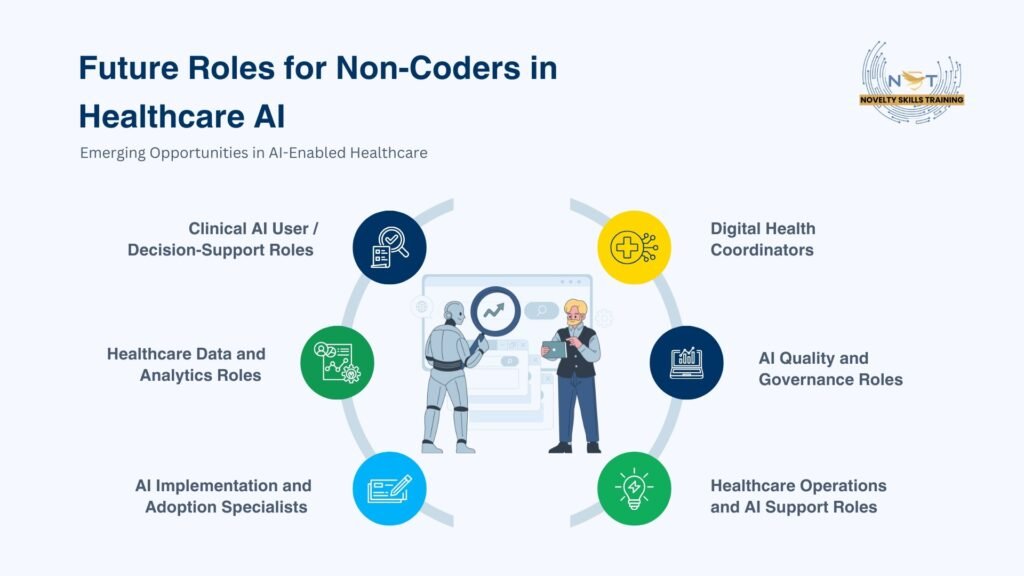
As artificial intelligence becomes a regular part of healthcare systems, the roles surrounding it are also changing. These roles are not about building AI models or writing code. They are about making sure AI is used correctly, safely, and meaningfully in real healthcare environments. For non-coders, this creates opportunities that are closely tied to healthcare knowledge, workflows, and decision-making.
Clinical AI Users and Decision-Support Roles
In many healthcare settings, professionals already interact with AI without formally labeling it as an AI role. These professionals work with systems that flag risks, highlight abnormalities, or suggest priorities. Their responsibility is to interpret this information, check whether it aligns with patient conditions, and decide how it should influence care or operations.
As AI becomes more embedded, this role will become more structured. Professionals who understand how to question AI outputs, recognize limitations, and apply insights responsibly will be central to safe AI use in clinical environments.
Healthcare Analytics and Insight Roles
AI generates large amounts of summarized and predictive information, but organizations still need people who understand what that information means in practice. Healthcare analytics roles focus on reviewing trends, validating AI-generated insights, and helping leadership or clinical teams understand implications for patient care, quality improvement, or planning.
These roles do not require building models. They require strong understanding of healthcare data, context, and the ability to translate insights into meaningful action.
AI Implementation and Adoption Roles
When healthcare organizations introduce new AI tools, successful adoption depends heavily on people who understand both healthcare workflows and digital systems. These professionals help align AI tools with real operational needs, support staff during transitions, and identify gaps between how technology is designed and how care is delivered.
As AI adoption increases, these implementation-focused roles will grow in importance because poorly integrated AI can create confusion rather than improvement.
Digital Health and AI Coordination Roles
AI in healthcare brings together clinicians, administrators, IT teams, vendors, and regulators. Coordination roles focus on communication across these groups. Professionals in these positions help ensure that clinical needs are understood by technical teams and that AI outputs are explained clearly to healthcare staff.
These roles value communication, system understanding, and domain expertise more than technical depth. They are especially important in maintaining trust and consistency as AI tools evolve.
Governance, Quality, and Responsible AI Roles
As AI systems influence more healthcare decisions, organizations will increasingly need professionals involved in oversight, quality assurance, and ethical use of AI. These roles focus on monitoring AI performance, identifying bias or risk, ensuring compliance with regulations, and maintaining patient safety.
Healthcare professionals with strong understanding of care standards and ethics are well positioned for these responsibilities, even without coding knowledge.
What This Means for Beginners
The future of healthcare AI is not built only by programmers. It relies on professionals who understand care delivery, patient safety, data interpretation, and real-world constraints. As AI becomes more common, non-coders who develop AI awareness alongside healthcare expertise will play an essential role in shaping how technology is used.
How Can Beginners Start Learning AI in Healthcare Without Coding?
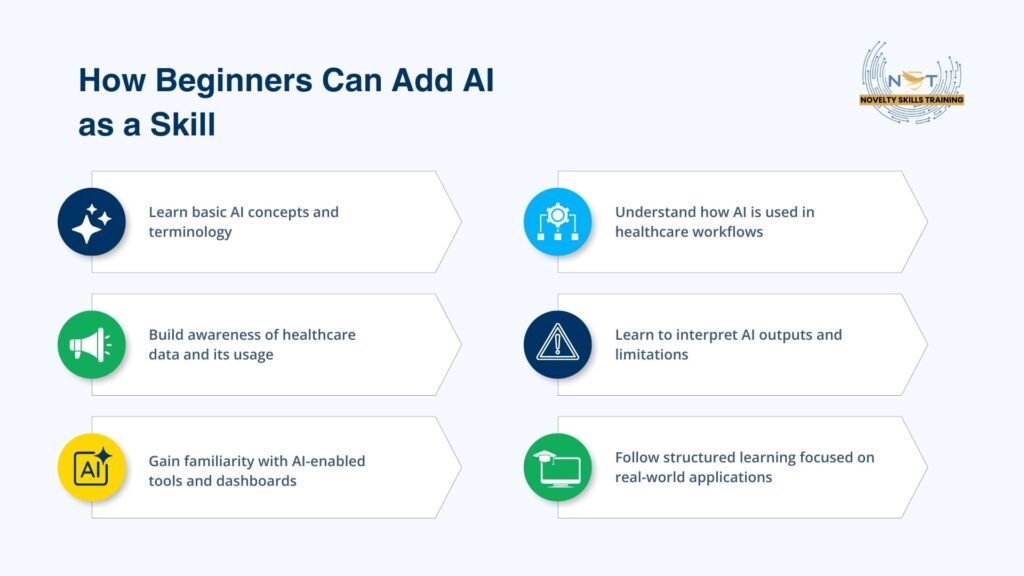
Getting started with artificial intelligence in healthcare does not begin with programming or technical tools. For most beginners, the first step is understanding where AI fits into everyday healthcare environments and how professionals interact with these systems during routine work. AI becomes easier to approach once it is seen as an extension of existing digital tools rather than a completely new technical field.
Building a Conceptual Understanding of AI in Healthcare
Beginners benefit from first understanding what AI is designed to do in healthcare and, just as importantly, what it cannot do. AI systems identify patterns, organize information, and support decision-making, but they do not replace clinical reasoning or responsibility. Learning basic concepts such as prediction, automation, and decision support helps professionals follow discussions around AI without needing technical depth. This foundational awareness removes much of the intimidation associated with the topic.
Understanding Healthcare Data and How It Is Used
AI systems work on healthcare data, including patient records, laboratory results, imaging reports, and monitoring information. Understanding how this data is created, documented, and interpreted helps beginners see how AI generates its outputs. Professionals who already work with clinical information often realize that they are familiar with the data itself; the difference lies only in how technology analyzes it.
Learning AI Limitations and the Need for Human Oversight
An important part of AI literacy is understanding that AI systems can make mistakes or produce misleading results if data is incomplete or situations fall outside training patterns. Beginners should learn why validation and human supervision remain necessary. This awareness helps professionals use AI confidently without over-relying on automated outputs.
Becoming Familiar With AI-Enabled Tools
Many healthcare organizations already use AI-enabled platforms within existing systems. Becoming comfortable navigating dashboards, reviewing alerts, and understanding how AI recommendations appear in workflows is often more valuable than technical knowledge. Familiarity grows naturally through exposure and practice rather than through coding.
For beginners, the starting point is not technical mastery but confidence in understanding how AI supports everyday work. Once professionals recognize how AI fits into existing healthcare processes, learning becomes gradual and practical rather than overwhelming, which is why structured programs such as the AI and ML in Healthcare training by Novelty Skills Training (NST-Dubai) focus on practical understanding and real-world healthcare applications rather than coding.
What Are the Common Misconceptions About Learning AI in Healthcare?
As interest in artificial intelligence grows, many healthcare professionals hesitate to explore it because of assumptions that make the field appear more technical or complicated than it actually is. These misconceptions often come from how AI is discussed in technical or media contexts rather than how it is used in everyday healthcare environments.
Misconception 1: AI Always Means Programming
One of the most common misunderstandings is that learning AI automatically requires learning programming languages or software development. While coding is essential for building AI systems, most healthcare roles involve using AI tools rather than creating them. Professionals interact with AI through existing platforms, where the focus is on understanding outputs and applying insights safely within clinical workflows.
Misconception 2: Only Engineers Can Work With AI
AI development involves engineers, but AI implementation depends heavily on domain expertise. Healthcare environments require professionals who understand patient care, safety standards, documentation, and operational realities. Technical teams build systems, but healthcare professionals ensure those systems are used correctly and responsibly. Without domain knowledge, AI systems cannot function effectively in real-world settings.
Misconception 3: Advanced Mathematics Is Required
Another common concern is that AI requires strong mathematical knowledge. Advanced mathematics plays a major role in designing machine learning models, but everyday AI use in healthcare rarely involves mathematical calculations. What matters more is understanding what an AI result represents, recognizing uncertainty, and knowing when further validation is needed.
Misconception 4: AI Will Replace Healthcare Professionals
Fear of job replacement often prevents professionals from engaging with AI. In reality, AI is primarily designed to support decision-making by handling repetitive analysis and organizing information at scale. Human judgment, communication, empathy, and accountability remain essential in healthcare. AI changes how work is done, but it does not remove the need for professionals who understand care delivery.
When these misconceptions are addressed, AI becomes less intimidating and more practical. Instead of being seen as a technical field reserved for programmers, it becomes a tool that healthcare professionals can learn to use as part of their evolving roles.
Conclusion
Artificial intelligence is becoming a normal part of healthcare, changing how information is reviewed, how risks are identified, and how decisions are supported. At the same time, working with AI does not mean becoming a programmer. In most healthcare environments, the value comes from understanding how AI fits into real workflows, interpreting its outputs responsibly, and ensuring that technology supports safe and effective care.
For beginners, the important shift is not toward technical complexity but toward awareness. Professionals who understand how AI tools function, where their limitations exist, and how their insights should be applied are better prepared for healthcare environments that are becoming increasingly digital. Clinical knowledge, critical thinking, and communication remain central, while AI acts as a tool that strengthens these abilities rather than replacing them.
As healthcare continues to evolve, those who learn to work confidently alongside AI will find new opportunities across clinical, operational, and digital health roles. The future of healthcare AI will not depend only on those who build the technology, but also on professionals who understand how to use it responsibly and meaningfully in everyday practice.
Frequently Asked Questions (FAQs)
1. How long does it usually take to become comfortable working with AI tools in healthcare?
For most beginners, basic familiarity with AI concepts and tools can develop within a few months of consistent learning and exposure. Comfort usually comes from understanding how AI outputs appear in workflows rather than from technical study.
2. Is AI used only in large hospitals or also in smaller healthcare settings?
AI is increasingly used across different healthcare environments, including clinics, diagnostic centers, telehealth platforms, and administrative operations. Many AI features are already embedded within existing healthcare software systems.
3. Do healthcare professionals need to understand machine learning models in detail?
No. Most professionals only need a conceptual understanding of how AI generates predictions or insights. Detailed knowledge of model development is generally required only for technical roles.
4. Can AI skills help healthcare professionals move into non-clinical roles?
Yes. AI awareness can open opportunities in healthcare operations, quality improvement, digital health coordination, analytics support, and technology implementation roles that do not require direct patient care.
5. How can professionals evaluate whether an AI tool is reliable?
Reliability is usually assessed through clinical validation, regulatory approval, and consistent performance within workflows. Professionals should also consider whether AI outputs align with clinical evidence and real-world observations before relying on them.
6. Are certifications or formal training necessary to work with AI in healthcare?
Formal training is not always mandatory, but structured learning helps beginners understand AI applications faster and avoid common misconceptions. Training is particularly useful for professionals transitioning into digital health or AI-supported roles.
7. How is the UAE healthcare sector adopting AI technologies?
The UAE is actively integrating AI through national initiatives such as the UAE National Strategy for Artificial Intelligence 2031, along with investments in digital health infrastructure, smart hospitals, and data-driven healthcare services.
8. Are AI healthcare tools regulated in Dubai and the UAE?
Yes. Authorities such as the Dubai Health Authority and the Ministry of Health and Prevention have introduced regulations and guidelines to ensure AI systems meet safety, privacy, and clinical oversight requirements before being used in healthcare environments.
9. Are there career opportunities in healthcare AI for non-coders in the UAE?
Yes. As hospitals and healthcare organizations adopt AI-supported systems, demand is increasing for professionals who understand healthcare workflows, data interpretation, and digital health operations without necessarily having programming skills.
10. Why is AI awareness becoming important for healthcare professionals in Dubai?
Dubai’s healthcare sector is rapidly adopting digital and AI-enabled systems to improve efficiency and patient outcomes. Professionals who understand how AI tools function are better prepared to adapt to evolving workflows and technology-driven healthcare environments.