
The UAE is rapidly growing in healthcare AI due to government-mandated AI adoption, centralized health data systems like Malaffi and NABIDH, and real-world deployment across hospitals. Faster validation cycles, strong public–private investment, and a growing talent gap are creating immediate demand for AI professionals.
If you are serious about building a career in healthcare AI, where you work matters more than what you learn.
The US and Europe are building some of the most advanced AI models in the world. But when it comes to deploying those systems across real hospitals, at scale, they are still dealing with fragmented data, slow regulatory cycles, and legacy infrastructure that was never built for AI.
Instead of retrofitting AI into an existing system, UAE built the healthcare AI infrastructure first. Centralized health data networks, mandated AI adoption, and sovereign capital have created something rare: a country where healthcare AI is not being piloted, it is operational at scale.
That is why the UAE is now attracting global healthcare AI talent at a pace no other country is matching right now. In this blog we will break down exactly what is happening in the healthcare AI space in the UAE, why it matters, and how you can position yourself to access AI jobs in UAE healthcare.
Top 8 Reasons Why UAE is One of the Best for Healthcare AI Careers
1. Mandated AI Adoption Driving System-Wide Implementation
The UAE Artificial Intelligence Strategy 2031 is a federal directive, not a vision document. It pushes AI adoption across all priority sectors, with healthcare near the top. And since it’s a directive, the execution part is overseen by the UAE Artificial Intelligence and Blockchain Council , which coordinates implementation across concerning ministries.
Strict policies like these are pushing government entities to appoint dedicated AI leadership roles like Chief AI Officers and equivalent roles, who are made responsible and accountable for the execution, and not just planning.
The result: AI adoption in UAE healthcare is not waiting for internal buy-in or budget approvals. It is directed, funded, assigned, and accountable. This level of government involvement will drive systemic requirements for skilled AI professionals across all tiers.
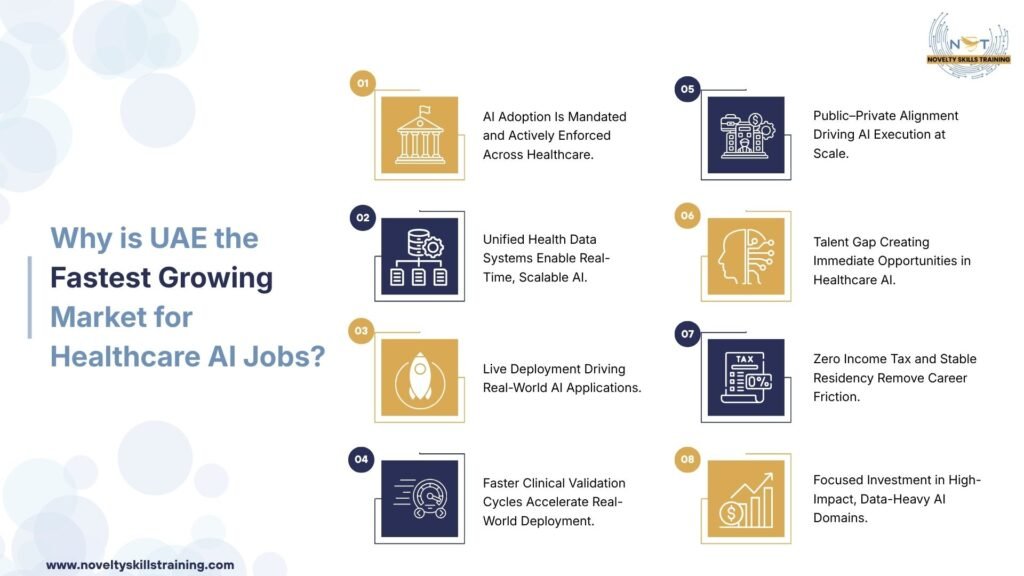
2. Unified Data Enabling Scalable AI Systems
Most western healthcare systems are still trying to integrate their healthcare data. The UAE has already unified it, at a national scale.
Malaffi and NABIDH are not just digital health platforms, instead they are integrated national data networks that connect hospitals, clinics, labs, and pharmacies into unified systems across Abu Dhabi and Dubai.
What that looks like in practice:
- Malaffi connects 3,000+ healthcare facilities and integrates 90+ EMR systems
- It enables millions of health records to be securely shared across the emirate, covering the vast majority of patient interactions in Abu Dhabi
- Doctors across different hospitals can pull the same patient’s full history in real time
- NABIDH does the same across Dubai, linking providers into one data flow
There is another layer most people miss. The UAE serves a population of over 200 nationalities — all flowing into the same unified data infrastructure. That creates one of the most diverse clinical datasets available in a single system, which makes AI models trained here more robust and more globally applicable.
3. Live Deployment Creating Real-World AI Applications
Here is where is already running LIVE in UAE in the healthcare AI space:
- National screening programs: M42 developed AIRIS-TB, an AI model designed to screen chest X-rays for tuberculosis. Tested across more than one million scans at the Capital Health Screening Centre, the model achieved an AUROC score of 98.5 percent with zero missed TB cases. It now enables 2,000 AI-assisted chest X-rays per day — a tenfold increase over conventional methods — while reducing radiologist workload by up to 80 percent.
- The study was peer-reviewed and published in npj Digital Medicine , making it one of the largest real-world clinical validations of an AI-driven healthcare solution to date.
- Population health and predictive analytics: AI integrated into Malaffi, analyzes hundreds of millions of clinical records to predict disease risk and flag early intervention opportunities across the population.
- Hospital imaging and diagnostics: AI is embedded into imaging workflows to detect abnormalities and prioritize urgent cases. At Emirates Health Services, diagnostic wait times dropped from 19 days to just one day after AI integration, enabling a same-day diagnosis model.
- Remote monitoring for chronic disease patients: Patients managing diabetes, cardiovascular conditions, or respiratory disease can now transmit health data from connected wearable devices to care teams. AI analyzes this data continuously, identifying patterns that require attention. Platforms like Enayati use AI to track health indicators and predict risks for vulnerable populations, keeping patients safely at home under clinical oversight.
- Operational automation and diagnostics at scale: NMC Healthcare centralized data from 70 facilities using Snowflake’s cloud platform, enabling real-time analytics and AI-assisted decision-making across its network. PureHealth, which operates more than 25 hospitals and over 100 clinics, recently launched the UAE’s largest AI-powered diagnostic lab ; a 70,000 sq ft facility processing over 30 million samples annually using AI-driven automation and robotics.
Key Domains Creating Demand in UAE Healthcare AI
These domains are directly creating healthcare AI roles in UAE across multiple systems.
| Domain | Roles in High-Demand in UAE |
|---|---|
| Medical Imaging & Diagnostics | Medical Imaging AI Engineer, AI Validation Engineer (Radiology), Radiology AI Integration Specialist, Clinical Data Annotator |
| Clinical Decision Support & Predictive Care | Clinical AI Specialist, Healthcare Data Scientist, Predictive Modeling Engineer, AI Clinical Validation Analyst |
| Remote Monitoring & Connected Care | Healthcare IoT Engineer, Remote Monitoring Data Engineer, AI Monitoring Systems Analyst, Patient Data Platform Engineer |
| Hospital Operations & AI Automation | Healthcare AI Operations Engineer, AI Workflow Optimization Analyst, Data Platform Engineer (Healthcare), AI Implementation Manager |
| Genomics & Precision Medicine | Bioinformatics Engineer, Genomics Data Scientist, AI Research Scientist (Healthcare), Precision Medicine Analyst |
4. Faster Clinical Validation Speeds Up AI Deployment
In most markets including the US and Europe, AI development and regulatory approval run separately. You build, then wait, then deploy. The gap between a working model and a deployed one can be years.
The UAE operates dynamically.
Regulators like the Department of Health — Abu Dhabi and the Dubai Health Authority allow AI solutions to be tested directly in controlled clinical environments. Models are evaluated on real patient data, under supervision, while being integrated into live workflows.
The TB screening system from M42 is a direct example. It was not held in isolated testing. It was validated across 1M+ real scans over two years , with regulatory oversight throughout, and expanded as performance was proven.
Traditional workflow: build → wait for approval → deploy
UAE workflow: build → test in real environment → validate → scale
5. Public–Private Alignment Driving AI Execution at Scale
The UAE’s healthcare AI ecosystem works because government direction and private execution are aligned — and both are backed by serious capital.
Mubadala Investment Company deployed $29.2 billion in 2024 , becoming the world’s largest sovereign wealth fund investor that year, with a strong focus on AI, healthcare, and future technologies.
Microsoft has committed USD 15.2 billion to UAE AI infrastructure between 2023 and 2029 — including a USD 1.5 billion equity stake in G42 and over USD 4.6 billion in AI and cloud datacenter infrastructure. G42 is using this to build large-scale compute systems and AI platforms that directly serve the healthcare sector.
In May 2025, Oracle, Cleveland Clinic, and G42 launched an AI-powered global healthcare delivery platform designed to enhance diagnostics and support personalized medicine. In July 2025, M42 and GE HealthCare partnered to develop AI-enabled diagnostic technologies across the UAE.
M42 operates 480+ healthcare facilities across 27 countries, serving 15 million patients annually, with AI embedded across its diagnostics and screening workflows. The Emirati Genome Program targets one million genetic samples from citizens, with over 800,000 already collected — creating one of the largest regional genomic datasets for AI-driven predictive healthcare.
The structure is simple but effective:
- The government provides direction, funding, and access
- Private players build and deploy systems
- Healthcare networks adopt and scale them
6. Talent Gap Driving Immediate Opportunities in Healthcare AI
The UAE is deploying healthcare AI faster than it can build the workforce to support it—and it is treating that gap as something to close quickly, not manage over time.
The response is already visible across training, partnerships, and policy.
Healthcare-specific AI training
The Department of Health – Abu Dhabi , in partnership with Mohamed bin Zayed University of Artificial Intelligence and Core42, launched the Global AI Healthcare Academy to train professionals in clinical AI, diagnostics, and healthcare system integration. This is not general AI education—it is focused on preparing talent for real healthcare systems already in operation.
Global upskilling partnerships
Alongside this, the UAE is expanding its talent pipeline through large-scale collaborations. Microsoft is working with the country to upskill individuals in AI, while G42 is building applied training and deployment environments that align directly with ongoing healthcare AI projects.
Talent attraction through residency
To complement local training, the UAE is also attracting experienced professionals globally. The Golden Visa offers long-term residency of up to 10 years, allowing skilled individuals to work across organizations without being tied to a single employer.
Even with these efforts, demand for healthcare AI jobs in UAE continues to outpace supply—making this one of the few markets where entering early can lead to faster growth and direct exposure to live systems.
7. Financial and Residency Benefits Attracting AI Talent
There is no personal income tax in the UAE. Salaries for AI and tech roles are already competitive. The effective take-home difference compared to markets like the UK, Germany, or India — where taxes can run 30 to 40 percent — is significant over time.
The UAE Golden Visa provides up to 10 years of long-term residency, with no strict dependency on a single employer. Professionals can move between organizations, build careers across the ecosystem, and plan long-term without constant immigration uncertainty.
8. Focused Domains Creating High-Value AI-enabled Roles
The UAE is not chasing every AI trend. It is concentrating investment in high-impact, data-intensive domains where long-term leadership can be built: genomics, diagnostics, and clinical AI.
The Emirati Genome Program has collected over 800,000 DNA samples from citizens, building population-scale genetic data to enable predictive and personalized healthcare. AI is already embedded across diagnostic systems — imaging, screening, and lab workflows — handling high-volume clinical data. M42 is developing healthcare-specific AI models designed for clinical reasoning and real-world deployment.
These domains share three characteristics: they require significant data, they are clinically critical, and they are difficult to execute at scale. The UAE is not following global trends here. It is ahead of them — which means professionals who develop expertise here are working on systems that most of the world has not built yet.
UAE vs US vs Europe: Where Healthcare AI Actually Stands
| Factor | UAE | United States | Europe |
|---|---|---|---|
| Clinical AI Deployment | M42 AIRIS-TB used in national screening: 1M+ X-rays processed, ~98.5% AUROC, ~2,000 scans/day | Used at leading systems like Mayo Clinic, but mostly limited to specific departments and use cases | Primarily pilot programs, with limited integration into daily clinical workflows |
| Health Data Infrastructure | Malaffi (600M+ records, ~98% coverage) and NABIDH enable real-time, system-wide access to patient data | Data spread across Epic, Cerner, insurers, with limited interoperability between systems | Data fragmented across countries; interoperability still a major barrier across public systems |
| AI at Operational Scale | PureHealth runs AI-powered lab processing 30M+ samples/year; NMC Healthcare integrates data across 70+ facilities | AI used in operations and analytics, but not standardized or deployed across entire systems | Limited operational AI; adoption varies widely across countries and providers |
| Validation & Deployment Speed | Models tested in real environments (e.g., 1M+ scans) under Department of Health – Abu Dhabi, enabling faster scale-up | Sequential approval via FDA slows deployment after model development | Multi-country regulatory requirements lead to longer validation and rollout timelines |
| AI Infrastructure Investment | G42 + Microsoft partnership ($1.5B+) building national AI and cloud infrastructure | Strong private investment (Google, Microsoft, Amazon), but execution remains decentralized | Large public funding (e.g., Horizon Europe), but slower conversion into real deployments |
| Specialized AI Domains | Emirati Genome Program (800K+ genomes) and growing demand for Arabic NLP in healthcare systems | Strong genomics and biotech ecosystem, but less centralized integration into clinical workflows | Strong research (e.g., UK Biobank), but limited integration into routine healthcare systems |
| Talent Market Dynamics | Net AI talent inflow (~4.4 per 10K professionals), supported by Golden Visa and tax advantages; demand exceeds supply | Large talent pool, but high competition and saturation in major hubs | Talent present but mobility constraints across countries slow market growth |
| Career Opportunity Stage | Expansion phase: active deployment + talent gap → faster entry and progression | Mature market: competitive, slower growth without specialization | Early-to-mid stage: fewer large-scale deployment roles available |
How to Position Yourself for Healthcare AI Roles in the UAE
- Build healthcare-specific projects — imaging, diagnostics, patient risk models — not generic machine learning demos
- Understand how platforms like Malaffi and NABIDH work at a system level
- Target companies actively deploying in this space, like M42 and G42
- Learn deployment thinking: how AI integrates into clinical workflows, not just how models are built
- Focus on roles tied to real systems — clinical AI, validation, imaging, integration
The difference between candidates who get into this space and those who do not is not technical skill alone. It is understanding how healthcare AI actually works in production.
Generic courses teach you to build models. They do not teach you how those models get validated, integrated, and deployed inside a live hospital system. That gap is exactly why trained candidates still struggle to get hired in this space.
Frequently Asked Questions
Yes. The UAE combines government-mandated AI adoption through federal-run policies like UAE AI Strategy 2031, live deployments at scale, centralized health data systems like Malaffi and NABIDH, zero income tax, and long-term residency options. Demand is already ahead of supply, which creates strong growth opportunities.
Salaries vary by role and experience. Entry-level roles typically range from AED 8,000 to 15,000 per month. Mid-level roles can reach AED 18,000 to 35,000, while senior roles go higher. The absence of income tax significantly increases take-home pay.
Key employers include M42, G42, the Department of Health – Abu Dhabi, Emirates Health Services, and global partners like Microsoft working on national AI programs.
No. Most roles—data science, integration, imaging AI, validation—do not require a clinical degree. What matters is technical skill combined with an understanding of healthcare workflows and systems.
Core skills include machine learning, Python, SQL, healthcare data systems (EMR, HL7, FHIR), medical imaging AI, and AI validation. Understanding clinical workflows and working with cross-functional teams is equally important.
It is a federal directive mandating AI integration across key sectors, including healthcare. It is backed by governance bodies, leadership roles like Chief AI Officers, and large-scale investment.
Malaffi connects 3,000+ healthcare facilities and enables real-time sharing of clinical records across Abu Dhabi. NABIDH is Dubai’s equivalent system. Together, they form the backbone of healthcare data integration in the UAE.
Yes. Graduates in computer science, data science, biomedical engineering, or health informatics can enter the field. The UAE is actively building entry-level pipelines alongside senior roles due to ongoing AI deployment.
Regulators like the Department of Health – Abu Dhabi and Dubai Health Authority allow AI systems to be tested in controlled clinical environments using real patient data. Systems are validated continuously and scaled based on performance.
Start by building healthcare-focused projects such as imaging models or patient risk prediction systems. Learn how platforms like Malaffi work, and focus on roles related to deployment, validation, and integration rather than just model building.