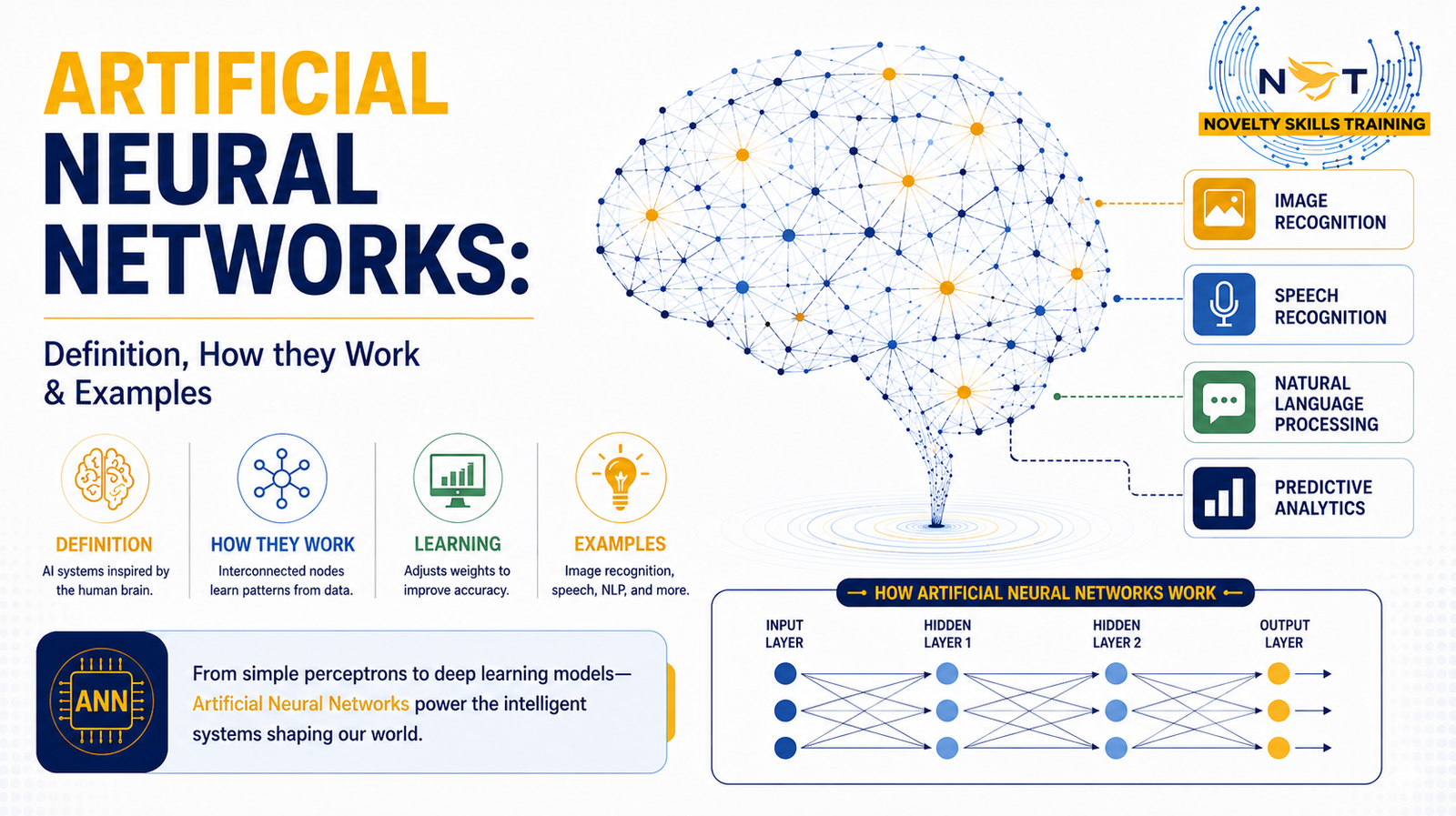
An artificial neural network (ANN) is a machine-learning model that uses interconnected neurons, layers, weights, and activation functions to learn patterns from data. It processes inputs through hidden layers, adjusts connections through training, and enables applications like image recognition, healthcare AI, and autonomous systems.
Dubai is accelerating AI adoption across transport, healthcare, government and business, with the artificial neural network becoming a key technology behind systems that learn from data and make intelligent decisions. Globally, neural networks power breakthroughs in generative AI, autonomous systems and medical intelligence. Microsoft reported 70.1% AI adoption among the UAE’s working-age population in Q1 2026, reflecting the region’s rapid AI growth. This blog explores how neural networks work, their architecture, types and real-world applications while highlighting the skills needed to work with AI systems.
What Is an Artificial Neural Network?
To put it simply, an artificial neural network is a system of interconnected mathematical “neurons,” modelled loosely on the human brain. Data enters through an input layer, moves through hidden layers where patterns are detected and weighted, and exits through an output layer as a prediction or a decision.
An artificial neural network is made up of interconnected computational units organized into three broad stages:
[ Input Layer ] ──> [ Hidden Layers ] ──> [ Output Layer ]

   (Raw Data)        (Feature Extraction)       (Predictions)
- Input layer: Receives raw information such as images, numbers, text or sensor readings.
- Hidden layers: Transform that information and identify increasingly complex patterns.
- Output layer: Produces a prediction, classification or other result.
The Mathematics Behind Artificial Neural Networks
An artificial neural network learns by adjusting parameters that control information flow, enabling it to recognize patterns and improve predictions through training.
Within this neural network architecture, individual artificial neurons calculate outputs using specific parameters:
- Weights and Biases: Adjustable parameters that control input importance and shift activation thresholds during training.
- Activation Function: Introducing non-linearity (e.g., ReLU, Sigmoid), enabling the network to learn intricate nonlinear boundaries.
- Backpropagation: The core mathematical optimization algorithm that calculates gradient error rates and adjusts weights across the networks.
Types of Neural Networks
Different tasks demand tailored structural design. Understanding the primary types of neural networks highlights why deep learning is versatile:
- Convolutional Neural Networks (CNNs): Designed for grid-structured visual inputs, CNNs automate spatial feature extraction, powering computer vision systems.
- Recurrent Neural Networks (RNNs): Built for sequential or temporal data, retaining internal memory states ideal for time-series forecasting.
- Transformers: The modern architecture utilizing self-attention mechanisms to map contextual relationships across massive unstructured datasets.
Key Takeaway: The term artificial neural network explained simply represents a family of scalable architectures, each tailored to ingest distinct data modalities.
Artificial Neural Network Examples in Dubai: Real-World Applications
Once you understand how neural networks work at the neuron level, spotting them in daily Dubai life gets easy.
1. Autonomous Transit & Traffic Infrastructure
Dubai’s Self-Driving Transport Strategy aims to transition 25% of total mobility journeys to autonomous modes by 2030.
- Autonomous taxis employ CNN-driven vision frameworks alongside LiDAR and radar data streams (over 40 sensors per vehicle) to make real-time operational decisions.
- The RTA’s Data Drive – Clear Guide system processes historical and live traffic data using AI analytics.
2. Smarter Public Transport
AI is also reshaping Dubai’s bus network. In 2026, the RTA reported that an AI-powered operational system contributed to a 68% reduction in early bus departures, using data analytics to predict cancellations, flag operational issues and support faster responses on the ground.
3. Healthcare Precision Intelligence
The UAE healthcare sector leads in AI adoption, with 59% of residents engaging with AI-driven health platforms, nearly double the global average.
- Medical imaging pipelines use artificial neural network examples to automate radiological evaluations and detect anomalies early.
- Dubai Health’s strategic portfolio includes 37 prioritized AI deployment initiatives designed to enhance diagnostic accuracy while maintaining strict governance under Dubai Health Authority policies.
4. Real Estate, Retail and the Job Market
- Real Estate & Retail: Neural networks can analyze property, pricing and customer-behavior data to support forecasting across Dubai’s real estate and retail sectors.
- AI Hiring: PwC’s 2026 Global AI Jobs Barometer found UAE job postings requiring AI skills rose from 1.0% in 2021 to 3.2% in 2025, moving the country from 21st to 13th globally.
Taken together, these artificial neural network examples span mobility, health, retail and hiring, proof that the technology has moved well past the lab.
Why Neural Networks Matter to Dubai’s AI Ecosystem
Dubai is moving AI beyond the lab into government, healthcare, transport, and business. The Dubai Universal Blueprint for AI and the UAE’s National Strategy for AI 2031 position AI as a driver of smarter services, higher productivity, and sector-wide transformation.
Essential Skills for an AI Career in Dubai
Building a sustainable career within Dubai’s evolving tech landscape requires a strong, practical skill stack:
| Foundational Programming | Python, data wrangling, linear algebra, vector calculus |
| Core Architecture Design | Training neural networks, loss-function optimization, hyperparameter tuning |
| Deep Learning Frameworks | Hands-on development with PyTorch or TensorFlow |
| Operational & Governance | Data privacy compliance, bias auditing, model deployment |
The Career Opportunity in Dubai
Dubai is moving AI into core operations. In 2026, the UAE announced plans to transition 50% of government sectors, services and operations to agentic AI within two years, supported by major AI investment and specialized training programmes.
For professionals, this creates demand for those who can build, interpret and manage systems powered by an ANN from engineers and analysts to clinicians and AI-enabled operators.
Conclusion
Dubai’s AI transformation is creating demand for professionals who can build, train and deploy neural-network systems across mobility, healthcare and smart services. Combining deep learning, data skills and responsible AI practices can help professionals contribute to real-world AI deployment.
Novelty Skills Training offers Artificial Intelligence and Machine Learning Training to help professionals upskill in practical AI technologies and apply them to real-world business and industry challenges.
Frequently Asked Questions (FAQs)
1. Can I learn neural networks without advanced mathematics?
Yes. Start with basic statistics, linear algebra and Python, then gradually build toward deeper mathematical concepts.
2. How are neural networks different from traditional machine learning?
Neural networks automatically learn complex patterns from large datasets, while many traditional machine-learning methods require more manual feature selection.
3. What are some artificial neural network examples in everyday life?
Examples include facial recognition, voice assistants, recommendation systems, medical-image analysis and autonomous vehicles.
4. Which types of neural networks should I learn first?
Start with basic feedforward networks, then explore CNNs, RNNs and Transformers based on your career interests.
5. How does backpropagation improve a neural network?
It measures prediction errors and adjusts the network’s weights so future predictions become more accurate.
6. Are deep neural networks useful for AI jobs in Dubai?
Yes. They are widely relevant to computer vision, generative AI, healthcare, autonomous mobility and other growing AI applications.