AI applications are transforming healthcare, banking, retail, logistics, and government through smarter decisions, automation, prediction, and optimized operations. As adoption grows, professionals with practical AI/ML skills can help organizations build and deploy solutions for real-world industry challenges.
Industries are evolving rapidly, and Artificial Intelligence (AI) is one of the key technologies driving this transformation. From healthcare and finance to logistics, energy, retail, and government, AI applications are helping organizations automate tasks, analyze data, improve decisions, and deliver better services. In 2025, 61% of surveyed CEOs said their organizations were actively adopting AI agents and preparing to implement them at scale, according to an IBM global CEO study
The economic potential of AI is equally significant. PwC estimates that AI could contribute up to $15.7 trillion to the global economy by 2030, driven by productivity gains and AI-enabled products and services. Understanding artificial intelligence applications across industries can therefore help businesses identify new opportunities while helping professionals recognize the skills needed to succeed in an increasingly AI-driven world.
How Businesses Are Using AI to Create Value
AI is helping businesses improve efficiency, anticipate change, manage risk, and create more personalized experiences. In Dubai, these capabilities are increasingly being applied across critical business operations.
1. Automating Complex Business Processes
Intelligent Automation uses AI agents to understand context, make decisions, and execute complex workflows. In Dubai, similar AI application examples include automated invoice reconciliation and trade compliance screening across banking and supply chains.
2. Improving Decisions with Predictive Analytics
AI can identify patterns early, helping businesses anticipate demand, market shifts, and potential risks. Real estate and retail businesses in Dubai are using predictive capabilities for property forecasting and inventory planning.
3. Maximizing Output Through Operational Optimization
AI continuously adjusts routes, resources, equipment, and workflows as conditions change. Logistics and utility networks are applying these AI application examples to infrastructure inspections, resource management, and supply-chain operations.
4. Hyper-Personalizing Customer Experiences
AI analyzes customer behaviour to deliver more relevant recommendations, offers, searches, and support. Luxury e-commerce and premium hospitality are using AI-powered assistants and other similar AI application examples to create more personalized digital experiences.
AI Application Across 6 Major Industries in Dubai
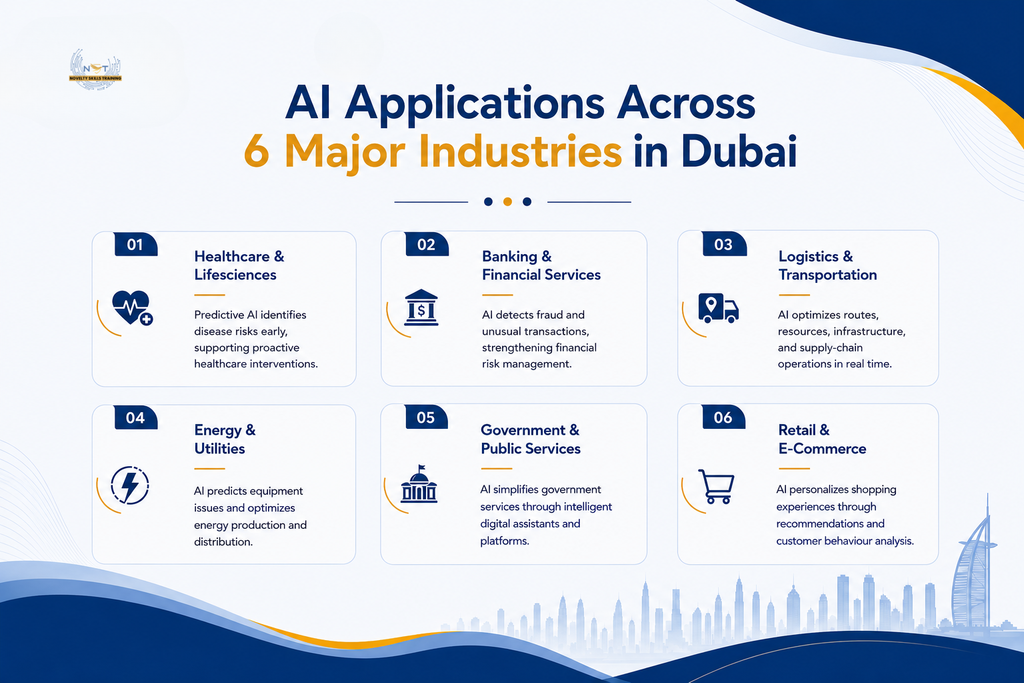
Dubai is moving from isolated AI use cases to large-scale adoption across business and public services. Driven by the UAE’s AI agenda, organizations across healthcare, banking, logistics, energy, government, and retail are using AI to improve efficiency, anticipate demand, and manage risk.
1. AI in Healthcare & Lifesciences: From Lab Research to Smart Bedside Care
AI is increasingly being integrated into healthcare across Dubai and the UAE, helping providers move toward earlier intervention, faster diagnosis, and more efficient care delivery. Here are a few AI use cases in the healthcare industry.
- Predictive Disease Detection: AI identifies chronic disease risks from patient and population data, enabling earlier intervention. DHA’s EJADA framework reportedly reduced chronic disease treatment burdens by 25%–30% through proactive preventive care.
- AI-Assisted Cancer Detection: Computer vision can analyze medical images and pathology slides to flag suspicious tissue and support faster cancer assessment. At Cleveland Clinic Abu Dhabi, M42’s NRL uses Qritive’s AI-powered digital pathology system to assist prostate cancer diagnosis.
- Intelligent Triage & Patient Flow: AI can assess patient information and hospital capacity to prioritize critical cases and manage resources more efficiently. According to a report from Khaleej Times, in Dubai, intelligent healthcare systems support bed tracking, workload management, and earlier identification of potential patient deterioration.
2. AI in Finance & Banking: From Fraud Prevention to Intelligent Financial Services
Across the UAE’s financial sector, AI is being applied to strengthen fraud detection, improve risk assessment, streamline customer services, and personalize digital banking experiences. Here we have discussed a few AI use cases in the finance and banking sector.
- AI-Powered Fraud Prevention: AI and machine learning can analyze transaction patterns and identify unusual activity to support faster fraud detection and risk management. Emirates NBD’s 2025 annual report highlights the use of AI to enhance fraud prevention, risk management, and operational efficiency.
- Generative AI for Financial Services: Banks are increasingly exploring generative AI to improve customer experiences, operational efficiency, and risk management. Emirates NBD’s 2025 GenAI Summit highlighted applications of GenAI across these areas.
- Responsible AI in Banking: Financial institutions also need to manage transparency, bias, accountability, explainability, and data privacy when deploying AI. The Central Bank of the UAE’s 2026 guidance provides principles for the responsible adoption and use of AI and machine learning by licensed financial institutions.
3. AI in Logistics, Transport & Supply Chain: From Smart Ports to Autonomous Mobility
AI is transforming logistics and transportation by improving traffic management, automating port operations, supporting autonomous mobility, and enabling more efficient movement of goods and people. Here we have listed a few AI uses cases in Dubai in transport and logistics sector.
- AI-Powered Traffic Management: AI and predictive analytics can analyze real-time traffic conditions and optimize signal operations to reduce congestion. The Roads and Transport Authority’s 2025 traffic-signal upgrade uses AI, predictive analytics, and digital-twin technology, with the project targeting a 10%–20% reduction in congestion at intersections.
- Autonomous Transportation: AI-powered vehicles combine cameras, sensors, and machine-learning algorithms to navigate roads and support driverless mobility. RTA’s autonomous-vehicle pilots are designed to support the transition toward commercial driverless services.
- AI-Enabled Port Operations: AI and automation can optimize container movement, terminal processes, and cargo tracking. At Jebel Ali Port, DP World’s ZODIAC system integrates automation, real-time container tracking, and AI/ML-supported terminal operations.
4. AI in Energy & Utilities: From Predictive Maintenance to Smart Energy Management
AI is helping energy and utility organizations monitor assets, predict equipment issues, and improve operational efficiency. These AI application examples also support smarter energy production and more effective management of complex power networks.
- Predictive Maintenance: AI analyzes equipment and sensor data to identify potential failures before they cause costly downtime. ADNOC’s predictive-maintenance program uses machine learning and digital twins to improve asset reliability and was designed to deliver maintenance savings of up to 20%.
- Smart Grid Management: AI can support automated decision-making and improve the reliability of electricity networks. DEWA’s smart-grid program uses AI and IoT technologies to support efficient and reliable electricity and water operations.
- AI-Powered Solar Forecasting: Deep learning models can analyze weather and atmospheric data to forecast solar energy generation more accurately. DEWA’s solar forecasting platform uses deep-learning AI and other advanced models to improve solar production forecasts.
5. AI in Government & Public Services: Smarter Services, Security & City Operations
AI is helping Dubai’s public sector improve service delivery, strengthen trade security, and manage complex city infrastructure through data-driven systems.
- AI-Powered Government Services: Generative AI can simplify access to government information and services through conversational platforms. Digital Dubai’s DubAI, developed with the Dubai Center for Artificial Intelligence, brings information across health, education, business, and aviation into one platform, enabling faster and more seamless service access.
- Smart Customs Risk Assessment: AI can analyze shipment and customs data before cargo arrives, helping authorities identify potential risks and streamline clearance. Dubai Customs’ AI-powered Advance Cargo Information (ACI) platform uses predictive risk assessment to strengthen border security while enabling faster cargo processing.
These artificial intelligence applications in real life help government entities streamline processes, reduce administrative workloads, and deliver faster and more efficient services.
6. AI in Retail & E-Commerce: Transforming Customer Experiences and Operations
AI is reshaping Dubai’s retail sector through personalized shopping, demand forecasting, and smarter store operations. These AI application examples include product recommendations, inventory prediction, and computer vision for more targeted in-store experiences. Check out some of the AI use cases in retail and E-Commerce sectors.
- AI-Powered Personalization: AI analyzes customer behaviour and interactions to deliver tailored recommendations and digital shopping experiences. Chalhoub Group’s Layla AI provides personalized beauty guidance across skincare, makeup, fragrance, and haircare, achieving 2.5× higher conversion rates than non-AI sessions.
- Intelligent Inventory Forecasting: AI helps retailers anticipate demand and optimize stock levels. Majid Al Futtaim Lifestyle, with MAGNOOS Information Systems, uses AI forecasting to analyze sales, tourism trends, and SKU data across brands like Lululemon and Lego, reducing supply-chain inefficiencies.
- Computer Vision in Physical Retail: AI analyzes anonymous shopper behavior to deliver context-aware advertising in real time. Pilot activations using Advertima’s retail media technology achieved 79% ad-targeting accuracy and a 68% sales uplift for partner brands within 20 days.
Key AI Adoption Statistics Across Industries
AI adoption is moving beyond experimentation, with organizations increasingly using AI for automation, prediction, decision-making, and operational efficiency. Recent statistics highlight how quickly this shift is taking place across major sectors.
1. Government and Public Sector
Governments are moving from basic AI assistants toward agentic AI capable of executing multi-step tasks autonomously. A major target is to transition 50% of government sectors, services, and operations to Agentic AI within two years.
2. Healthcare & Lifesciences: Rapid AI Growth
AI adoption in healthcare is expanding across diagnostics, treatment support, and remote patient monitoring. The sector is projected to grow at approximately 42% CAGR, reaching more than AED 3 billion by 2029.
3. Enterprise & Corporate Business: From Experimentation to Execution
Businesses are increasingly treating AI as a strategic capability rather than an experimental technology. Around 20% of organizations are already implementing AI governance platforms, compared with 12% globally, highlighting the growing focus on responsible and scalable AI adoption.
4. Transport, Logistics & Utilities: AI-Powered Operations
AI is becoming embedded in infrastructure through automated workflows, predictive systems, and intelligent service delivery. Recent implementation has improved digital test verification efficiency by approximately 85% and enhanced digital-channel quality by up to 93%.
How Companies Implement Applications of AI: 7 Key Steps
Building successful applications of AI involves more than developing a model. Professionals need to understand how businesses identify use cases, prepare data, test solutions, manage risks, and move AI projects into real-world operations.
1. Identify High-Value Business Problems
Start with a specific operational challenge where AI can deliver a measurable benefit, such as reducing delivery delays or improving demand forecasts.
2. Build a Reliable Data Foundation
Clean, structured, and secure data is essential for accurate AI applications. Businesses must connect data sources, remove inconsistencies, and establish reliable data pipelines.
3. Meet Privacy and Regulatory Requirements
AI systems must account for data protection, security, and industry-specific requirements from the beginning, particularly in regulated sectors such as healthcare and finance.
4. Decide Whether to Buy or Build
Organizations must assess whether an existing AI solution meets their needs or whether a customized system offers greater value, control, or scalability.
5. Test Through Controlled Pilots
Small-scale pilots and Proofs of Concept (PoCs) allow businesses to evaluate accuracy, performance, risks, and business value before wider deployment.
6. Keep Humans in the Loop
For high-impact decisions, human oversight remains essential. AI can identify patterns or flag risks, while qualified professionals retain decision-making authority.
7. Upskill Teams for AI Adoption
Successful implementation depends on employees understanding new AI tools, workflows, and responsible usage. As AI rapidly changes skill requirements, continuous upskilling becomes essential.
Build Your AI & ML Skills with Novelty Skills Training
Understanding how businesses use AI is the first step. To build and implement these applications of AI, you need practical skills in machine learning, data, deployment, and industry-specific problem-solving.
- Artificial Intelligence & Machine Learning Training
Artificial Intelligence and Machine Learning Training helps you build practical AI/ML skills across Python, machine learning, deep learning, NLP, and model deployment. Work with TensorFlow, Keras, Scikit-learn, Docker, and AWS while developing solutions for real-world business challenges.
Key skills: Machine Learning • Deep Learning • NLP • Python • Model Deployment • Cloud Integration
- AI & ML Healthcare Training
AI and ML Healthcare Training helps you apply AI and machine learning to healthcare data, medical imaging, clinical prediction, and healthcare operations. Develop practical skills in Python, predictive modelling, deep learning, NLP, and AI deployment through healthcare-focused projects.
Key skills: Healthcare Data Analysis • Predictive Modelling • Medical Imaging • NLP • Healthcare AI Deployment
Conclusion
As these use cases mature, the value of AI will increasingly depend on how effectively organizations can turn data, models, and intelligent systems into scalable solutions. For professionals, this creates a growing need for practical skills that go beyond theory—combining AI/ML knowledge with the ability to build, deploy, and apply solutions to real industry challenges.
FAQs
1. What are the most common artificial intelligence applications in Dubai?
Dubai businesses use AI for automation, predictive analytics, customer personalization, risk management, resource optimization, and intelligent decision-making.
2. Which industries in Dubai are adopting AI applications fastest?
Healthcare, banking, retail, logistics, government, and energy are among the sectors actively expanding AI adoption.
3. What are some AI applications examples relevant to Dubai businesses?
Examples include predictive maintenance, fraud detection, intelligent document processing, demand forecasting, AI assistants, and traffic optimization.
4. How do Dubai companies identify valuable AI use cases?
Companies typically assess operational challenges, available data, expected business impact, implementation costs, and regulatory requirements before selecting use cases.
5. What skills are needed to work on applications of AI in Dubai?
Professionals need skills in Python, machine learning, data analysis, model deployment, cloud platforms, and responsible AI practices.
6. Are AI skills relevant across different industries in Dubai?
Yes. AI skills can be applied across technology, healthcare, finance, retail, logistics, government, energy, and other sectors.
7. How can professionals prepare for AI opportunities in Dubai?
Building practical AI projects and learning to develop, evaluate, and deploy models can strengthen readiness for Dubai’s growing AI ecosystem.
8. Where can I learn practical AI and ML skills in Dubai?
Novelty Skills Training offers AI and ML training focused on practical machine learning, deep learning, NLP, deployment, and industry applications.