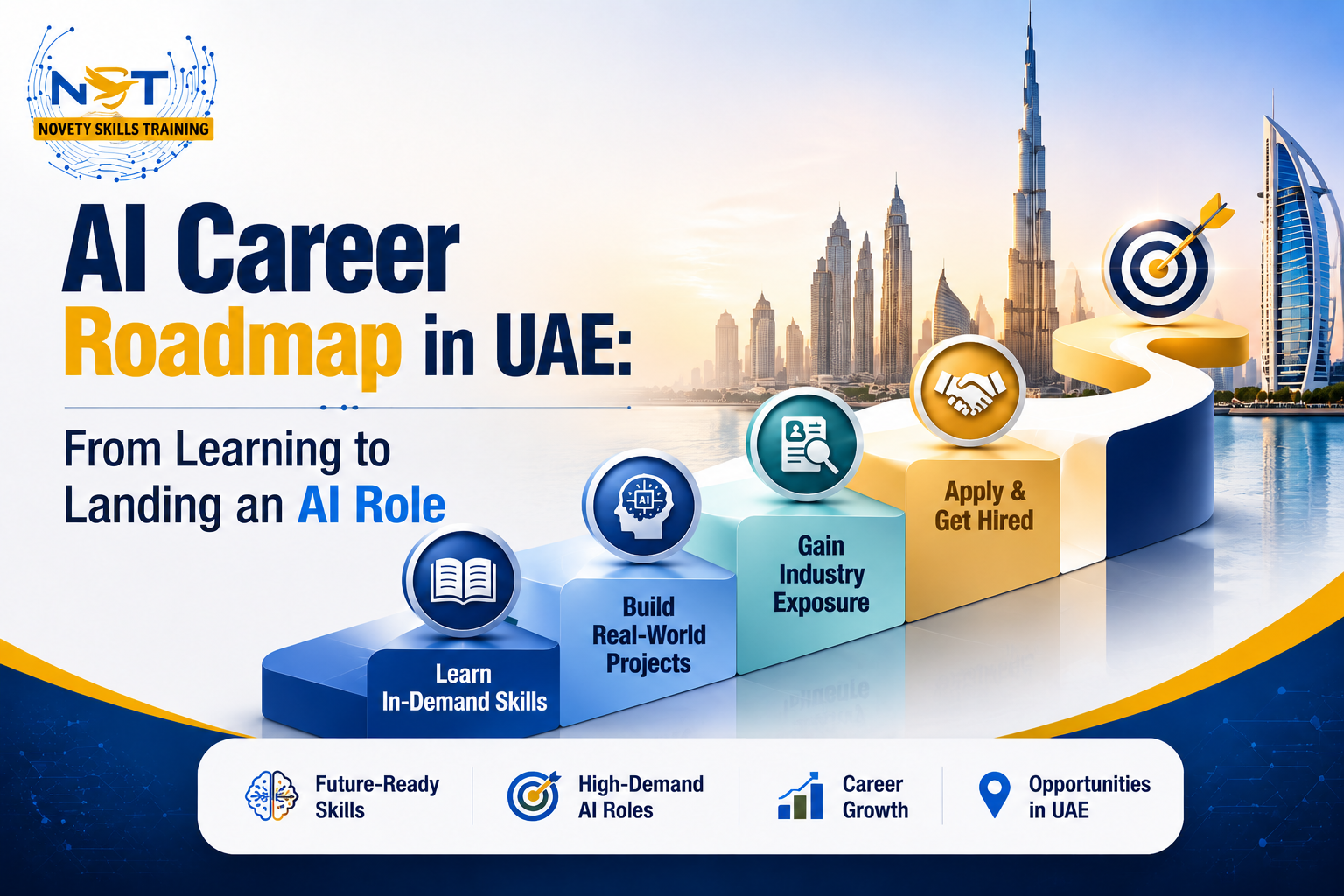
An AI career roadmap in the UAE takes you from choosing the right AI role and building core skills to gaining practical experience, proving your capabilities, and preparing for the UAE job market. With 700+ AI-focused companies in Dubai, professionals who align their skills with market needs can access growing opportunities across the UAE.
AI is moving from an emerging technology to a core business capability, and that shift is changing the skills employers look for. As more professionals prepare to enter or transition into AI, having a clear AI career roadmap in the UAE is becoming less about learning everything and more about preparing for the right role. In fact, according to the Stanford University AI Index Report, the UAE recorded the highest growth in AI talent concentration globally, with a 121% surge.
But a growing market does not automatically translate into a career. You still need to know which AI role to target, what skills to build, how to gain practical experience, and how to position yourself in the UAE job market.
For aspiring AI professionals, this growth signals a market where the right skills, practical experience and role-specific preparation can matter as much as formal qualifications. The challenge is knowing where to start, what to prioritize, and how to turn AI learning into a career.
Why Build an Artificial Intelligence Career in Dubai?
Dubai’s AI ecosystem is growing, with 700+ AI-focused companies across DIEZ’s economic zones, creating demand for professionals with practical, job-ready AI skills.
1. Growing AI Job Market
AI-related job postings in the UAE increased from 1.0% of all postings in 2021 to 3.2% in 2025, according to PwC’s 2026 AI Jobs Barometer. This points to a rapidly expanding market for professionals with relevant AI capabilities.
2. High AI Adoption
The UAE ranked first globally in AI diffusion, with 64% of its working-age population using AI tools by the end of 2025, according to Microsoft’s AI Economy Institute. This creates an environment where AI skills can be applied across real business use cases.
3. Major Technology Investment
Large-scale investments in AI infrastructure and cloud capabilities are strengthening the ecosystem. Microsoft’s investment in G42 alone included $1.5 billion, supporting the expansion of AI and cloud infrastructure in the UAE.
4. Opportunities Across Industries
AI careers are not limited to technology companies. Finance, healthcare, energy, retail, logistics and professional services are increasingly adopting AI, creating opportunities for both technical and domain-focused professionals.
5. Long-Term Career Flexibility
Eligible AI and technology professionals may also qualify for UAE Golden Visa pathways, offering long-term residency independent of a traditional employer sponsor.
The opportunity is only the starting point. The next question is how to turn that opportunity into a realistic career path.
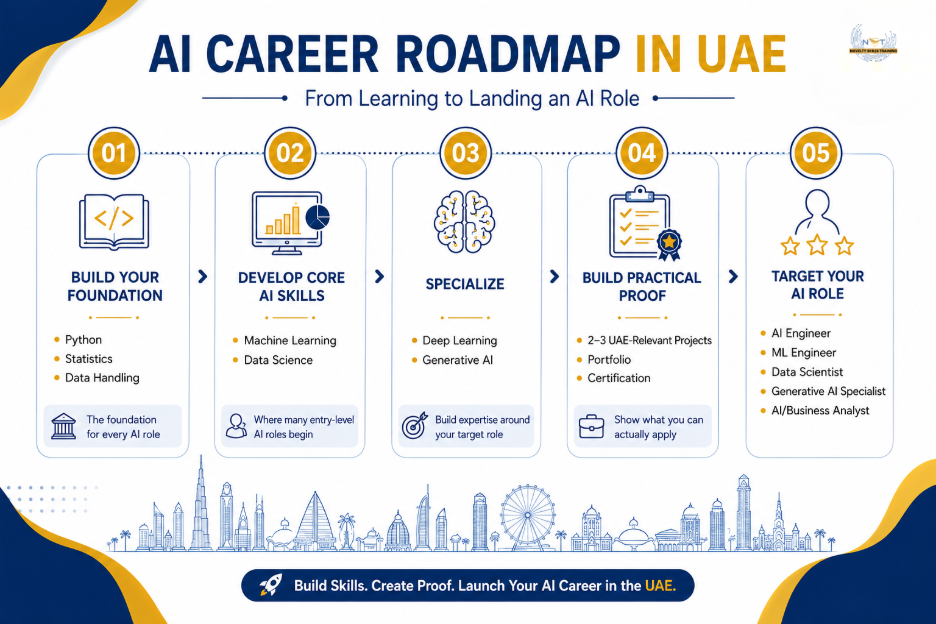
AI Career Roadmap in UAE: 6 Steps from Learning to Landing a Role
A practical AI career roadmap should follow a clear progression:
Choose → Build → Develop → Specialize → Prove → Apply
Each stage answers a different career question, taking you from deciding what you want to do to demonstrate that you can do it.
Step 1: Choose Your Target AI Role
AI offers diverse career paths with different skill requirements. Choose your target role before deciding what to learn.
| AI Role | Core Focus |
|---|---|
| AI Engineer | AI applications, integration, APIs and deployment |
| Machine Learning Engineer | Model development, training, deployment and MLOps |
| Data Scientist | Statistics, data analysis and predictive modelling |
| Generative AI Specialist | LLMs, RAG, prompt engineering and AI applications |
| AI/Business Analyst | AI applications, analytics and business decision-making |
| AI Product/Project Roles | AI product development, implementation and delivery |
Your target role determines your skill priorities. ML Engineers need model development and deployment skills, while AI/Business Analysts need analytics and business expertise. In the UAE, AI-related job postings rose from 1.0% to 3.2% between 2021 and 2025, according to PwC.
You do not need to master every area of AI. Choose a direction first, then build the skills that support it.
Step 2: Build Your AI Foundation
Once you know where you are heading, build the foundation required to get there.
Start with:
- Python for programming and AI development
- Statistics for understanding data and model performance
- Data handling for cleaning, transforming and analyzing datasets
- AI fundamentals to understand how common AI and machine learning approaches work
Do not rush through this stage. Strong fundamentals make it easier to understand machine learning, deep learning, and generative AI later.
The goal is not to become an expert in every foundation topic. It is to develop enough technical fluency to understand problems, work with data and build AI solutions.
Step 3: Develop Core AI Skills
With the foundation in place, move into the skills that allow you to solve real AI problems.
Focus on:
- Machine learning
- Data science
- Model development
- Model evaluation
- Basic deep learning concepts
Make your learning practical: work with datasets, train models, and evaluate results instead of only studying algorithms. Align your focus with your target role, like Data Scientists may emphasize statistical modelling, while AI Engineers need stronger deployment skills.
PwC found that AI-exposed jobs in the UAE are experiencing faster skill change, making continuous upskilling increasingly important.
Step 4: Build Your Skills in the Area of Specialty
After developing core AI capabilities, specialize around your target role.
Possible directions include:
- Deep Learning: neural networks, computer vision or NLP
- Generative AI: LLMs, prompt engineering, RAG, evaluation and AI applications
- AI Engineering: APIs, cloud platforms, deployment and model monitoring
- Applied AI: combining AI with a domain such as healthcare, finance, logistics or real estate
Specialization does not mean learning every advanced technology. It means developing deeper capability in the area most relevant to the role you want.
Step 5: Build Projects That Prove Your AI Skills
Learning tells an employer what you studied. Projects show what you can apply.
Build 2–3 meaningful projects that demonstrate your ability to solve practical problems. Where possible, choose use cases relevant to industries operating in the UAE.
Examples include:
- Predictive analytics for logistics
- Customer-service automation using generative AI
- Healthcare data analysis
- Demand forecasting for retail
- Fraud or anomaly detection for financial services
For every project, show:
Problem → Data → Approach → AI solution → Result → Business value
A strong portfolio should make it easy for a recruiter or hiring manager to understand what you built, why you built it and what your solution achieved.
Certifications can support your profile, but they should complement—not replace—practical evidence.
Step 6: Prepare for the UAE AI Job Market
The final stage is turning your skills and portfolio into applications.
Prepare a role-specific:
- Resume
- LinkedIn profile
- Project portfolio
- GitHub or technical showcase
- Interview preparation plan
Start with UAE job descriptions for your target role. Identify recurring requirements and use them to spot skill gaps.
Apply strategically rather than sending the same resume everywhere. Highlight relevant skills and projects and be ready to explain your technical decisions in interviews.
Your 12-Month AI Career Roadmap
The six steps above explain what to do. This timeline gives you a practical way to sequence the work.
| Timeline | Primary Focus | Career Output |
|---|---|---|
| Months 1–3 | Python, statistics, data and AI fundamentals | Technical foundation |
| Months 4–6 | Machine learning and data science | Core AI capability |
| Months 7–9 | Deep learning, GenAI or role-specific specialization | Target-role expertise |
| Months 10–12 | Projects, portfolio, interviews and applications | Job-ready profile |
This is a flexible guide rather than a fixed deadline. Someone with an existing technical background may move faster, while a complete beginner may need more time on the foundation.
Conclusion
Dubai’s AI ecosystem is expanding, but opportunity alone does not make someone job ready. A focused combination of technical fundamentals, role-specific skills, practical projects and career preparation is what turns AI learning into a professional pathway.
If you start strategically, your AI career roadmap can become more than a learning plan. With Novelty Skills Training – Dubai’s Artificial Intelligence and Machine Learning Training, it can lead towards a specialized career in the UAE’s growing AI ecosystem.
Frequently Asked Questions (FAQs)
1. Can a non-technical person start an AI career in Dubai?
Yes. Beginners can start with Python, statistics and AI fundamentals, then progress into machine learning through structured practice and relevant projects.
2. Do Dubai employers require AI certification for entry-level roles?
Not always. Dubai employers may value practical AI skills, relevant projects and portfolios alongside formal certifications, particularly for technical and business-facing roles.
3. Can healthcare professionals build AI careers in Dubai?
Yes. Healthcare professionals can combine domain knowledge with AI, data science and analytics to explore roles supporting healthcare technology, operations and digital transformation.
4. How long does it take to become AI job-ready in Dubai?
It depends on your background and target role. A focused roadmap can progressively cover fundamentals, machine learning, specialization, projects and interview preparation.
5. Is Python enough to qualify for AI jobs in Dubai?
Python is an important foundation, but most AI roles also require machine learning, data handling, model development and, for some positions, cloud or deployment knowledge.
6. Which Dubai industries are hiring AI talent?
AI career opportunities are emerging across Dubai’s healthcare, finance, logistics, government, mobility, real estate and technology sectors, creating demand for both technical and domain-focused professionals.