Discover the top 5 AI projects for beginners to build practical skills, strengthen your portfolio, and prepare for AI careers. Learn how projects in machine learning, Generative AI, NLP, and computer vision can help showcase real-world problem-solving abilities.
Artificial Intelligence is the new foundation of the software industry, with recent McKinsey data showing that 88% of organizations globally now use AI in their daily business functions. However, while over $500 billion is being poured into AI infrastructure, nearly 95% of enterprise AI pilots fail because the industry lacks hands-on builders who know how to deploy functional models.
If you want to break into tech or future-proof your resume as the world shifts toward advanced, autonomous Agentic AI systems, building a portfolio of real code is your best path forward.
This guide breaks down the absolute best AI projects for beginners, organized by the major subfields driving today’s tech ecosystem:
- Natural Language Processing (NLP): Teach machines to interpret human text.
- Data Prediction & Regression: Turn messy numbers into accurate future forecasts.
- Computer Vision: Explore how computers visually “see” and map the physical world.
- Generative AI & Low-Code APIs: Leverage modern LLMs to build intelligent apps using simple APIs.
You don’t need a supercomputer or a Ph.D. to start. All it takes is a basic understanding of Python and a free tool like Google Colab. Let’s dive in.
Factors Contributing to the Growing Demand for AI Talent in Dubai
The demand for AI talent in Dubai is being driven by the UAE’s national AI strategy, Dubai’s investment in AI infrastructure, and the adoption of AI across finance, logistics, healthcare, mobility and other industries. The UAE National Strategy for Artificial Intelligence 2031 explicitly identifies talent development, infrastructure and AI adoption as key priorities, while Dubai’s AI initiatives are designed to attract AI companies and skilled professionals to the emirate.
1. Government Backing & Strategic Vision
The growth of AI is strongly supported by government-led strategies and initiatives designed to accelerate adoption and develop the talent required to support it.
- National Strategy for Artificial Intelligence 2031: The UAE aims to become a global AI leader by 2031 by expanding AI capabilities across sectors such as healthcare, logistics, energy, tourism and cybersecurity, while focusing on developing and attracting AI talent.
- Universal Blueprint for Artificial Intelligence: The initiative accelerates AI adoption by building an ecosystem that supports AI businesses, innovation hubs and skilled professionals.
- AI Innovation Campus: AI-focused campuses provide infrastructure and programs aimed at AI companies, entrepreneurs and professionals. These initiatives focus on AI talent development, training opportunities, and building a stronger technology ecosystem. The initiative is expected to create 25,000 jobs and generate AED 12.9 billion in economic value.
- Golden Visa for specialised talent: Long-term residency pathways are available for eligible foreign talent. The official government portal lists AI, big data, computer engineering and software engineering among the scientific and engineering fields covered under specialised talent categories, subject to the applicable eligibility requirements.
2. High-Demand AI Roles
As organisations move from AI experimentation to implementation, professionals with practical AI and data skills are increasingly in demand across technical and non-technical roles. AI-exposed jobs are experiencing faster skill changes, highlighting the need for continuous learning and applied AI capabilities. AI-exposed jobs saw skill requirements changing 66% faster than other roles
- Machine Learning Engineers: Build, train and deploy machine learning models for applications such as forecasting, recommendation systems, automation and predictive analytics.
- Data Scientists & AI Analysts: Analyze large datasets, identify patterns and develop models that help organizations make data-driven business decisions.
- Generative AI Specialists: Work with large language models, AI applications, prompt engineering, retrieval-augmented generation and automation to develop solutions for areas such as customer support, knowledge management and content workflows.
- Computer Vision Specialists: Develop AI systems that interpret images and video. These skills can support applications involving smart mobility, surveillance, industrial automation, and other computer-vision use cases.
3. Key Sectors Recruiting and Adopting AI Talent
AI adoption is expanding across industries beyond technology, creating demand for professionals who can develop and apply AI solutions.
- Finance & FinTech: AI is being used for automation, analytics, fraud detection and intelligent decision-making.
- Logistics & Supply Chain: AI applications in forecasting, route optimization, warehouse management and predictive maintenance are driving adoption.
- Healthcare: AI is transforming medical imaging, predictive analytics, clinical decision support and healthcare operations.
- Real Estate & Smart Infrastructure: AI-powered solutions such as digital twins, intelligent buildings and smart mobility are creating new opportunities.
Based on a survey of 1,993 firms by McKinsey, 88% of organisations surveyed in 2025 reported that they are utilising AI in at least one of their business functions.
India’s strong technology talent pool and the global expansion of AI are creating new career pathways for professionals. For beginners, practical AI skills and AI project ideas can provide a competitive advantage when pursuing opportunities in international AI ecosystems.
A new WEF report predicts that AI and automation will create 170 million jobs while displacing 92 million roles as companies adapt to technological change.
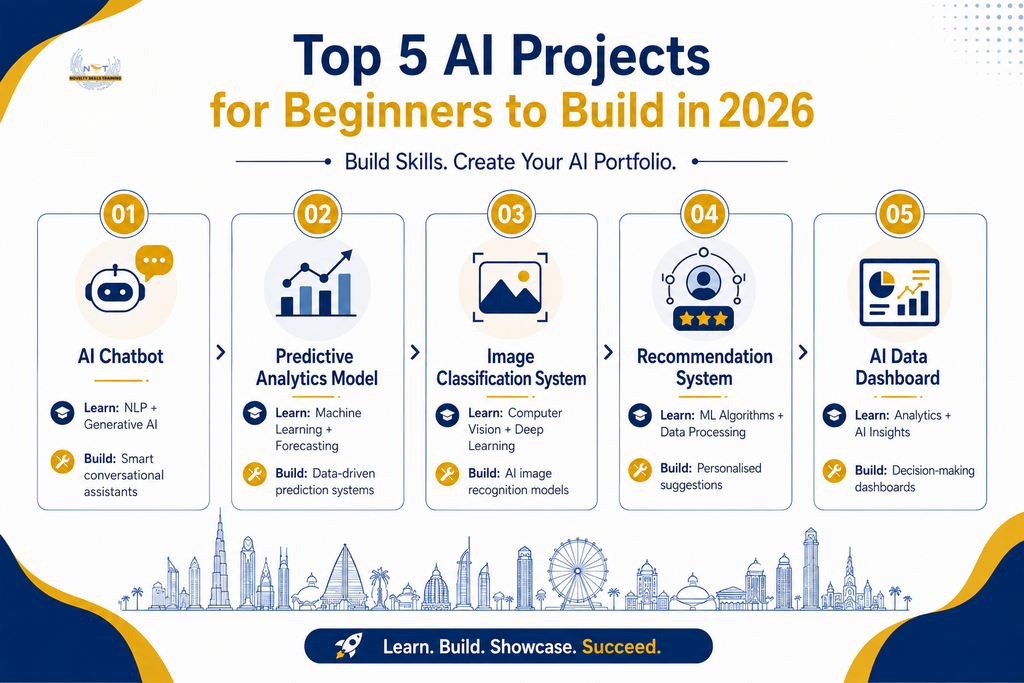
Top 5 AI Projects for Beginners
Building simple AI projects is one of the most effective ways for beginners to demonstrate practical skills and stand out in the competitive AI job market. These projects help bridge the gap between learning concepts and applying AI techniques to real-world problems, creating a strong portfolio for future career opportunities.
1. Real Estate Price Predictor
Build a machine learning regression model that predicts property prices using factors such as location, property size, number of rooms, amenities, and nearby facilities. Research has demonstrated that machine-learning models can use property characteristics and transaction data to predict real estate prices and support data-driven valuation. A 2020 study published in Applied Sciences used actual transaction data and multiple machine-learning models for property price prediction.
Results: This AI project idea demonstrates how AI can analyze property data and support pricing, valuation, and investment decisions. A 2025 systematic review also found that machine-learning approaches such as Random Forest and other advanced models can improve predictive capabilities in real-estate valuation. The 2025 review highlights the growing use of AI for housing price prediction.
Tech Stack: Python, Pandas, NumPy, Scikit-learn, Linear Regression or Random Forest.
2. Automated Resume Screener
Develop an NLP-based application that reads resumes, extracts relevant skills and qualifications, and compares them with a given job description. A 2026 research study describes an automated resume-screening system that uses NLP, TF-IDF, Word2Vec, and BERT to parse resumes and match candidates with job descriptions. The 2026 study demonstrates how these techniques can support automated candidate ranking.
Results: The project demonstrates how AI can automate repetitive recruitment tasks while helping recruiters identify candidates whose skills and qualifications closely match job requirements. A 2025 study similarly used TF-IDF and cosine similarity to compare resume content with job requirements and rank candidates. The research on automated resume screening supports this practical application of NLP.
Tech Stack: Python, NLTK, spaCy, TF-IDF Vectorizer, Scikit-learn.
3. Tourist Hotspot Sentiment Analyzer
Create an NLP model that analyzes customer reviews and classifies them as positive, negative, or neutral based on the language used. A 2025 study published in Information Technology & Tourism used tourism-review datasets to automatically classify customer sentiment and identify important themes and preferences. The research demonstrates how sentiment analysis can extract useful insights from tourism reviews.
Results: Businesses can use sentiment analysis to understand customer satisfaction, identify recurring complaints, and discover what visitors value most. Earlier research analyzing 2,000 online reviews across 1,000 tourist attractions also demonstrated how NLP-based sentiment analysis can identify visitor opinions and generate useful recommendations. The 2022 research provides further support for this application.
Tech Stack: Python, TextBlob, VADER Sentiment Analysis, Pandas.
4. Retail Demand Forecasting
The Concept: Build a time-series forecasting model that predicts future product demand using historical sales, seasonal patterns, holidays, and promotional periods. A 2025 study compared ARIMA and machine-learning approaches for sales forecasting, demonstrating how time-series models can be applied to predict future demand. The research on sales forecasting highlights the importance of forecasting for inventory planning and resource allocation.
Results: The project shows how AI and predictive analytics can help retailers plan inventory, reduce stock shortages, and avoid excess stock during changing demand conditions. The same 2025 study found that its hybrid forecasting approach reduced forecasting error by up to 18% compared with classical methods in its experimental setting.
Tech Stack: Python, Pandas, Statsmodels, ARIMA/SARIMA, Prophet.
5. Computer Vision Parking Space Detector
Develop a computer vision application that processes parking-lot images or video to identify available and occupied parking spaces. Research into automated parking systems has demonstrated the use of computer vision to detect parking spaces and classify their occupancy from camera footage.
Why It Matters: This AI project for beginners demonstrates how computer vision can support smart parking, real-time occupancy monitoring, and better space utilization. Research on automated parking detection has explored image-processing and deep-learning approaches for identifying available parking spaces, making this a practical computer-vision project for beginners. A recent review of parking-space detection research provides evidence of these approaches.
Tech Stack: Python, OpenCV, Canny Edge Detection, Contours.
How to Build an AI Career Portfolio That Stands Out
In an AI-driven job market, a strong portfolio helps beginners showcase practical skills beyond certifications. Employers increasingly value candidates who can apply AI concepts to solve real-world problems, making project-based experience an important career advantage.
- Build Industry-Relevant Simple AI Projects
Focus on AI or machine learning projects for beginners that address practical challenges rather than basic demonstrations. Solutions related to healthcare analytics, financial forecasting, automation, recommendation systems or predictive models can better showcase problem-solving ability and business understanding.
- Show Your Complete Development Process
A strong portfolio should explain the problem statement, dataset, approach, model selection, testing and outcomes. Documentation, GitHub repositories and project demonstrations help recruiters understand your technical thinking and development approach.
- Demonstrate Diverse AI Skills
Include beginner AI projects across different AI areas such as machine learning, Generative AI, NLP, computer vision and data analytics. Examples like AI chatbots, healthcare prediction models, image classification systems and forecasting dashboards can highlight your ability to apply AI across use cases.
- Highlight Technical Skills and Business Impact
Showcase your experience with tools such as Python, TensorFlow, PyTorch, SQL, cloud platforms and AI frameworks. Beyond technical performance, explain how your AI or machine learning projects for beginners create value through automation, improved predictions or better decision-making.
- Make Your Portfolio Recruiter-Friendly
Organize your GitHub profile, provide clear project descriptions and highlight your contribution. Certifications demonstrate knowledge, but practical beginner AI projects demonstrate your ability to build solutions and contribute to AI-driven teams.
Conclusion
AI is becoming a core skill shaping the future of technology careers. For beginners, building practical projects is the best way to move beyond theory and demonstrate real-world problem-solving abilities. A strong portfolio with AI applications such as predictive models, chatbots, sentiment analysis or computer vision projects can help showcase your skills to potential employers. As AI adoption continues to grow across industries, hands-on experience will become a key advantage for building a successful career in the AI-driven future.
FAQs
1. What are some AI projects for beginners?
Beginner AI projects include chatbots, recommendation systems, predictive models, sentiment analysis and image classification applications.
2. What are the best machine learning projects for beginners?
Popular machine learning projects include price prediction, customer churn analysis, spam detection and sales forecasting models.
3. Do I need coding experience to build AI project for beginners?
Basic Python knowledge helps, but beginners can learn AI concepts through guided projects and available tools.
4. How do AI projects help in building a career?
AI projects for beginners demonstrate practical skills, problem-solving abilities and real-world experience that strengthen your career portfolio.
5. What tools are used for beginner AI projects?
Common tools include Python, Scikit-learn, TensorFlow, PyTorch, SQL and Generative AI frameworks.
6. Can AI projects help beginners get AI jobs?
Yes, practical AI projects for beginners showcase applied skills and help recruiters evaluate technical capabilities.
7. How many AI projects should beginners add to their portfolio?
Beginners should showcase 3–5 quality projects demonstrating different AI skills and real-world applications.
8. Where can beginners find datasets for AI projects?
Beginners can find datasets on Kaggle, UCI Repository and various open-data platforms.