
Data loss prevention is a cybersecurity strategy that protects sensitive information from unauthorized access, leaks, or accidental sharing. It uses policies, monitoring, and security controls to identify and safeguard critical data across devices, networks, and cloud environments, helping organizations prevent costly breaches.
Data Loss Prevention has become a crucial cybersecurity approach as organizations face increasing risks from data breaches, insider threats, and unauthorized information sharing. With sensitive data constantly moving across cloud platforms, networks, and devices, businesses need smarter ways to identify, monitor, and protect valuable information before it falls into the wrong hands.
This guide explores how Data Loss Prevention works, why it is important for cybersecurity and UAE data protection, key techniques, leading DLP tools, and the future of data security with AI and machine learning. It highlights how modern DLP solutions are helping organizations prevent data exposure, strengthen compliance, and build a more proactive cybersecurity strategy.
What is Data Loss Prevention?
Data Loss Prevention is a cybersecurity approach designed to identify, monitor, and protect sensitive information from unauthorized sharing, transfer, or misuse. It helps organizations prevent accidental data leaks, insider threats, and security breaches by applying policies that control how confidential data is accessed and shared across devices, networks, and cloud environments.
Modern DLP solutions can detect sensitive information such as personal data, financial records, intellectual property, and business-critical files. They analyze data movement and user activities, then apply security actions like blocking unauthorized transfers, issuing alerts, or restricting access to reduce the risk of data exposure
Why is Data Loss Prevention Important in Cybersecurity and UAE Data Protection?
In an era where data breaches can damage business reputation and customer trust within minutes, DLP helps organizations stay ahead of security risks. It provides visibility, control, and protection over sensitive information across networks, devices, and cloud environments.
Key reasons why DLP is important in cybersecurity and UAE data protection:
- Prevents sensitive data breaches: DLP identifies and blocks unauthorized access, sharing, or transfer of confidential information, reducing risks from cyberattacks, insider threats, and human errors.
- Strengthens cybersecurity controls: It continuously monitors data movement across endpoints, networks, and cloud platforms, helping security teams detect suspicious activities before they become major incidents.
- Supports UAE PDPL compliance: Organizations in the UAE use DLP to improve data governance and reduce risks related to non-compliance, including legal penalties, license suspension, and potential liabilities under the Personal Data Protection Law (PDPL).
- Protects critical personal information: DLP can automatically detect and restrict unauthorized sharing of sensitive identifiers such as Emirates IDs, passport numbers, financial records, and confidential business data.
- Controls cross-border data transfers: It helps organizations enforce policies around international data movement, supporting secure handling and localization requirements for regulated information.
- Improves breach detection and response: Through detailed monitoring logs and activity tracking, DLP enables faster investigation, reporting, and response when suspicious data activity occurs.
- Builds trust and business resilience: By protecting valuable information and maintaining compliance standards, DLP in Cybersecurity helps organizations preserve customer confidence, market reputation, and eligibility for government and enterprise contracts.
How Does Data Loss Prevention Work?
DLP protects sensitive information by identifying, monitoring, and controlling how data is accessed, shared, and transferred across devices, networks, emails, and cloud platforms. It helps organizations detect risks early and prevent unauthorized data exposure.
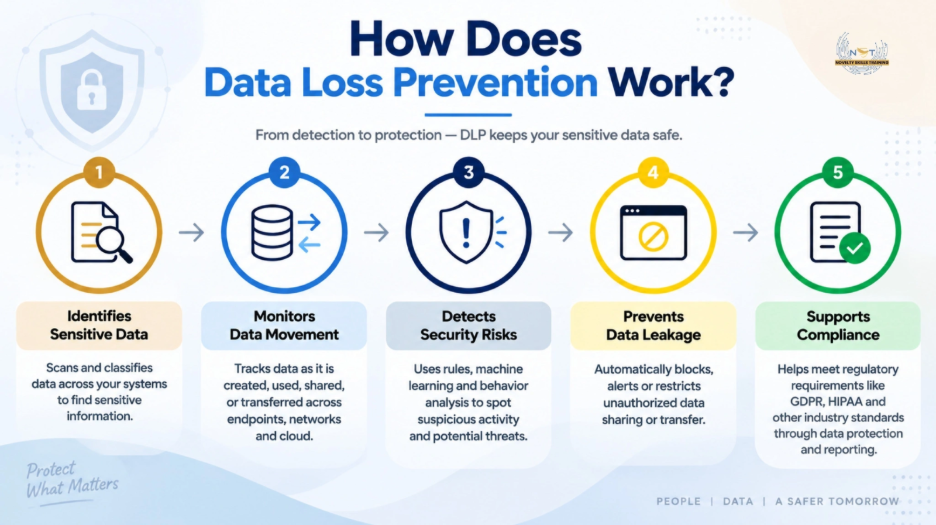
1. Identifies Sensitive Data
DLP discovers and classifies critical information, including:
- Personal data
- Financial and healthcare records
- Intellectual property
- Sensitive identifiers like Emirates IDs and passport numbers
2. Monitors Data Movement
It tracks how data is accessed, copied, shared, and transferred, helping organizations understand who is using the data and whether activities are authorized.
3. Detects Security Risks
DLP identifies threats such as unauthorized sharing, suspicious downloads, and attempts to move confidential data outside approved channels.
4. Prevents Data Leakage
When risks are detected, DLP can block transfers, restrict access, encrypt files, or alert security teams to stop potential breaches.
5. Supports Compliance
Detailed activity logs help organizations investigate incidents and meet data protection requirements such as the UAE Personal Data Protection Law.
Key Data Loss Prevention Techniques and Tools
DLP goes beyond blocking leaks by helping organizations discover, monitor, and control sensitive data across devices, networks, and cloud environments. It combines security policies with automated protection to prevent unauthorized exposure.
| DLP Process | How It Works |
| Discover | Identifies sensitive information such as personal data, financial records, healthcare information, intellectual property, Emirates IDs, and passport numbers. |
| Classify | Categorizes data based on sensitivity and applies appropriate security policies. |
| Monitor | Tracks how data is accessed, shared, copied, and transferred across devices, networks, emails, and cloud platforms. |
| Detect | Identifies risks such as unauthorized sharing, suspicious downloads, and unusual data movement. |
| Prevent | Blocks unsafe transfers, restricts access, encrypts files, or alerts security teams. |
| Report | Maintains activity logs to support investigations, compliance, and incident response. |
Popular Data Loss Prevention Tools
DLP tools help organizations discover, monitor, and protect sensitive information across endpoints, networks, emails, and cloud environments. They prevent unauthorized sharing, improve compliance, and reduce data breach risks.
1. Microsoft Purview DLP
Protects sensitive data across Microsoft 365 apps, Teams, Exchange, SharePoint, OneDrive, and endpoints through classification, policy controls, and automated protection.
Key features:
- Data classification
- Policy-based protection
- Compliance monitoring
2. Symantec DLP
Helps discover and control sensitive data across endpoints, networks, cloud applications, and storage systems.
Key features:
- Data discovery
- Endpoint protection
- Policy enforcement
3. Forcepoint DLP
Protects data across devices, cloud platforms, email, and networks by monitoring user activity and preventing risky transfers.
Key features:
- Insider threat detection
- Real-time monitoring
- Cloud and endpoint security
4. IBM Guardium Data Protection
Monitors sensitive data access, detects unusual activity, and supports compliance reporting.
Key features:
- Data activity monitoring
- Risk detection
- Compliance reporting
5. Trellix DLP
Helps organizations classify, monitor, and secure sensitive information across enterprise environments.
Key features:
- Data classification
- Endpoint protection
- Policy management
Future of DLP
The future of DLP uses AI driven security risks and automation to predict risks, understand data behavior, and prevent threats across growing digital environments.
Key Future Trends in DLP:
- AI-Powered Risk Prediction:
Future DLP systems will use AI and machine learning to analyze user behavior, data movement, and access patterns to identify potential threats before they turn into breaches.
- Intelligent Data Classification:
ML-driven DLP will automatically understand and classify sensitive information based on content and context, reducing manual effort and improving data protection accuracy.
- Protection Across Cloud and AI Platforms:
Next-generation DLP will secure data across cloud applications, remote environments, and generative AI tools by monitoring how sensitive information is shared and used.
- Automated Threat Response:
Advanced DLP solutions will take faster action by automatically blocking risky activities, adjusting security controls, and alerting teams based on threat severity.
- Advanced Insider Threat Detection:
AI-enabled DLP will identify unusual user behavior, such as abnormal downloads or unauthorized transfers, helping organizations prevent insider-driven data loss.
- Adaptive Cybersecurity Protection:
Future DLP will continuously learn from new data patterns and evolving threats, creating a more proactive and responsive security framework.
Conclusion
As organizations continue to generate and manage massive volumes of sensitive data, protecting information from breaches, unauthorized access, and accidental exposure has become a cybersecurity priority. DLP provides a proactive approach by helping businesses identify risks, control data movement, and safeguard critical information. With the integration of AI and automation, the future of DLP is becoming more intelligent, enabling faster threat detection and stronger data protection strategies.
To prepare professionals for this evolving cybersecurity landscape, Novelty Skill Training (NST) delivers industry-focused cybersecurity training designed around practical skills and real-world applications. Through hands-on learning, expert-led sessions, and exposure to modern security tools and techniques, NST helps learners build the knowledge and confidence required to navigate emerging cybersecurity challenges and advance their careers in the digital security domain.
Frequently Asked Questions
What is the best DLP software for businesses?
The best DLP software depends on business needs. Tools like Microsoft Purview DLP, Symantec DLP, Forcepoint DLP, IBM Guardium, and Trellix DLP help protect sensitive data and prevent leaks.
Why are DLP tools important?
DLP tools help businesses detect sensitive information, prevent unauthorized transfers, and strengthen data security across devices, networks, and cloud environments.
What is Symantec DLP used for?
Symantec DLP helps organizations discover, monitor, and protect sensitive data across endpoints, networks, and storage systems through security policies.
How does Forcepoint DLP work?
Forcepoint DLP monitors user activity and data movement across devices, emails, cloud platforms, and networks to prevent risky data transfers.
What is Endpoint DLP?
Endpoint DLP protects devices such as laptops and desktops by preventing unauthorized actions like copying, sharing, or transferring sensitive files.
How does data leakage prevention help organizations?
Data leakage prevention reduces the risk of sensitive information exposure by detecting unauthorized sharing, controlling data movement, and blocking potential security threats.
Why is data classification important in DLP?
Data classification helps organizations categorize sensitive information based on risk level, allowing them to apply the right security controls and protection measures.