
Cybersecurity careers in UAE are growing due to digital transformation, cloud adoption, smart infrastructure, and increasing cyber risks. Students can build careers in areas like ethical hacking, cloud security, GRC, OT security, and threat hunting by developing practical skills, certifications, and UAE-focused cybersecurity knowledge.
Cybersecurity Jobs Dubai and across the UAE are expanding as organizations invest in cloud infrastructure, digital services, smart infrastructure, and risk management. Dubai and Abu Dhabi offer opportunities across security operations, cloud security, governance and compliance, threat detection, and industrial cybersecurity.
Securing lucrative Cybersecurity Jobs Dubai and across the UAE has become a major priority as the nation accelerates its digital transformation. The growing demand for cybersecurity professionals is reflected globally, with the cybersecurity workforce gap, creating strong demand for skilled talent across security operations, cloud security, risk management, and incident response roles. From smart cities and autonomous transport in Dubai to sovereign cloud systems and energy networks across the emirates, the UAE’s economy relies on interconnected digital infrastructure. Protecting this ecosystem is now a national security priority led by the UAE Cyber Security Council (CSC).
However, a growing skills gap creates a strong opportunity for students, fresh graduates, and career switchers looking to enter this high-growth field.
If you are looking to secure high-paying cybersecurity jobs Dubai and across the UAE, this guide provides the exact roadmap, salary realities, specialized career tracks, and actionable steps needed to launch a successful career.
6 Key Factors Driving the UAE Cybersecurity Boom
The UAE’s shift toward a resilient digital economy is increasing demand for cybersecurity professionals across government, banking, energy, healthcare, and technology sectors. Six major factors are shaping this growth:
| Factors | Impact on Cybersecurity Jobs |
| Mandatory Compliance Frameworks Authority like National Electronic Security (NESA) or Personal Data Protection Law (PDPL) | UAE cybersecurity regulations are increasing demand for GRC professionals who manage risk, audits, and compliance. Organizations must follow frameworks like UAE IA Standards (NESA), DESC ISR, and PDPL. |
| Growing Cyber Threat Landscape | As a global hub for finance, logistics, and energy, the UAE faces increasing cyber risks. Critical sectors require security teams for threat detection and incident response. |
| Cloud Adoption & Data Sovereignty | The growth of UAE-based cloud infrastructure from providers like AWS, Microsoft Azure, and G42/Core42 is increasing demand for Cloud Security Architects. |
| OT Security & Smart Infrastructure | Smart cities, automated ports, and industrial systems are creating opportunities for OT Security Engineers who protect critical infrastructure such as SCADA networks. |
| AI-Driven Threat Detection | Organizations are moving toward proactive security monitoring, increasing demand for Incident Responders and Threat Hunters. |
| Specialized Talent Shortage | The gap between general IT skills and specialized cybersecurity expertise is encouraging organizations to hire professionals with practical security skills. |
High-Demand Cybersecurity Job Dubai: Roles and Career Opportunities
Dubai’s cybersecurity job market is expanding across security operations, cloud security, compliance, and industrial protection. According to ISC2’s Cybersecurity Workforce Study, the global cybersecurity workforce gap reached 4.8 million professionals, highlighting the continued shortage of skilled security talent.
| Cybersecurity Job Roles | ||||
| 1. Cyber Security Analyst / SOC Analyst | 2. Cloud Security Engineer | 3. GRC Analyst / Cybersecurity Auditor | 4. OT Security Engineer | 5. Threat Hunter / DFIR Analyst |
1. Cyber Security Analyst / SOC Analyst
Role Overview:
Cyber Security Analysts monitor, detect, and respond to security incidents using SIEM, endpoint detection, and threat intelligence tools. These roles are commonly found in Dubai’s banking, government, and managed security sectors.
Market Demand:
Security operations remains a key hiring area as organizations require continuous threat monitoring and incident response capabilities. ISC2 reports that organizations continue to face cybersecurity skills shortages globally.
Responsibilities:
- Monitor security alerts and investigate incidents
- Analyze logs and threat indicators
- Support vulnerability assessments
Skills:
SIEM, networking, Linux, threat detection, vulnerability management
Hiring Sectors:
Banks, MSSPs, government entities, enterprises
Certification Track:
Security+, CEH, CySA+
2. Cloud Security Engineer
Role Overview:
Under UAE Federal Decree-Law No. 45 of 2021 (PDPL), sensitive citizen data must be stored and processed within national borders. Cloud Security Engineers protect cloud environments by implementing security controls, identity management, encryption, and compliance measures across AWS, Azure, and regional cloud platforms.
Market Demand:
Cloud security is becoming a critical skill area as organizations continue migrating workloads to cloud platforms. ISC2 research highlights cloud security among the key technical skill areas organizations need to strengthen.
Responsibilities:
- Secure cloud infrastructure
- Manage IAM controls
- Implement Zero Trust security practices
Skills:
AWS/Azure security, IAM, encryption, cloud architecture
Hiring Sectors:
Technology companies, banking, government, healthcare
Certification Track:
AWS Security Specialty, Azure Security Engineer, CCSP
3. GRC Analyst / Cybersecurity Auditor
Role Overview:
GRC professionals help organizations meet cybersecurity regulations through risk assessments, audits, and compliance frameworks such as NESA, DESC ISR, and PDPL.
Market Demand:
Increasing cybersecurity regulations globally are driving demand for professionals who can manage risk, governance, and compliance requirements.
Responsibilities:
- Conduct security audits
- Manage compliance documentation
- Assess cybersecurity risks
Skills:
Risk management, security frameworks, auditing
Hiring Sectors:
Banking, healthcare, government, consulting
Certification Track:
CISA, CRISC, CISM
4. OT Security Engineer
Role Overview:
OT Security Engineers protect industrial control systems, SCADA networks, and critical infrastructure used in energy, utilities, and manufacturing.
Market Demand:
The growth of connected industrial systems and smart infrastructure is increasing the need for professionals who understand both cybersecurity and operational technology. Deep mastery of the global IEC 62443 industrial automation standard and regional Critical Infrastructure Protection (CIP) regulations.
Responsibilities:
- Secure SCADA and PLC systems
- Identify industrial vulnerabilities
- Apply IEC 62443 security practices
Skills:
Industrial networking, SCADA, PLC security, IEC 62443
Hiring Sectors:
Oil & gas, energy, utilities, manufacturing
Certification Track:
GICSP, GIAC GRID
5. Threat Hunter / DFIR Analyst
Role Overview:
Financial hubs like the Dubai International Financial Centre (DIFC) and Abu Dhabi Global Market (ADGM) process high transaction volumes daily, making them primary targets for cyber threats. Passive monitoring is no longer enough; local enterprises rely on proactive threat hunters.
Market Demand:
As cyberattacks become more sophisticated, organizations increasingly require professionals skilled in threat intelligence, incident response, and forensic analysis.
Responsibilities:
- Investigate cyber incidents
- Analyze malware and attack patterns
- Perform digital forensics
Skills:
Threat intelligence, malware analysis, digital forensics
Hiring Sectors:
Banks, MSSPs, defense, enterprises
Certification Track:
CySA+, ECIH, GCFA
Note:UAE cybersecurity salaries are usually reported as gross monthly compensation. According to the Hays GCC Salary Guide 2025, Information Security Engineers earn AED 22,000–45,000/month, while Security Architects can reach AED 60,000/month based on experience.
6. Penetration Tester / Ethical Hacker
Role Overview:
Penetration Testers identify vulnerabilities by simulating cyberattacks and help organizations improve application, network, and system security.
Market Demand:
Growing security risks are increasing demand for professionals skilled in penetration testing and ethical hacking.
Responsibilities:
- Perform vulnerability assessments and penetration tests
- Identify security weaknesses
- Recommend security improvements
Skills:
Ethical hacking, vulnerability assessment, Linux, networking, penetration testing tools
Hiring Sectors:
Banks, consulting firms, government, enterprises
Cybersecurity Jobs Dubai: Salary Structure & Role Growth
Below is an overview of standard monthly compensation tiers for Cybersecurity jobs in Dubai with salary expectations:
| Experience Level | Key Job Roles | Core Regional Expectation | Estimated Monthly Salary Range (AED) |
| Entry-Level (0–3 Years) | • Cyber Security Analyst • Associate SOC Analyst • Junior Penetration Tester • GRC Coordinator | Log parsing, tool execution, basic scripting, and familiarity with NESA/DESC documentation. | AED 10,000 – AED 18,000 |
| Mid-Level (3–7 Years) | • Cyber security engineer jobs in Dubai • OT Security Engineer • Cloud Security Architect | Designing secure architectures, performing digital forensics, and mapping systems to local laws. | AED 18,000 – AED 35,000 |
| Senior / Strategic (7+ Years) | • Head of GRC • Lead Threat Hunter • Chief Information Security Officer (CISO) | Managing multi-million AED budgets, board-level risk reporting, and full federal compliance oversight. | AED 35,000 – AED 65,000+ |
Salary Note: These salary ranges are indicative estimates and may vary based on employer, emirate, experience, specialization, certifications, and industry. Compensation bands for cyber security jobs Dubai salary standards tend to sit at the highest end in the energy, sovereign wealth, defense, and government sectors.
Cybersecurity Certification Roadmap for UAE Careers
Cybersecurity certifications should be selected based on your experience level, career goals, and specialization. Professionals do not need to complete every certification listed below.
| Career Stage | Recommended Certifications |
| Beginner | CompTIA Security+, Google Cybersecurity Certificate |
| Early Career | CySA+, CEH, Vendor-specific Cloud Security Certifications |
| Experienced Professionals | CISSP, CISM, CISA, CRISC |
| Specialized Roles | GICSP, GIAC Certifications, Cloud Security Certifications |
6-Month Cybersecurity Career Roadmap for Freshers
| Timeline | Focus Area |
| Month 1 — Networking + Linux | Learn networking basics and Linux fundamentals. |
| Month 2 — Security Fundamentals | Understand threats, vulnerabilities, and security concepts. |
| Month 3 — SOC / Ethical Hacking Labs | Practice security tools, SOC workflows, and ethical hacking. |
| Month 4 — Choose Specialization | Select SOC, Cloud Security, GRC, OT Security, or Threat Hunting. |
| Month 5 — Portfolio Projects | Build 2–3 cybersecurity projects. |
| Month 6 — Certification + Job Applications | Earn relevant certifications and apply for UAE roles. |
| STUDENT TO EMPLOYED PROFESSIONAL | |||
| Academic Foundation | Practical Lab Mastery | Localized Policy Alignment | National Competitions |
1. Choose a Specialization:
- Select a focused path such as Cloud Security, SOC Operations, OT Security, GRC, or Threat Hunting based on your interests and UAE industry demand.
2. Build Practical Skills:
- Gain hands-on experience through security labs, projects, and tools related to vulnerability testing, threat detection, and ethical hacking.
3. Earn Relevant Certifications:
- Certifications like Security+, CEH, and CySA+ help validate your foundation, while advanced credentials like CISSP support career growth.
4. Create a UAE-Focused Portfolio
- Build projects aligned with regional frameworks such as NESA and DESC ISR to demonstrate practical cybersecurity knowledge.
5. Gain Industry Exposure
- Participate in cybersecurity events like GISEC Global, challenges, and professional communities to improve skills and industry connections.
Who Can Start a Cybersecurity Career in the UAE?
Cybersecurity is not limited to computer science graduates. Professionals from technical and IT-related backgrounds can build careers in this field.
Relevant backgrounds include:
- Computer Science / IT
- Engineering
- Networking
- Information Systems
- Mathematics
- Electronics
- Recent graduates interested in security
- IT professionals switching to cybersecurity
A formal degree can provide a foundation, but practical skills, security labs, projects, and relevant certifications play an important role in building cybersecurity expertise.
A Practical First-90-Days Plan for Students
- Choose a Specialization Early: Novelty Skill Training- Dubai helps students identify focused cybersecurity paths like Ethical Hacking, Cloud Security, SOC Operations, and GRC based on UAE industry needs.
- Build a UAE-Focused Portfolio: Create practical projects aligned with NESA or DESC ISR frameworks to showcase regional cybersecurity understanding.
- Upskill with Industry-Relevant Training: Cybersecurity course from Novelty Skill Training- Dubai focuses on practical tools, hands-on labs, and skills required for evolving cybersecurity roles in Dubai.
- Gain Industry Exposure: Engage with platforms like GISEC Global and cybersecurity challenges to understand real-world threats.
- Validate Your Skills: Certifications like Security+ and CEH can strengthen your cybersecurity foundation and career readiness.
Conclusion
The UAE cybersecurity sector continues to create opportunities for skilled professionals across roles such as Security Analysts, Cyber Security Engineers, Cloud Security Specialists, and GRC professionals. By choosing the right domain, understanding UAE security frameworks, and building hands-on expertise, students can prepare for roles across security operations, cloud security, ethical hacking, and compliance.
Novelty Skill Training (NST) Dubai helps learners build industry-relevant cybersecurity skills through practical Cybersecurity Training, hands-on labs, and exposure to tools and techniques aligned with modern security roles. With the right cybersecurity certification roadmap, students can strengthen their foundation and move confidently toward their cybersecurity career goals.
Frequently Asked Questions (FAQs)
Is cybersecurity a good career option in UAE for fresh graduates?
Yes, cybersecurity offers strong opportunities in the UAE. Fresh graduates can explore roles like SOC Analyst, Security Analyst, GRC Associate, and Penetration Testing Trainee with relevant skills.
What are the best cybersecurity jobs in Dubai for freshers?
Freshers looking for cybersecurity jobs Dubai can explore roles like SOC Analyst, Junior Security Analyst, GRC Associate, Penetration Testing Trainee, and cybersecurity internships after gaining skills and certifications.
Which cybersecurity certification is useful for beginners in UAE?
Certifications like Security+, CEH (Certified Ethical Hacker Certification), and CySA+ help beginners build cybersecurity foundations and improve career opportunities.
Do I need a computer science degree for cybersecurity jobs Dubai?
A technical degree helps, but employers also value practical skills, certifications, hands-on projects, and cybersecurity training.
What skills are required for cybersecurity jobs in Dubai?
Important skills include networking, Linux, ethical hacking, cloud security, vulnerability assessment, threat detection, and security tools like Wireshark and Nmap.
What is the cybersecurity salary in Dubai?
The cybersecurity salary in Dubai depends on experience, specialization, certification, and industry. Roles range from entry-level SOC positions to advanced cloud security and leadership roles.
How do I choose the right cybersecurity specialization in UAE?
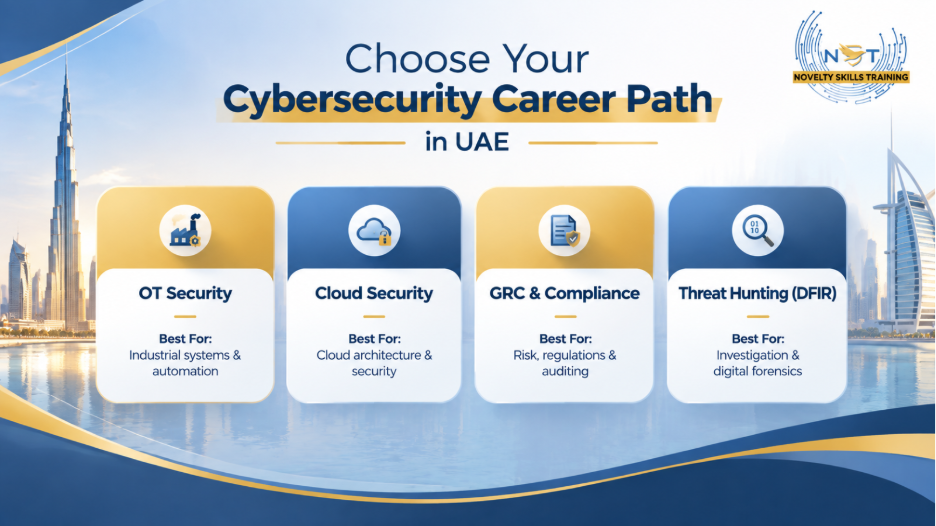
Choose based on your interests: OT Security for industrial systems, Cloud Security for cloud technologies, GRC for compliance, and Threat Hunting for investigation.
How does Novelty Skill Training- Dubai help students build cybersecurity skills?
Novelty Skill Training (NST) Dubai’s Cybersecurity Training Program provides hands-on learning, practical tools, and industry-relevant skills for modern cybersecurity roles.