
SIEM (Security Information and Event Management) is a cybersecurity solution that collects, analyzes, and correlates security data from multiple sources like servers, networks, and applications. It helps security teams detect threats, investigate incidents, monitor activities, and respond faster through real-time alerts and centralized security visibility.
The UAE’s digital ecosystem spans firewalls, email platforms, cloud services, applications, and connected devices, each generating security information in different formats. Security Information and Event Management SIEM acts as a centralized command center, bringing these signals together on one platform to help security teams identify threats and respond faster.
This centralized visibility is becoming increasingly important as the UAE’s cyber threat landscape grows. Reported attempted cyberattacks increased from 90,000–200,000 per day in March 2026 to 600,000–800,000 per day by July 2026, highlighting the need for stronger security preparedness and faster threat detection.
Across banking, healthcare, government, telecom, and critical infrastructure, organizations are strengthening cyber resilience to manage risks and protect critical digital assets Security Information and Event Management
supports these efforts through centralized monitoring, incident investigation, threat detection, and security reporting, including support for applicable cybersecurity and data-protection requirements such as the UAE PDPL.
As Security Information and Event Management becomes an important part of modern Security Operations Centers (SOCs), professionals who can configure, monitor, analyze, and manage Security Information and Event Management platforms can develop practical skills relevant to cybersecurity operations in the UAE.
640,000 Cyberattacks in One Day
The UAE recorded 640,000 cyberattacks in a single day, highlighting the scale of the country’s evolving cyber threat landscape. This growing volume reinforces the need for continuous security monitoring, faster threat detection, and coordinated incident response key capabilities supported by Security Information and Event Management solutions.
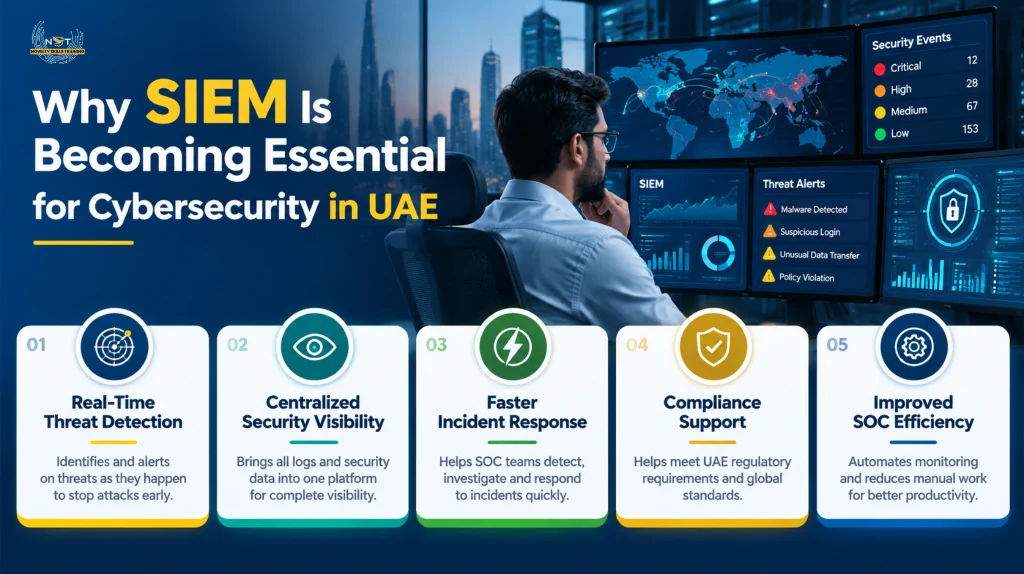
Why SIEM Is Becoming Essential for Cybersecurity in UAE
The UAE’s rapid digital transformation and cloud adoption are increasing cybersecurity risks, making stronger security monitoring essential. SIEM tool centralizes and analyzes security data to help teams detect threats, investigate incidents, and respond faster.
Key Drivers Behind Security Information and Event Management UAE Adoption in UAE
1. Real-Time Threat Detection
Security Information and Event Management analyzes security events continuously to detect phishing, malware, ransomware, and unauthorized access.
Example: Repeated failed logins followed by unusual network activity can flag a potential account compromise.
2. Centralized Security Visibility
Security Information and Event Management brings events from cloud, on-premises, and hybrid environments into one view, helping reduce monitoring gaps.
Example: Teams can monitor network, endpoint, and cloud activity from a single platform.
3. Faster Incident Response
SIEM correlates related alerts to help SOC teams identify attack patterns, investigate incidents, and prioritize threats.
Example: Alerts from multiple systems can be linked to identify a coordinated attack.
4. Compliance Support
Security Information and Event Management helps organizations maintain security logs, audit trails, and reports for cybersecurity reviews and compliance requirements.
Example: Centralized security logs management can provide evidence during audits and incident investigations.
5. Improved SOC Efficiency
Automation and risk-based prioritization help reduce alert fatigue and focus analysts on critical threats.
Example: Analysts can investigate high-risk alerts instead of manually reviewing every security event.
What Is SIEM?
Every digital activity within an organization from user logins and application access to network traffic and system updates generates security data. As businesses manage millions of security events every day, identifying genuine threats among normal activities has become increasingly complex. This is where Security Information and Event Management helps organizations improve security visibility, detect threats, and strengthen incident responses.
Security Information and Event Management is a cybersecurity technology that collects, analyzes, and monitors security data from multiple sources, including networks, servers, applications, endpoints, and cloud environments. By consolidating this information into a centralized platform, Security Information and Event Management enables security teams to gain a complete view of their IT environment, identify suspicious activities, and respond to potential threats more effectively.
Key Functions of Security Information and Event Management
- Centralized Security Monitoring: Collects data from different systems into a single platform for better visibility.
- Threat Detection: Identifies suspicious activities and potential cyber threats through security analysis.
- Log Management: Stores and analyzes security logs management for investigations, reporting, and compliance.
- Event Correlation: Connects multiple security events to uncover hidden threat patterns.
- Real-Time Alerts: Notifies security teams about unusual activities requiring attention.
- Incident Response Support: Helps teams investigate and respond to security incidents faster.
SIEM security is built on two core capabilities: Security Information Management (SIM) and Security Event Management (SEM). SIM focuses on collecting and analyzing security logs, while SEM focuses on real-time monitoring and alert generation.
A key advantage of Security Information and Event Management is event correlation, which helps identify threats by connecting multiple activities. For example, repeated login failures, unusual access locations, and abnormal data activity together may indicate a possible security breach.
In the UAE, where industries such as banking, healthcare, government, and energy rely heavily on digital systems, Security Information and Event Management has become an important part of cybersecurity strategical operations. It supports continuous monitoring, threat detection, and faster response to protect critical digital infrastructure.
How Security Information and Event Management Works for Threat Detection
Organizations generate enormous volumes of security data every day from networks, applications, servers, endpoints, and cloud environments. With rising cyber threats, manual data analysis is no longer effective. Security Information and Event Management monitoring helps security teams detect threats, analyze events, and respond quickly.
01 — CollectSecurity Information and Event Management gathers security data from firewalls, servers, applications, endpoints, cloud platforms, and access systems. | 02 — AnalyzeIt standardizes and analyzes logs to identify unusual activity and potential security risks. |
03 — CorrelateSecurity Information and Event Management connects related events such as failed logins, unfamiliar access, and unusual data transfers to detect possible threats. | 04 — RespondWhen suspicious activity is detected, Security Information and Event Management generates real-time alerts and supports investigation and faster incident response. |
In the UAE, organizations across industries such as banking, healthcare, government, and energy use Security Information and Event Management solutions to strengthen cybersecurity operations and support Security Operations Centers (SOCs).
By combining centralized visibility, intelligent threat detection, and faster response capabilities, Security Information and Event Management enables organizations to take a proactive approach toward protecting their digital infrastructure from evolving cyber threats.
SIEM Solutions and Tools Used by UAE Businesses
Security Information and Event Management solution helps UAE organizations centralize security monitoring by collecting and analyzing logs from networks, endpoints, applications, servers, and cloud platforms. These tools use AI, machine learning, threat intelligence, and automation to detect threats, investigate incidents, and support SOC operations across industries such as banking, healthcare, government, telecom, and critical infrastructure.
| SIEM Solution | Provider | Core Capabilities | UAE Applications |
|---|---|---|---|
| Microsoft Sentinel | Microsoft | Cloud SIEM/SOAR, AI detection, threat intelligence, automation | Cloud security monitoring, identity protection, SOC automation |
| Splunk Enterprise Security | Splunk | Security analytics, log correlation, threat hunting, risk alerts | Enterprise monitoring, threat investigation, SOC operations |
| IBM QRadar SIEM | IBM | Event correlation, behavioral analytics, compliance reporting | Banking security, enterprise monitoring, incident analysis |
| FortiSIEM | Fortinet | Event monitoring, UEBA, security analytics, Fortinet integration | Network security, firewall monitoring, hybrid environments |
| ArcSight SIEM | OpenText | Event processing, correlation, threat detection, compliance | Large-scale monitoring, insider threat detection |
| Elastic Security | Elastic | Log analytics, threat hunting, endpoint monitoring | Custom security analytics and infrastructure monitoring |
SIEM Monitoring: How UAE Organizations Detect and Respond to Cyber Threats
Security Information and Event Management monitoring enables UAE organizations to gain centralized visibility across their digital infrastructure by collecting, analyzing, and correlating security events from multiple systems. It helps Security Operations Centre (SOC) teams identify potential threats, investigate suspicious activities, and respond quickly to cyber incidents.
| Stage | SIEM UAE Monitoring Process |
|---|---|
| 1. Security Data Collection | SIEM collects and consolidates security logs from multiple sources, including firewalls, servers, endpoints, applications, cloud environments, and network devices, creating a unified view of security activities. |
| 2. Log Processing & Analysis | The collected data is processed, filtered, and analyzed to identify abnormal patterns, suspicious behaviour, system changes, and potential security risks. |
| 3. Threat Detection & Event Correlation | SIEM correlates data from different sources and uses threat intelligence, analytics, and detection rules to identify threats such as malware, phishing attempts, ransomware activity, unauthorized access, and insider threats. |
| 4. Alert Generation & Prioritization | Detected threats are converted into security alerts and prioritized based on severity and risk level, allowing SOC teams to focus on the most critical incidents. |
| 5. Incident Investigation | Security analysts examine alerts by analyzing user activity, system logs, network behaviour, and attack timelines to determine the source, impact, and scope of the incident. |
| 6. Response & Recovery | Security teams respond by blocking malicious activity, isolating affected systems, disabling compromised accounts, removing threats, and strengthening security measures to prevent future incidents. |
Conclusion
As cyber threats become more complex, Security Information and Event Management will continue to play a vital role in UAE cybersecurity by enabling continuous monitoring, proactive threat detection, and faster incident response. With advancements in AI, machine learning, threat intelligence, and automation,SIEM UAE monitoring platforms will become more intelligent and efficient, helping organizations strengthen their security posture.
To support the growing need for skilled cybersecurity professionals in the UAE, Novelty Skills Training delivers industry-focused training that equips learners with practical knowledge of modern security operations and technologies shaping the future of cybersecurity.
Frequently Asked Questions
1. What is SIEM UAE?
SIEM UAE refers to SIEM solutions used by organizations in the UAE to centralize security monitoring, detect threats, investigate incidents, and support faster response.
2. What is a SIEM solution?
A SIEM solution collects and analyzes security data from networks, endpoints, applications, servers, and cloud environments to identify suspicious activity and potential threats.
3. What is a SIEM tool used for?
A SIEM tool helps security teams collect logs, correlate events, detect threats, generate alerts, and investigate security incidents from a centralized platform.
4. How does SIEM security help organizations?
SIEM security improves visibility across IT environments, supports real-time threat detection, helps prioritize alerts, and enables security teams to respond to incidents more efficiently.
5. Which SIEM solutions are used by UAE businesses?
UAE organizations can use solutions such as Microsoft Sentinel, Splunk Enterprise Security, IBM QRadar Security Information and Event Management, FortiSIEM, ArcSight, and Elastic Security, depending on their security and infrastructure requirements.
6. What is Vulnerability Intelligence?
Vulnerability intelligence provides information about security weaknesses and potential exploits, helping organizations identify and address risks.
7. What are Attack Patterns in cybersecurity?
Attack patterns are common methods used by attackers, such as phishing, credential theft, and privilege escalation, to compromise systems. Identifying these patterns helps improve threat monitoring and response.