
Agentic AI in the UAE refers to AI systems that can understand business goals, plan multi-step tasks, make decisions, and execute actions with limited human intervention. UAE businesses are adopting AI agents across customer service, finance, HR, IT, sales, procurement, and other workflows to automate operations, improve productivity, reduce costs, and support faster decision-making. Successful adoption requires the right data, system integrations, governance, security controls, and human oversight.
Agentic AI business UAE refers to advanced artificial intelligence systems designed to understand complex goals, plan multi-step actions, and execute tasks autonomously with minimal human oversight. By handling entire end-to-end workflows independently, these autonomous agents radically enhance business growth by eliminating operational bottlenecks and allowing companies to scale rapidly without a linear increase in overhead costs.
This immense value has sparked a major enterprise shift across the Emirates, causing corporate AI adoption in the UAE to surge to 72% as businesses aggressively prepare for an era of digital co-workers. Driven by visionary policies, such as the national framework to transition 50% of government operations to agentic systems—local organizations are rapidly re-engineering their infrastructure and workflows. This blog explores exactly how UAE businesses are navigating this technological leap, adapting their structures, and preparing for an autonomous future.
What Is Agentic AI and its Role in the UAE Businesss Landscape?
Agentic AI refers to AI systems that can understand a goal, plan the steps required, make decisions, and take actions to achieve that goal with limited human intervention. These systems can interact with software, databases, APIs, and other digital tools to carry out tasks and respond to changing situations.
In simple terms, agentic AI is designed to act on an objective rather than simply generate an answer. It can assess a situation, determine what needs to happen next, execute actions, and adapt its approach based on the results.
This is making an impact across current marketplaces and businesses in the UAE by enabling more automated, responsive, and personalized business processes, from customer service and sales to operations and decision-making. As businesses adopt these systems, AI is increasingly becoming part of how work gets done rather than being used only as a supporting tool.
How Is Agentic AI for Business Different from Chatbots, Conventional AI, and RPA?
Although these technologies are often discussed together, they serve different purposes. The key difference is how much autonomy they have and how they handle a task. Agentic AI is designed to work toward a goal, plan multiple steps, use tools, and adapt its actions based on the situation.
| Technology | What it mainly does | How it works | Level of autonomy |
| Chatbots | Communicate with users and answer questions | Responds to user inputs, often within a defined conversational flow | Low |
| Conventional AI | Analyzes data, predicts outcomes, or generates content | Produces an output based on its model, data, or instructions | Low to moderate |
| RPA | Automates repetitive, rule-based tasks | Follows predefined steps across software and systems | Moderate, but rule-dependent |
| Agentic AI | Achieves goals and completes multi-step tasks | Plans, reasons, uses tools, takes actions, and can adapt to changing conditions | High |
A chatbot is primarily focused on conversation, while conventional AI can perform tasks such as prediction, classification, recommendation, or content generation. RPA is useful for structured, repetitive workflows where the steps are known in advance.
Agentic AI goes a step further by combining reasoning, planning, tool use, and action. It can break a larger objective into smaller tasks, interact with external systems such as databases and APIs, evaluate results, and continue working toward the intended outcome.
For businesses, this distinction is important because agentic AI is not simply another chatbot or automation tool. It can potentially operate across entire workflows, while still requiring appropriate permissions, governance, and human oversight for sensitive actions.
How to Implement Agentic AI in Your UAE Business
Implementing agentic AI business UAE is not simply about adding an AI tool to your existing operations. Businesses need to identify where autonomous business processes of decision-making can create value, prepare the right data and systems, and establish clear governance before allowing AI agents to take action.
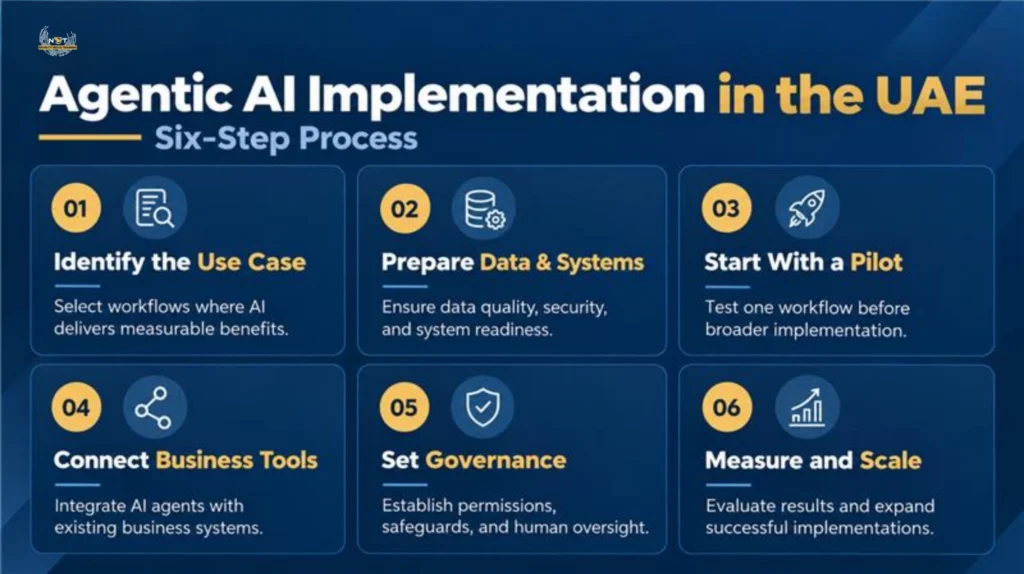
A practical implementation process can be broken down into these steps:
1. Identify the Right Business Use Case
Start with a specific business problem rather than trying to deploy agentic AI across the entire organisation. Look for workflows that involve repetitive decisions, multiple steps, large amounts of data, or frequent interaction with different business systems.
For example, a UAE company could explore agents for customer support, sales follow-ups, finance operations, procurement, HR processes, compliance, or supply-chain management.
This approach aligns with the UAE’s broader AI strategy, which identifies sectors such as healthcare, logistics, transport, energy and cybersecurity as important areas for AI transformation.
2. Assess Your Data and Technology Infrastructure
Agentic AI needs access to reliable information and, where appropriate, agentic AI business applications such as CRMs, ERP systems, databases, and APIs. Before implementation, businesses should check whether their data is accurate, accessible and properly secured.
This is particularly important as AI adoption is already significant in the UAE. In 2025, 72% of surveyed UAE workers said they had used AI at work during the previous 12 months, according to PwC.
3. Start With a Controlled Pilot
Rather than giving an AI agent access to critical business processes immediately, begin with one clearly defined workflow. Set measurable targets such as time saved, processing accuracy, cost reduction or customer response time. A successful pilot can then be expanded to additional departments and more complex workflows.
4. Connect the Agent to Business Systems
Once the pilot is validated, integrate the agent with the systems it needs to complete its tasks. Depending on the use case, this could include CRM platforms, internal databases, communication tools, financial systems or customer-service platforms.
The objective is to allow the agent to retrieve information, make decisions and perform authorized actions within the existing business environment.
5. Establish AI Governance and Human Oversight
This is one of the most important steps for UAE businesses. Define what the agent is allowed to do, which decisions require human approval, what data it can access, and how its actions will be monitored.
The UAE’s AI Charter specifically highlights responsible AI use, data privacy, transparency, human oversight, governance and accountability. The country’s National AI Cybersecurity Policy also sets requirements around governance, infrastructure, operational safety and threat monitoring.
6. Measure, Improve and Scale
After deployment, continuously evaluate the agent’s performance. Track whether it is actually improving the workflow and whether errors, security risks or unexpected decisions are occurring.
This gradual approach is particularly relevant in the UAE, where AI adoption and investment are accelerating. PwC’s 2026 UAE CEO survey found that 45% of surveyed UAE CEOs reported applying AI to demand generation, while 40% applied it to support services.
Cost and ROI of AI Agents for UAE Companies
The cost of implementing an AI agent varies significantly depending on the complexity of the agent, number of users, integrations, data requirements, security controls, and level of autonomy. A simple customer-support agent may require relatively limited investment, while an enterprise AI UAE agent connected to ERP, CRM, finance, or operational systems can involve substantially higher implementation and infrastructure costs.
For UAE companies, ROI should therefore not be measured only by the cost of the AI software. Businesses should consider the total cost of implementation against measurable outcomes such as reduced operating costs, employee productivity, faster processing, higher customer conversion, fewer errors, and additional revenue.
Importantly, businesses should not assume that every AI agent will deliver immediate returns. Deloitte’s 2025 research across Europe and the Middle East found that most organizations achieving satisfactory ROI from typical AI use cases reported a 2–4 year timeframe, while only 6% reported payback within one year. For agentic AI business UAE specifically, the higher complexity means organizations generally need to evaluate ROI over a longer period.
At the same time, there is evidence of measurable value from AI agents. PwC’s 2025 survey found that 66% of organizations already adopting AI agents reported measurable value through increased productivity.
Typical Cost and ROI Considerations
| Cost / ROI Factor | What UAE Businesses Need to Consider |
| AI platform & model costs | Subscription, API usage, model inference and agent-management costs |
| Development & implementation | Building the agent, workflows, prompts, testing and deployment |
| System integration | Connecting the agent with CRM, ERP, databases, APIs and other business applications |
| Data preparation | Cleaning, structuring and securing the data required by the agent |
| Security & governance | Access controls, monitoring, compliance, human approvals and ongoing risk management |
| Employee training | Training teams to work with, supervise and manage AI agents |
| Maintenance & optimisation | Monitoring performance, updating workflows and improving agent reliability |
| Productivity gains | Hours saved on repetitive or multi-step tasks |
| Cost reduction | Lower manual processing, operational and service-delivery costs |
| Revenue impact | Higher conversions, faster sales cycles, improved customer retention or new AI-enabled services |
| ROI measurement | Compare the financial value generated against the total cost of implementation and operation |
For UAE businesses, the strongest ROI is likely to come from redesigning complete workflows rather than simply adding an AI agent to an existing process.
How Agentic AI Is Changing Business Operations in the UAE
Agentic AI is moving businesses from task-based AI automation Dubai toward end-to-end workflow execution. AI agents can access business data, use connected systems, make decisions within defined boundaries, and coordinate multiple steps to achieve an outcome.
For UAE businesses, this can reshape several operational processes:
1. Customer Service & Sales
AI agents can manage customer enquiries, retrieve customer information, qualify leads, recommend next actions and initiate follow-ups. They can also work directly with CRM and sales systems, helping teams respond faster and reduce manual follow-up.
2. Finance & Accounting
In finance, agents can support billing, cash application, invoice processing, dispute resolution and financial reporting. Instead of handling each task separately, agents can coordinate multiple steps across the finance workflow and escalate exceptions to employees when needed.
3. HR & Workforce Management
Agentic AI business UAE can support employee onboarding, payroll-related processes, workforce scheduling, talent acquisition and employee requests. This allows HR teams to spend less time coordinating routine administrative work.
5. IT & Internal Operations
AI agents can increasingly operate across IT workflows, including service requests, system monitoring and issue resolution. Enterprise platforms are now being designed to allow agents to work across IT, security, HR, finance, legal, procurement and customer service workflows.
6. Banking & Financial Services
For the UAE’s large financial-services sector, agentic AI can support areas such as credit, lending, trade finance and treasury. For example, Oracle’s 2026 banking platform includes agents that can extract information from loan documents, validate agentic AI business applications, and identify exceptions for banker review.
7. Cross-Department Operations
The bigger opportunity comes when agents can work across departments rather than operating as isolated tools. A single business process could involve agents coordinating sales, finance, inventory, procurement and customer service, with humans stepping in where approval or judgement is required.
This shift is creating what IBM describes as an “agentic enterprise”, where AI agents are integrated across business functions and can execute multi-step processes alongside employees.
For UAE businesses, the real impact of agentic AI will therefore be measured not by how many AI tools they deploy, but by how effectively they redesign and connect their business processes around AI.
Case Studies: How UAE Businesses Are Using Agentic AI
ADNOC: Moving AI from Individual Tools to Enterprise-Wide Operations
As one of the UAE’s largest energy companies, ADNOC manages complex operations across procurement, finance, HR, auditing and energy production. A key challenge is managing large volumes of data and repetitive processes across different business functions while maintaining operational efficiency.
ADNOC is addressing this by deploying AI agents across multiple business functions, allowing AI to support workflows rather than operate as isolated tools. The company has deployed more than 115 AI agents and trained around 20,000 employees to use and develop AI solutions. It has also reported 3,000 active AI models being used daily.
The significance is the shift from using AI for individual tasks to embedding AI into day-to-day business operations. Agents can help employees analyse information, automate processes and support decisions across departments, reducing the amount of manual work involved in complex workflows.
What this shows: For large UAE enterprises, agentic AI can become an operational layer connecting multiple departments, rather than simply another productivity tool.
CozmoX: Automating Repetitive Work for Businesses
Many businesses face a different problem: employees spend significant amounts of time on repetitive administrative work such as entering data, processing invoices, responding to customer enquiries and following up on routine requests. These tasks may not require complex human judgement, but they consume considerable employee time.
Dubai-based CozmoX uses AI agents to automate these types of workflows. Its AI employees can handle tasks including customer service, sales, debt collection, auditing and invoice processing, allowing businesses to delegate repetitive processes to AI while employees focus on work requiring greater judgement.
The company has reported that some customers achieved savings of more than $100,000 per month through automation. It also reported having onboarded more than 50 UAE companies by 2025.
What this shows: Agentic AI can address one of the most immediate business problems—the cost and time associated with repetitive operational work—by allowing AI to execute processes rather than simply assist employees with individual tasks.
Key Takeaways for UAE Businesses
Agentic AI is becoming a practical way for UAE organisations to redesign operations around intelligent, goal-driven automation. Rather than using AI only for isolated tasks, businesses can connect agents to workflows, systems, and decision points across departments.
- Start with focused use cases: Prioritise workflows where automation can reduce manual effort, improve response times, or support faster decision-making.
- Build on reliable data and integrations: AI agents need accurate information and secure access to the tools they will use.
- Keep governance central: Define permissions, human approvals, monitoring, and accountability before expanding autonomy.
- Measure business value: Track productivity, cost reduction, customer experience, and revenue impact to assess ROI over time.
The most successful UAE businesses will be those that treat agentic AI as part of a broader operational transformation—not just another software tool.
Conclusion
Agentic AI is reshaping workplace expectations, making continuous upskilling essential for professionals who want to remain relevant in the evolving UAE job market. Developing knowledge of AI, automation, and digital technologies can help individuals adapt to emerging responsibilities, strengthen their professional capabilities, and prepare for new career opportunities.
Novelty Skills Training helps professionals build future-ready skills through industry-relevant training. By investing in continuous learning and practical skill development, individuals can improve their adaptability, expand their career prospects, and prepare to contribute effectively to technology-driven workplaces.
FAQs
1. What is agentic AI for businesses in the UAE?
Agentic AI enables UAE businesses to automate multi-step tasks, make decisions, and execute actions with limited human intervention.
2. What are the main agentic AI business applications?
Key applications include customer service, sales, finance, HR, procurement, IT support, supply-chain management, compliance, and business intelligence.
3. How can AI agents help businesses?
AI agents automate repetitive tasks, retrieve information, coordinate workflows, and execute authorised actions, helping businesses improve operational efficiency.
4. How is AI automation being used in Dubai?
Dubai businesses use AI automation across customer experience, finance, logistics, healthcare, government services, and operations to streamline workflows.
5. What are autonomous business processes?
Autonomous business processes use AI systems to complete multi-step tasks, make decisions, execute actions, and escalate exceptions when necessary.
6. How can enterprises in the UAE adopt agentic AI?
UAE enterprises can identify suitable workflows, prepare infrastructure, pilot AI agents, integrate systems, establish governance, and gradually scale implementation.
7. Is agentic AI suitable for small and medium-sized businesses in the UAE?
Yes, SMEs can automate customer support, lead qualification, invoice processing, appointment management, and data entry through focused AI applications.
8. What should UAE businesses consider before implementing AI agents?
Businesses should assess data quality, integration, security, privacy, compliance, implementation costs, employee training, human oversight, and measurable ROI.