
Endpoint security is the practice of protecting end-user devices, such as laptops, desktops, smartphones, servers, and IoT devices, from malicious actors and cyber threats. For businesses in the UAE, endpoint security helps prevent unauthorized access, detect threats, and safeguard sensitive business data. Endpoint security solutions use technologies such as EPP, EDR, and XDR to strengthen device protection and respond to security incidents.
As businesses across the UAE adopt cloud technologies, AI, and hybrid work models, protecting digital infrastructure has become increasingly complex. Endpoint security plays a critical role in this environment by helping organizations secure connected devices against cyber threats and unauthorized access. This reality hit home dramatically in the region when the UAE Cybersecurity Council confirmed that the UAE faces over 800,000 daily cyberattacks, with the country absorbing an overwhelming 35% of all digital threats targeted at the Gulf region. The frontline of this battle resides at the endpoint; a striking study by Verizon Business indicates that 90% of all successful cyberattacks now originate at endpoint devices.
The financial and operational consequences of leaving these access points vulnerable are steeper than ever, especially in the Middle East. According to the 2026 IBM Cost of a Data Breach Report, the average cost of a data breach for a Middle East organization has skyrocketed to an astronomical $8 million (approximately AED 29.3 million) per incident, sitting drastically higher than the global average of $4.99 million. This financial strain is compounded by sophisticated, multi-vector campaigns, such as the recent coordinated cyberattacks thwarted by the UAE Cybersecurity Council targeting aviation, energy, and financial sectors—which explicitly weaponized targeted phishing loops to exploit human endpoints as entry pathways.
In this blog, we will demystify how endpoint security works, analyze the rising regional threat models of the current landscape, and explore the advanced tools necessary to keep your corporate network secure.
What is Endpoint Security?
Endpoint security is the comprehensive process of protecting a network’s endpoints, which include laptops, desktops, smartphones, tablets, servers, and virtual machines, from malicious actors and cyber threats. In cybersecurity, an “endpoint” is any device that communicates with the network to which it is connected.
At its core, endpoint security acts as a digital perimeter defense for individual devices. Because every device connected to an enterprise network represents a potential entry point for attackers, endpoint security focuses on securing these individual interfaces. The primary objective is to prevent unauthorized access, block malware execution, detect data exfiltration, and ensure that every connected device complies with corporate security policies before it can interact with sensitive network resources.
Major Types of Endpoint Security
The modern threat landscape is highly complex; organizations cannot rely on a single defensive tool. Modern architecture divides endpoint security into several distinct types and functional layers, each designed to address specific vectors of risk.
Here are the primary types of endpoint security solutions used to protect enterprise environments today:
1. Endpoint Protection Platforms (EPP)
An EPP serves as an organization’s first line of defense. It is a preventative solution deployed directly on devices to detect and block known threats before they can execute. EPP solutions typically combine traditional antivirus capabilities with next-generation antivirus (NGAV), personal firewalls, and data loss prevention (DLP) tools. According to Mordor Intelligence’s 2026 Analysis, foundational defensive features like Firewalls/UTMs accounted for nearly 20% of the entire endpoint security UAE market share, underscoring how vital preventative EPP utilities remain to core infrastructure.
2. Endpoint Detection and Response (EDR)
When an advanced attack successfully bypasses a preventative EPP, EDR takes over. EDR software continuously monitors and records activity across all endpoint devices to uncover anomalous behavior, fileless malware, and zero-day exploits in real-time. Instead of just blocking known files, EDR gives security teams deep forensic visibility and automated containment tools to isolate a compromised device instantly. The Insight Partners project an even steeper curve, forecasting the global EDR market to reach $22.00 billion by 2031, surging at a 25.9% CAGR from 2024 to 2031.
3. Extended Detection and Response (XDR)
While EDR focuses strictly on what happens on the device, XDR expands that scope by unifying telemetry across the entire corporate ecosystem. XDR integrates data from endpoints, networks, cloud environments, email streams, and identity servers into a single console. This allows security teams to track a malicious actor moving laterally across different environments. Driven by massive enterprise cloud migrations, the adoption of XDR has exploded. A MarketsandMarkets Report note that the global XDR market size is expanding from roughly $10.98 billion in 2026 to an estimated $38.09 billion by 2031.
4. Mobile Threat Defense (MTD)
With the rise of remote work and Bring Your Own Device (BYOD) cultures, smartphones and tablets have become prime targets for attackers. MTD provides dedicated security for mobile operating systems (iOS and Android). It monitors mobile-specific risk vectors, such as malicious mobile apps, network-level phishing links over public Wi-Fi, and operating system vulnerabilities that could allow device rooting or jailbreaking.
5. Unified Endpoint Management (UEM)
Security cannot exist without proper hygiene. UEM blends endpoint security with proactive IT administration. It allows administrators to track device inventory, remotely configure settings, push operating system security patches, and wipe data from lost or stolen corporate assets. By ensuring every device is fully patched and configured according to strict corporate policies, UEM effectively minimizes the attack surface that hackers can exploit.
Key Features of Endpoint Security Solutions
To effectively shield an enterprise from sophisticated modern cyber threats, an endpoint security solution must possess more than basic scanning capabilities. A modern security suite relies on a combination of real-time monitoring, intelligent automation, and behavioral analytics.
When evaluating modern enterprise security tools, look for these five key features:
1. Next-Generation Antivirus (NGAV) & Behavioral Analytics
Unlike traditional tools that rely on explicit databases of past viruses, NGAV focuses on behavior. It leverages machine learning algorithms to examine file metadata, registry changes, and process memories in real-time. This allows it to spot and isolate sophisticated threats like fileless malware or zero-day exploits before they execute. Industry data underlines the explosive demand for these smarter defenses: according to research and markets, the global Antivirus Software Market was valued at USD 4.28 billion in 2025 and is projected to reach USD 4.53 billion in 2026. It is expected to continue growing at a CAGR of 5.93%, reaching USD 6.41 billion by 2032.
2. Continuous Telemetry & Endpoint Detection and Response (EDR)
When sophisticated malware manages to sneak past initial preventative perimeters, EDR functionality serves as the ultimate safety net. EDR tools work by continuously capturing and storing system-level behaviors across all connected workstations, mobile devices, and server instances. This deep forensic visibility allows corporate threat hunters to pinpoint malicious indicators and investigate exactly how a breach occurred. The critical nature of this feature is reflected in the enterprise market; Fortune Business Insights’ 2026 EDR Industry Report estimates that global enterprise investments in dedicated EDR solutions will surge past USD 7.23 billion this year alone.
3. Integrated Threat Intelligence
Cyber threats evolve on a second-by-second basis globally. Top-tier endpoint solutions integrate global cloud threat intelligence feeds directly into their platforms. This means if a new strain of ransomware hits a company on one side of the globe, the signature and behavioral data of that attack are instantly uploaded to a shared cloud registry. Within minutes, every other enterprise endpoint worldwide is updated to block that identical threat vector.
4. Automated Incident Response & Device Containment
When an active threat is identified, human IT staff often cannot move fast enough to stop network propagation. Advanced endpoint security tools leverage automated isolation protocols to immediately cut off a compromised device. By digitally quarantining a laptop at the moment anomalous outbound data or system alterations are recognized, the software blocks the threat from moving laterally across internal identity servers and cloud environments.
5. Data Loss Prevention (DLP) & Device Control
Endpoints are frequent exit points for sensitive corporate records. Built-in DLP features allow security administrators to block unauthorized transfers of intellectual property or regulated customer data. These systems monitor file activity across web browsers, email clients, and external ports, preventing employees from copying internal information onto unencrypted USB drives or uploading protected records to unauthorized personal cloud services.
What are the Ways to Implement Endpoint Security?
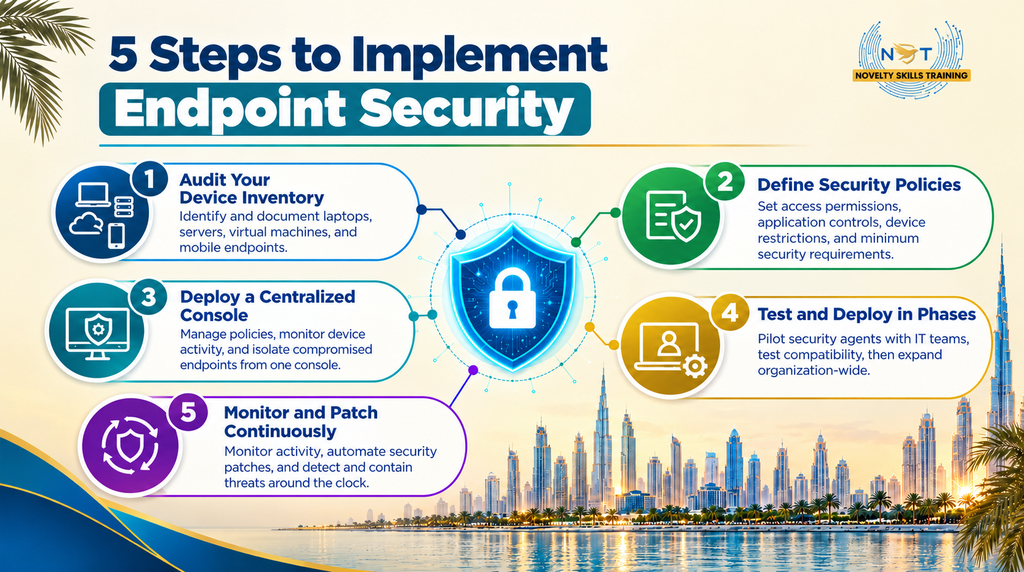
Implementing an enterprise endpoint security strategy requires a systematic approach. Rather than haphazardly installing software, organizations must follow a structured, multi-phase deployment roadmap to guarantee full network coverage and minimize operational disruption.
You can successfully implement endpoint security across your organization by following these five critical phases:
1. Discover and Audit Your Asset Inventory
You cannot protect what you do not know exists. The first phase involves running network discovery scans to identify and document every single device that connects to your corporate ecosystem. This audit must account for all:
- Physical workstations, laptops, and on-premises servers.
- Virtual machines and cloud-hosted instances.
- Mobile devices and tablets, including personal employee devices used under Bring Your Own Device (BYOD) policies.
2. Define Granular Access and Security Policies
Before installing software, security teams must establish a baseline of security policies. Using the concept of Least Privilege, permissions should be configured so that users only have access to the specific applications and data required for their job roles. These policies should define:
- Application whitelists (which programs are allowed to run).
- Device control restrictions (e.g., blocking unauthorized USB storage devices).
- Compliance baselines (e.g., forcing a minimum operating system version before network access is granted).
3. Deploy a Centralized Management Console
Effective endpoint management relies on a single pane of glass. Organizations should establish their administrative command center, which is typically a cloud-native platform like Microsoft Defender for Endpoint or CrowdStrike Falcon. A cloud-based console ensures that security administrators can push global policy updates, track telemetry, and isolate compromised systems instantly, regardless of where the device or the employee is physically located.
4. Roll Out Agents via a Phased Pilot Strategy
To prevent unexpected software conflicts from stalling business operations, avoid installing endpoint agents on every corporate device at the exact same time. Instead, utilize a phased rollout timeline:
- The IT Testing Phase: Install the agent on IT and security team devices first to catch initial bugs.
- The Department Pilot Phase: Expand deployment to a small, diverse group of non-technical users across different departments (e.g., Finance, HR, and Sales) to monitor application compatibility.
- The Global Production Phase: Once the software is verified as stable, scale deployment across the rest of the enterprise infrastructure.
5. Establish Continuous Monitoring and Patch Cycles
Implementation is not a one-time event; it is an ongoing operational commitment. Security teams must integrate their endpoint platforms with automated patch management workflows to instantly remediate software vulnerabilities. Additionally, endpoint data should be fed into a broader security center or managed detection service to maintain Round-the-Clock Threat Monitoring capabilities. This ensures that sophisticated, automated attacks occurring over weekends or holidays are intercepted and contained in real time.
Top 5 Key Benefits of Endpoint Security
Implementing a robust endpoint security UAE framework offers measurable operational, financial, and strategic advantages. Protecting individual entry points allows organizations to safeguard critical assets while maintaining high operational efficiency.
Five key benefits of endpoint security include:
1. Drastic Reduction in Financial Losses
A single security breach can devastate an organization’s bottom line. Because ransomware and data extortion tactics have evolved into persistent corporate threats, preventative endpoint security blocks malicious payloads before encryption can begin. According to StationX’s Ransomware Threat Analysis, the average cost of a ransomware attack has risen to a staggering $5.08 million. Implementing next-generation endpoint software mitigates these massive clean-up costs, minimizing direct financial impacts, and ensuring long-term fiscal stability.
2. Complete Asset Visibility and Network Control
You cannot protect what you cannot see. Modern endpoint platforms provide security teams with a unified view of the entire corporate ecosystem. Whether an employee is working from the main corporate office, a home network, or a public airport terminal, the IT department gains real-time visibility into the device’s operational behavior and security posture. This real-time insight allows administrators to easily track device inventories, monitor access requests, and enforce corporate compliance policies continuously.
3. Accelerated Threat Response and Containment
When an attack occurs, seconds matter. Advanced endpoint security tools utilize Autonomous Cybersecurity Management to drastically reduce threat of “dwell time”—the duration an attacker spends inside a system before being discovered. Rather than waiting for a manual review by a human analyst, integrated system engines automatically isolate compromised devices. This rapid containment stops hackers from moving laterally through the network and accessing other corporate assets.
4. Seamless Support for Hybrid and Remote Workforces
The modern workplace has changed, with widespread cloud adoption reshaping operational perimeters. According to Host Intrusion Prevention System Outlooks, a substantial 52.74% of enterprises rely heavily on cloud-hosted environments for day-to-day operations. Endpoint security acts as a portable defensive shield, allowing employees to access internal business platforms safely from anywhere in the world without exposing the company to unnecessary network exploits.
5. Automated Patching and Streamlined IT Operations
Manually keeping devices updated is an administrative nightmare that leads to unpatched vulnerabilities. Endpoint platforms help streamline routine maintenance by automating system updates and patch distribution across the organization. By automatically resolving software vulnerabilities as soon as patches become available, these tools remove a heavy workload from internal help desks, allowing IT personnel to focus on core strategic projects rather than constant emergency troubleshooting.
Conclusion
As cyber threats continue to evolve, upskilling in endpoint security and cybersecurity has become essential for professionals looking to build or advance their careers in this field. Developing practical skills in threat detection, endpoint protection, network security, ethical hacking, vulnerability management, and incident response can help professionals prepare for emerging cybersecurity challenges.
Novelty Skills Training, Dubai, offers a Cybersecurity Training Program designed to help you develop industry-relevant knowledge and practical skills. Build your cybersecurity expertise and prepare to pursue opportunities in a field where organizations increasingly need professionals who can protect their devices, networks, and sensitive data.
Frequently Asked Questions
1. What is endpoint security, and why is it important for UAE businesses?
Endpoint security protects connected devices from cyber threats, helping UAE businesses safeguard sensitive information and reduce security risks.
2. What endpoint security solutions are suitable for businesses in the UAE?
EPP, EDR, XDR, and UEM solutions help UAE businesses prevent threats, monitor devices, and strengthen endpoint protection.
3. How does endpoint protection for businesses help prevent cyberattacks?
Endpoint protection for businesses detects malware, blocks suspicious activity, monitors devices, and helps contain compromised endpoints before threats spread.
4. What are the most commonly used endpoint security tools?
Common endpoint security tools include antivirus software, EPP, EDR, XDR, mobile threat defence, and unified endpoint management platforms.
5. What should UAE businesses consider when choosing endpoint security tools?
UAE businesses should assess device coverage, threat detection, automated response, scalability, integration capabilities, data protection, and applicable compliance requirements.
6. How does endpoint security support data protection compliance in the UAE?
Endpoint security helps protect personal data through access controls, device monitoring, and threat prevention, supporting applicable UAE data protection requirements.
7. Are endpoint security solutions necessary for small businesses in the UAE?
Yes, endpoint security solutions help small businesses protect devices, prevent malware infections, reduce cyber risks, and safeguard sensitive business information.
8. How can professionals develop skills in endpoint security in the UAE?
Professionals can pursue cybersecurity training covering endpoint protection, network security, threat detection, vulnerability management, and incident response to build practical skills.