
AI Skills for Managers in the UAE involve developing expertise in AI tools, business strategy, workflow automation, and responsible AI governance. These capabilities help managers improve decision-making, optimise operations, manage AI-related risks, and lead digital transformation
AI Skills for managers in the UAE is increasingly important as workplaces adapt to rapidly changing skill requirements and autonomous AI systems. PwC’s 2026 AI Jobs Barometer gives the UAE a skills transformation score of 7.22, compared with the global average of 4.47, while a Dataiku CIO report found that 15% of UAE organizations operate more than 500 AI agents in production. These developments highlight the need for managers to build change agility, oversee AI-driven workflows, and establish governance measures that support responsible collaboration between employees and AI agents.
This shift is also reflected in the UAE’s growing investment in AI adoption and workforce development. For instance, following reports that the UAE’s workforce AI adoption rate scaled past 70%, the government launched the landmark Ai Native program to train 20,000 employees by 2026, featuring a dedicated executive track for leaders. Concurrently, organizations like the Dubai Chambers have rolled out advanced training programs for over 14,000 companies, cementing AI competency as a fundamental requirement for modern UAE management.
Why AI Upskilling for Managers in the UAE Must Happen
Upskilling in artificial intelligence has shifted from a forward-looking advantage to a pressing corporate requirement for managers in the United Arab Emirates. Several critical regional factors drive this necessity:
- Managing an AI-Saturated Workforce: Managers are increasingly leading teams that are already deeply reliant on autonomous tools. According to data from the Microsoft AI Economy Institute, the generative AI adoption rate among the UAE’s working-age population reached an unprecedented 73.3% during the second quarter (“The UAE ranked first globally in AI adoption in Q1 2026”). Leaders must master vital AI Skills for Managers to effectively govern, evaluate, and direct these tech-heavy operational workflows.
- Explosive Corporate AI Integration: Organizations across the country are aggressively embedding intelligent infrastructure into their core models. An ecosystem report by Amazon Web Services and the UAE AI Office revealed that business adoption of AI surged rapidly to 72%, climbing from 53% just a year prior. Managers who lack technical oversight risk becoming operational bottlenecks as corporate structures adapt.
- Sustaining Macroeconomic Growth Targets: The demand for AI-literate leadership is closely tied to the country’s macro-financial ambitions. Strategic projections from Emirates NBD Research indicate that AI is expected to account for up to 13.6% of the UAE’s total GDP by the landmark target year. Leaders must align their departments with these targets to capture emerging digital revenue streams.
- Adapting to Evolving Talent Demands: As positions change, the fundamental AI Skills for Managers required to lead teams are shifting beneath managers. The PwC AI Jobs Barometer highlights that highly exposed AI roles require an average of 77 new skills compared to just 22 for less exposed roles. Managers must continually upskill to successfully recruit, retain, and guide professionals in this rapidly changing talent market.
AI Skills for Managers UAE: Essential Areas of Expertise
Managers in the UAE need a combination of technical understanding, strategic thinking, and leadership capabilities to integrate AI effectively into business operations. The following areas of expertise help managers evaluate AI tools, improve decision-making, automate workflows, manage risks, and lead responsible AI adoption across their teams.
- Strategic AI Direction & Project Management
Managers need to understand how to integrate AI systems with existing business operations, align technology investments with organisational goals, and oversee implementation. In the UAE, this includes coordinating systems, teams, and processes to support scalable digital transformation.
| Skill | What it Covers |
| Tech Selection & Project Framing | Evaluating AI tools, defining project objectives, and aligning solutions with business needs. |
| System Rules & Boundary Setting | Establishing AI usage limits, operational guidelines, and human oversight requirements. |
| AI Output Auditing & Quality Control | Reviewing AI-generated outputs for accuracy, relevance, consistency, and reliability. |
- AI Governance & Ethical Risk Management Skills
Managers need to understand AI governance frameworks, data privacy, algorithmic bias, and accountability to ensure responsible AI adoption. In the UAE, aligning AI use with applicable data protection laws and national AI governance principles helps organizations manage risks and maintain stakeholder trust.
| Skill | What it Covers |
| Regulatory Alignment & DIFC Compliance | UAE data protection laws, DIFC regulations, and responsible AI data handling. |
| Algorithmic Bias Auditing | Detecting bias in AI outputs, recruitment, and customer assessments. |
| AI Agent Safety | Setting AI agent limits, approval rules, and human oversight. |
| AI Security & Threat Prevention | Identifying data poisoning, prompt injection, and AI security risks. |
| Explainable AI & Audit Readiness | Documenting AI decisions, maintaining audit trails, and supporting compliance reviews. |
- Cloud Economics & FinOps (Financial Operations) Skills
Managers need to understand cloud computing costs, AI infrastructure expenses, and FinOps practices to optimize budgets, track resource usage, and ensure AI investments deliver measurable business value.
Why Cloud Economics and FinOps Matter for Managers in the UAE
- Managing Usage-Based Cloud Costs: AI workloads incur variable costs based on usage, making it essential to monitor consumption, prevent unexpected spending, and control departmental budgets.
- Optimising Sovereign Cloud Spending: UAE data protection requirements can influence cloud hosting choices. Managers must balance compliance needs with infrastructure costs and avoid unnecessary premium hosting expenses.
- Measuring AI Return on Investment: FinOps helps managers track metrics such as cost per transaction and cost per customer query to evaluate AI investments and demonstrate measurable business value.
- Controlling Cross-Border Cloud Expenses: Managing operations across the UAE and international markets requires visibility into regional cloud fees, data transfer charges, and currency-related costs.
- Aligning Engineering and Finance Teams: FinOps helps managers connect technical resource usage with financial goals, encouraging engineering and finance teams to share accountability for cost efficiency.
| Skill | What it Covers |
| Predictive Cloud Forecasting & Unit-Cost Modeling | Forecasting cloud spending and calculating costs per transaction, query, or workload. |
| Cloud Waste Identification & Resource Optimization | Identifying idle resources, overprovisioning, and unnecessary cloud expenses. |
| Sovereign Cloud Workload Mapping | Matching workloads to UAE-based cloud infrastructure based on data residency, compliance, and cost requirements. |
| Multi-Cloud Rate Optimization & Lifecycle Management | Comparing cloud pricing, optimising resource rates, and managing infrastructure throughout its lifecycle. |
| Cross-Functional Financial Tagging & Taxonomy | Categorising cloud expenses by department, project, and business unit for clear cost allocation. |
| Technical FinOps KPI Translation | Converting technical metrics, such as resource usage and performance, into financial indicators and business outcomes. |
- Change Leadership & Workflow Redesign
Managers need to lead teams through AI-driven changes by redesigning workflows, managing resistance, and aligning employees with new processes. In the UAE, this includes supporting digital transformation while maintaining collaboration, productivity, and workforce adaptability.
| Skill Area | What it Covers |
| Business Process & Workflow Redesign | Identifying tasks for AI integration and redesigning workflows to improve efficiency. |
| Change Management & Employee/Employer Buy-In | Communicating AI adoption goals, addressing concerns, and securing stakeholder support. |
| AI-Driven Performance Metric Redesign | Updating KPIs to measure AI-driven productivity, quality, and business outcomes. |
How Managers in the UAE Can Approach AI Training and Upskilling
Managers can approach AI upskilling through a structured process that connects learning with business priorities, practical application, and responsible AI adoption. The following steps can help them build relevant capabilities and apply them effectively at work.
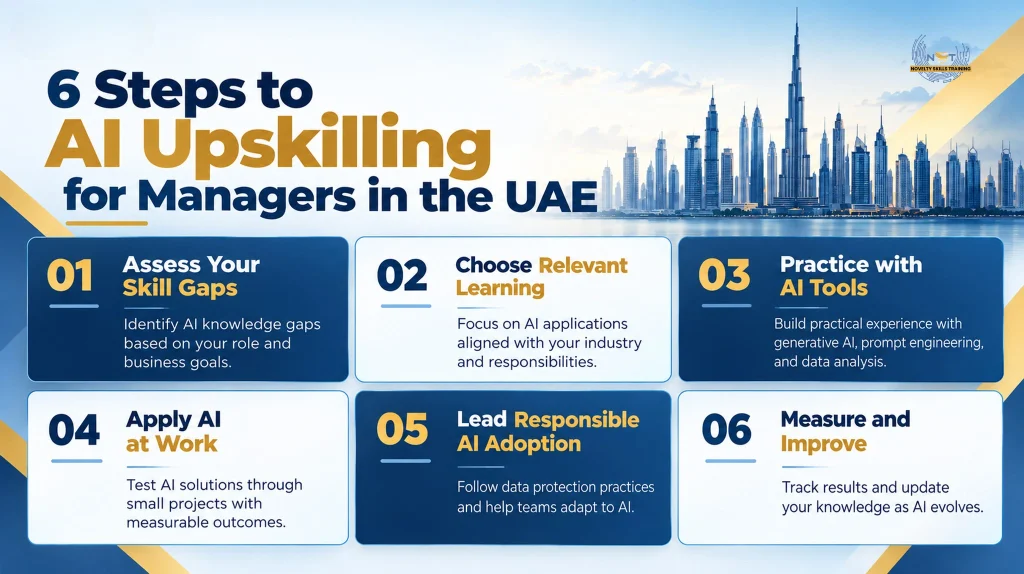
Step 1: Assess Your AI Knowledge and Skill Gaps
Evaluate your understanding of AI tools, data analysis, automation, and AI governance. Identify the capabilities you need to strengthen based on your managerial responsibilities and your organization’s digital transformation goals.
Step 2: Choose Learning Based on Business Needs
Prioritize learning that aligns with your role and industry. For example, HR managers can explore AI-assisted recruitment, finance managers can focus on forecasting, and operations managers can learn workflow automation.
Step 3: Practice with AI Tools
Build practical experience with generative AI, prompt engineering, data analysis, and productivity tools. Experiment with low-risk tasks, such as summarizing reports, analyzing data, or preparing presentations, to understand their benefits and limitations.
Step 4: Apply AI Through Workplace Projects
Test your knowledge through small, measurable projects. Identify a suitable business process, establish performance benchmarks, and evaluate whether AI improves efficiency, accuracy, or decision-making before expanding its use.
Step 5: Develop Responsible AI and Change Leadership
Understand applicable UAE data protection requirements, responsible AI practices, and human oversight. Learn to communicate changes clearly, address employee concerns, and help teams adapt to AI-supported workflows.
Step 6: Measure Results and Continue Learning
Track improvements in productivity, cost efficiency, and output quality. As AI tools and business requirements evolve, update your knowledge and refine your approach based on practical results and emerging organizational needs.
As organizations increasingly integrate AI into their workflows, managers need to understand how these technologies can support productivity, decision-making and business performance. According to McKinsey’s 2025 State of AI report, 88% of respondents reported regular AI use in at least one business function in 2025.
Key Topics to be Covered in AI Training for Managers
An effective AI training programme for managers should combine foundational knowledge with practical business applications and leadership capabilities. The focus should be on helping managers understand AI technologies, identify opportunities for implementation, and integrate them into everyday operations responsibly.
| Topic | What is Covered |
| Module 1: AI Fundamentals | AI concepts, differences between machine learning and generative AI, and practical limitations. |
| Module 2: Business Value of AI | ROI measurement, productivity improvements, and AI use cases across business functions. |
| Module 3: Generative AI for Managers | Using ChatGPT, Microsoft Copilot, and Google Gemini for management tasks. |
| Module 4: Prompt Engineering Essentials | Context framing, structured prompts, output design, and iterative refinement. |
| Module 5: AI in Everyday Management | Automating emails, summarizing reports, analyzing spreadsheet data, and preparing presentations. |
| Module 6: AI Strategy for Managers | AI readiness assessments, build-versus-buy decisions, and pilot project planning. |
| Module 7: AI Risks and Responsible Use | Algorithmic bias, inaccurate outputs, data privacy, security, and responsible AI practices. |
| Module 8: Leading AI Adoption | Change management, addressing employee resistance, and integrating AI into team workflows. |
Conclusion
AI upskilling for managers in the UAE is becoming essential as organizations embrace automation, data-driven decision-making and digital transformation. By pursuing a Certified AI for business leaders training courses, professionals can learn to use generative AI tools, streamline workflows, evaluate business opportunities and lead responsible AI adoption. These skills can help managers improve operational efficiency, strengthen team productivity and prepare for emerging AI-related leadership responsibilities. With the UAE continuing to invest in AI management skills capabilities, managers who combine practical AI knowledge with industry experience and AI leadership skills can position themselves for future career growth.
FAQs
1. How can AI skills for managers in the UAE improve business performance?
AI skills help managers streamline operations, improve forecasting, allocate resources efficiently, and make informed decisions using data-driven insights.
2. Which AI leadership skills are important for senior managers?
Strategic thinking, AI governance, risk assessment, change management, and evaluating AI investments are essential AI leadership skills for senior managers.
3. How can managers measure the ROI of AI implementation?
Managers can measure AI ROI by comparing implementation costs against improvements in productivity, operational efficiency, cost savings, and revenue.
4. How do AI management skills help with team productivity?
AI management skills help managers delegate repetitive tasks to AI tools, improve collaboration, and enable employees to focus on higher-value responsibilities.
5. What should managers consider before adopting AI tools in the UAE?
Managers should evaluate business needs, data security, regulatory requirements, integration costs, employee readiness, and the reliability of AI-generated outputs.
6. How can AI for business leaders support strategic planning?
AI for business leaders supports scenario analysis, demand forecasting, market research, and resource planning to inform strategic business decisions.
7. How can managers keep their AI knowledge relevant as technology evolves?
Managers can stay current through continuous learning, industry research, hands-on experimentation, peer discussions, and regular reviews of emerging AI applications.
8. How can managers address employee concerns about AI adoption?
Managers can communicate AI’s purpose clearly, provide practical training, involve employees in workflow redesign, and explain how roles may evolve.