Python programming for beginners introduces the fundamentals of coding through Python’s simple syntax, readable structure, and practical applications. It helps learners understand programming concepts such as variables, data types, loops, and functions while building a foundation for exploring web development, data analysis, automation, and artificial intelligence.
Programming can often feel like learning a complex foreign language, complete with confusing grammar and rigid rules. However, Python is a powerful, high-level programming language known for its simplicity and readability. Its English-like syntax makes it easier for beginners to understand coding concepts and focus on solving problems. Python programming for beginners provides a practical starting point for exploring different areas of technology, including web development, task automation, data science, and artificial intelligence. By following a Python programming tutorial for beginners, learners can understand the fundamentals and practice writing Python basic programs before moving on to more advanced applications.
This straightforward design philosophy has propelled Python from a modest hobby project into the defining language of the modern technological landscape. According to the latest global data from the TIOBE Index, Python firmly holds the number one position as the world’s most popular python programming language. Tech authorities reporting on the index highlight that Python’s market dominance has surged significantly due to its absolute necessity in building modern tech stacks. From tech giants like Google and Netflix to AI companies like OpenAI, organisations rely on Python for various applications, demonstrating its versatility across industries. Its combination of beginner-friendly syntax and industry-wide applications makes it a valuable language to learn, giving learners a strong reason to consider a beginner Python course as a starting point for developing practical programming skills.
Furthermore, data from the massive global Stack Overflow Developer Survey reveals that Python is leading the charge in modern innovation, commanding a dominant 39% usage share specifically for building advanced AI models and coding agents.
What is Python?
Python is a high-level, general-purpose programming language used for web development, data analysis, automation, software development, and artificial intelligence. Its simple syntax and readable code make Python programming accessible to beginners while remaining useful for experienced developers. This makes it a popular starting point for Python for beginners who want to understand programming concepts and explore different technology fields.
Created by Guido van Rossum and first released in 1991, Python was named after the British comedy show Monty Python’s Flying Circus, not the snake. Its primary goal was to make programming simpler, more readable, and easier to understand. A structured Python programming course for beginners can help learners build on this foundation and gradually develop practical coding skills.
High-Level vs. Low-Level Programming Languages
Programming languages differ in how closely they interact with computer hardware. High-level languages, such as Python, use human-readable instructions, making coding easier to understand. Low-level languages, such as assembly language and machine code, work closer to the hardware and require more technical knowledge.
Python is considered a high-level language because developers can write readable instructions without directly managing most hardware operations. Understanding this distinction is an important part of learning Python for beginners, and a Python program tutorial for beginners can help explain these concepts through simple coding examples.
Key Features of the Python Language
Python’s massive global popularity isn’t an accident. It is the direct result of deliberate design choices that make programming highly intuitive for python for beginners while remaining powerful enough for enterprise development. According to global developer insights, Python’s intentional feature set contributes to maintaining a massive 51% popularity rating among all developers on the Stack Overflow Developer Survey, solidifying its status as an industry favorite.
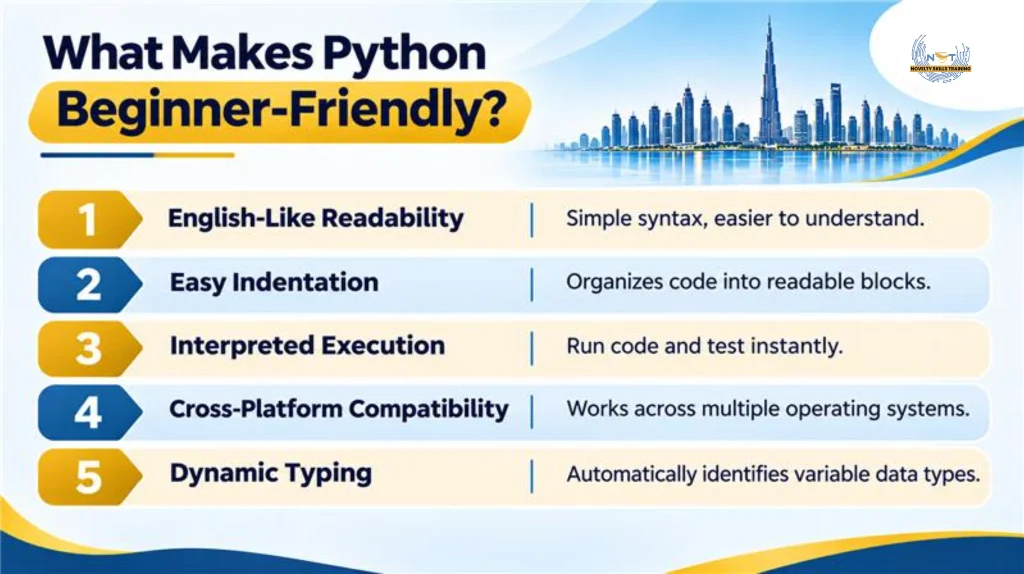
These core technical features set Python apart from other programming options:
- English-Like Readability: Python strips away the intimidating appearance of traditional code. It uses clear, plain English keywords (like if, else, and, and not) that make scripts look like natural sentences. This minimizes the learning effort for beginners, making Python programming for beginners easier to understand and helping them focus on programming logic rather than complex syntax.
- The Power of Indentation: Most languages use curly brackets {} or semicolons to group blocks of code, which can cause minor errors if forgotten. Python uses mandatory whitespace (indentation) to structure code blocks. This encourages developers to write neat, organized code that is easier to read and maintain. Many Python programming examples demonstrate how indentation helps structure instructions clearly.
- Interpreted Execution: Python is an interpreted language, meaning your code is executed by an interpreter. Unlike compiled languages such as C++, Python allows you to run code and check results without manually compiling the entire program first. This provides quicker feedback and makes experimentation easier, particularly when practicing through Python programming online tutorials.
- Cross-Platform Compatibility: Python is designed to work across multiple operating systems. A Python script written on Windows can generally run on macOS or Linux with minimal or no code changes, provided the required dependencies are available. This portability allows developers to build projects that work across different computing environments.
- Dynamic Typing: In many programming languages, developers must explicitly declare the data type a variable will hold before using it. Python determines the data type automatically based on the assigned value. This keeps code concise and flexible, making it easier to experiment while learning. A structured Python programming online course can help beginners understand these concepts through practical exercises.
Python vs. Other Programming Languages
When deciding which language to learn first, beginners often find themselves comparing Python against established giants like JavaScript, Java, and C++. Every language has its unique purpose, but Python consistently stands out for its exceptional efficiency. This unmatched ease of use explains why it captures a staggering 19.23% market share on the TIOBE Index, outstripping older languages and drawing in millions of new coders every year.
| Feature | Python | JavaScript | Java | C++ |
| Primary Use Case | Data Science, AI, Back-End Web | Front-End & Full-Stack Web | Enterprise Apps, Android Apps | Game Engines, Systems Software |
| Learning Curve | Smooth and beginner-friendly | Moderate | Steep | Very Steep |
| Syntax Complexity | Minimal (Uses plain English) | Moderate (Uses curly brackets) | High (Strict and verbose) | Very High (Complex memory rules) |
| Code Length | Short and clean | Moderate | Long | Very Long |
| Execution Type | Interpreted (Line-by-line) | Interpreted (In-browser/Node) | Compiled to bytecode | Compiled to machine code |
How Python is Used: Common Applications
Python’s adaptability means it is rarely confined to just one corner of the tech industry. Instead, it serves as the foundational engine driving some of the most innovative fields in technology today.
- Data Science & Analytics: The modern business world runs da ta, but raw data is messy. Python provides specialized libraries like Pandas and NumPy that allow data analysts to clean up corrupted files, filter through massive datasets, and spot hidden trends. Because of this power, Python is the top choice for data professionals, capturing a dominant 71.8% adoption rate among coding learners on the Stack Overflow Developer Survey.
- Artificial Intelligence & Machine Learning: When developers build smart software that can “think” or predict outcomes, they write it in Python. Industry-standard frameworks like TensorFlow and PyTorch handle the intense mathematical calculations required to train neural networks. This makes Python indispensable for AI development, securing a 39% usage share for building advanced AI models and coding agents.
- Web Development: While you don’t use Python to design buttons on a webpage, it is heavily used to power backend servers the invisible machinery that processes user accounts, handles payments, and talks to databases. Frameworks like Django and Flask make it incredibly fast to build secure, scalable web applications from scratch.
- Automation & Scripting: You don’t have to be a full-time engineer to benefit from Python. It excels at automation, allowing you to write simple scripts that eliminate boring, repetitive tasks. With a few lines of code, Python can automatically rename thousands of files, scrape data off the internet, or organize chaotic Excel spreadsheets in seconds.
Reasons to Learn Python for Beginners
If you are stepping into the coding world for the first time, Python offers distinct advantages that other programming languages simply cannot match:
- Exceptionally Gentle Learning Curve: Python’s simple syntax makes Python programming for beginners easier to understand compared to languages with more complex structures. You don’t have to spend weeks memorizing where to place semicolons or curly brackets. Following a Python programming tutorial for beginners can help you understand basic syntax, programming logic, and fundamental concepts without feeling overwhelmed.
- Massive, Welcoming Global Community: When you start learning to code, you will inevitably encounter errors and challenges. Python’s large global community provides access to discussions, tutorials, and solutions to common programming problems. Resources available through Python program tutorial for beginners can help learners understand coding errors, while online forums and documentation make it easier to find answers and improve programming skills.
- Ultimate Versatility: Choosing your first programming language does not mean limiting your future career options. Learning Python provides a foundation for exploring web development, artificial intelligence, data science, and automation. A beginner Python course or Python programming course for beginners can help you build these foundational skills through practical exercises and Python basic programs, preparing you to explore different areas of technology.
What Kind of Jobs Can You Get with Python?
Because Python is so heavily utilized across tech sectors, learning it opens the door to several highly lucrative, high-demand career paths:
- Python Developer / Software Engineer: Focuses on building backend server-side logic, integrating application features, and constructing the core infrastructure that powers web platforms.
- Data Analyst / Data Scientist: Focuses on extracting corporate data, cleaning cluttered datasets, and using Python libraries to unlock predictive business insights.
- Machine Learning Engineer: Focuses on designing data-driven automation models and feeding algorithms to build modern artificial intelligence.
- DevOps / Automation Engineer: Focuses on writing custom deployment scripts to automate server management, software testing, and network operations.
Entry-Level Job Availability & Salary Potential
The job market remains incredibly welcoming to Python-skilled beginners, especially those who pair the language with SQL or a cloud platform. Recent 2026 hiring data shows that a beginner with a strong project portfolio can break into excellent starting packages.
According to market benchmarks tracked on Indian career portals, an entry-level Python Developer fresher in India typically starts between ₹3 LPA to ₹6 LPA, though exceptions scaling up to ₹8 LPA exist for those with strong framework knowledge. Similarly, an entry-level Data Analyst fresher in India commands a starting range of ₹3.5 LPA to ₹7 LPA, depending heavily on their dashboarding skills and internship history.
How to Get Started with Python: The Beginner Setup
Getting started with Python requires installing the language and choosing a suitable code editor.
Download and Install Python
Visit the official Python website and download the latest stable version for your operating system. Follow the installation instructions and verify the setup before writing your first program.
Choose a Beginner-Friendly Code Editor
Two popular options for Python development are:
- Visual Studio Code (VS Code): A lightweight, flexible code editor with Python extensions, debugging, and code suggestions. Suitable for beginners.
- PyCharm: A dedicated Python IDE with built-in tools for writing, testing, debugging, and managing Python projects.
Interactive Python (REPL) vs. .py Files
Python offers two simple ways to execute code:
- Interactive Python (REPL): Allows you to enter commands and see results immediately, making it useful for testing small code snippets.
- Python Files (.py): Lets you save multiple lines of code in a file and execute them whenever needed, making it suitable for structured python basic programs
and projects.
Conclusion
As Dubai continues to embrace digital transformation across industries, Python programming skills are becoming increasingly relevant in areas such as software development, data analytics, artificial intelligence, and automation. Understanding Python can help aspiring professionals build technical capabilities that align with evolving industry requirements and explore opportunities across technology-driven sectors.
Building these skills requires more than understanding programming concepts; it also involves consistent practice and practical application. Novelty Skills Training helps learners develop their Python programming knowledge through structured training and hands-on learning, providing a foundation to apply coding concepts to real-world tasks and build confidence in programming.
FAQs: Python Programming for Beginners
1. What is Python programming?
Python programming is the process of writing instructions using the Python programming language to develop software, automate tasks, analyze data, and build web and AI applications.
2. Is Python easy to learn for beginners?
Yes. Python has simple syntax, readable code, and a large learning community, making it a suitable programming language for beginners with no prior coding experience.
3. How can I start learning Python programming as a beginner?
Start by installing Python, choosing a code editor such as VS Code or PyCharm, and learning basic concepts like variables, data types, loops, conditions, and functions. Practice with small programs to strengthen your understanding.
4. What are the basic Python programs beginners should learn?
Beginners can start with simple Python programs such as:
- Hello World
- Addition of two numbers
- Even or odd number checker
- Simple calculator
- Multiplication table
- Factorial calculator
5. Where can I find Python programming examples?
You can explore Python programming examples through the official Python documentation, beginner tutorials, coding platforms, and GitHub repositories.
6. Can I learn Python programming online for free?
Yes. You can learn Python programming online through free resources such as Python.org, Google’s Python course, and freeCodeCamp.
7. What is included in a Python tutorial for beginners?
A Python tutorial for beginners generally covers installation, syntax, variables, data types, operators, conditional statements, loops, functions, lists, dictionaries, and basic programming exercises.
8. How long does it take to learn Python programming?
The learning time depends on your practice schedule and previous experience. With consistent daily practice, beginners can understand basic Python concepts within a few weeks and gradually develop practical programming skills over several months.
9. What is the difference between Python and other programming languages?
Python is known for its readable syntax and simple structure. Compared with languages such as Java and C++, it generally requires less code for many common tasks, making it a popular choice for beginners.
10. Do I need mathematics to learn Python programming?
No advanced mathematics is required to start learning Python. Basic arithmetic and logical reasoning are sufficient for beginner-level programming. Advanced mathematical concepts become useful in areas such as data science and machine learning.
11. What should I look for in a Python programming online course?
Choose a course that covers Python fundamentals, hands-on coding exercises, practical projects, debugging, and real-world applications. Beginner-friendly instruction and regular practice opportunities are also important.
12. What career opportunities are available after learning Python?
Python skills can support career paths such as Python developer, software developer, data analyst, data scientist, automation engineer, and machine learning engineer. The required skills vary depending on the role.
13. Is Python programming language certification necessary to get a job?
Certification is not always mandatory for Python-related jobs. However, a recognized Python programming language certification can demonstrate your knowledge, while practical projects and problem-solving skills help strengthen your profile.
14. What is the difference between a Python programming course and beginner Python training?
A Python programming course generally follows a structured curriculum covering concepts and applications. Beginner Python training often focuses on foundational concepts, guided exercises, and hands-on coding practice for people with little or no programming experience.
15. Can I learn Python programming without any coding experience?
Yes. Python is beginner-friendly and does not require previous programming knowledge. Start with basic syntax, practice simple programs, and gradually move towards functions, data structures, and small projects.