
AI Governance skills UAE professionals need include data privacy compliance, AI risk assessment, algorithmic bias detection, cybersecurity, and ethical oversight. These capabilities help organizations manage AI responsibly, meet applicable regulatory requirements, protect sensitive information, maintain human accountability, and govern emerging technologies such as autonomous AI agents across different industries.
With AI adoption accelerating across the UAE, organizations need professionals who can ensure its responsible and secure implementation. According to an AWS and UAE Artificial Intelligence Office report, 72% of UAE businesses have already deployed AI. At the individual level, Microsoft’s Global AI Diffusion Report confirms that 70.1% of the UAE’s working-age population actively uses AI, the highest rate in the world. However, faster adoption also brings governance challenges. A joint study by IDC, Microsoft, and CPX found that 98% of UAE security teams have encountered AI-related security risks, while 43% of CIOs report employees regularly using unapproved AI tools. This highlights the growing importance of AI Governance skills UAE professionals need to identify AI-related risks, protect sensitive information, and establish accountability. These capabilities are relevant across IT, compliance, legal, HR, and management, where understanding responsible AI practices can help address algorithmic bias, prevent data leaks, and maintain appropriate human oversight.
This urgency to build AI governance skills is also reflected in the UAE’s evolving regulatory landscape. Under the UAE National Strategy for Artificial Intelligence 2031, the country aims to strengthen its position as a global AI hub. Organizations must also consider applicable requirements under the UAE Personal Data Protection Law (PDPL), DIFC Regulation 10, and relevant initiatives such as the Dubai AI Seal. As regulatory expectations evolve, organizations in banking, healthcare, aviation, and government increasingly need professionals who can align AI innovation with responsible implementation and regulatory requirements. This also creates opportunities for those looking to explore AI Governance jobs Dubai, particularly in roles involving risk management, data protection, and compliance.
This blog covers AI Governance UAE frameworks, data protection laws, and cybersecurity requirements. It also explores essential AI Governance skills UAE professionals need, ways to develop them through training, and emerging career opportunities in Dubai.
Why are AI Governance Skills UAE Important for Career Aspirants?
As AI becomes part of everyday business processes, professionals need to develop AI Governance skills UAE organizations require to manage its use responsibly. From assessing AI-related risks and protecting confidential information to reviewing automated decisions, these capabilities help maintain accountability, transparency, and trust in AI-driven operations.
Here are five reasons why these skills are becoming increasingly important:
- Managing Shadow AI and Security Risks
Organizations need professionals with AI compliance skills to monitor unapproved AI usage and protect confidential information. As employees increasingly experiment with generative AI tools, businesses need people who can establish clear usage policies, monitor data flows, identify security vulnerabilities, and prevent sensitive information from being exposed through unauthorized platforms.
- Understanding UAE Compliance Requirements
Professionals need AI Governance UAE knowledge to understand data protection, impact assessments, and human oversight. The UAE Personal Data Protection Law (Federal Decree-Law No. 45 of 2021) and DIFC Regulation 10 establish relevant responsibilities for organizations handling personal data and autonomous AI systems.
- Accessing Government and Enterprise Opportunities
Knowledge of responsible AI practices and regulatory compliance can help professionals contribute to AI documentation, risk assessments, and verification processes. Developing Responsible AI skills can also prepare them for emerging AI Governance jobs Dubai, particularly in government and enterprise projects. In October 2025, the Dubai Department of Finance called on government entities to engage AI service providers holding the Dubai AI Seal.
- Addressing the AI Governance Talent Gap
The PwC 2026 AI Jobs Barometer (UAE Analysis) identifies the UAE as one of the world’s fastest-growing AI talent markets and notes that AI-exposed roles require an average of 77 new skills. Deloitte Middle East’s AI Readiness research also identifies workforce skills and governance execution as key barriers to AI adoption.
- Preparing for Autonomous Agentic AI
As organizations adopt autonomous AI agents, professionals need skills in permission management, continuous monitoring, and accountability. CPX and IDC research shows that 52% of UAE enterprises have AI agents deployed or in active development, but only 10% consider themselves fully prepared to govern and secure them.
Building these capabilities can help career aspirants prepare for emerging AI Governance jobs Dubai, particularly in AI risk management, data governance, regulatory compliance, and responsible AI implementation.
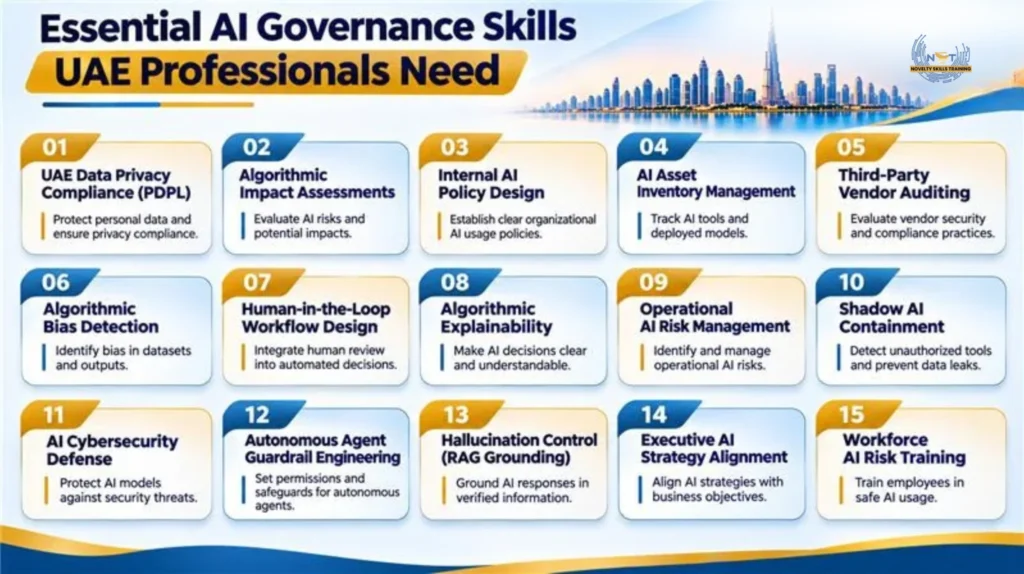
Essential AI Governance Skills UAE Professionals Need
AI governance requires a combination of regulatory knowledge, ethical decision-making, technical expertise, and leadership capabilities. Developing Responsible AI skills and AI compliance skills helps UAE professionals manage risks, protect data, ensure accountability, and support the responsible adoption of AI across industries.
- UAE Data Privacy Compliance (PDPL): Professionals must know how to align AI models with the UAE Personal Data Protection Law (Federal Decree-Law No. 45 of 2021) to protect personal data and user rights. Under DIFC Regulation 10, organizations deploying autonomous systems must verify lawful consent and maintain strict data privacy controls.
- Algorithmic Impact Assessments: Specialists need the ability to formally evaluate high-risk AI systems before deployment to document legal accountability and operational safety. Both the UAE PDPL and DIFC Regulation 10 mandate structured impact assessments whenever automated tools process sensitive data or make consequential decisions.
- Internal AI Policy Design: Organizations need leaders who can draft clear corporate rulebooks governing how employees and departments use artificial intelligence. The UAE Charter for the Development and Use of Artificial Intelligence makes formal governance and accountability core national priorities, while the Central Bank of the UAE (CBUAE) requires financial institutions to maintain documented governance frameworks.
- AI Asset Inventory Management: Teams must track and catalog every internal and third-party AI tool operating across a company to eliminate blind spots. Regulatory guidance highlighted in AlignE’s UAE AI Charter analysis emphasizes maintaining live inventories of deployed models so boards can monitor operational risk.
- Third-Party Vendor Auditing: Companies bidding on government contracts need specialists who can vet external AI suppliers and verify their compliance claims. Following the Dubai Department of Finance directive requiring public entities to contract exclusively with certified suppliers, businesses are rushing to build auditing skills for the Dubai AI Seal.
- Algorithmic Bias Detection: Specialists must know how to test training datasets and model outputs to prevent discrimination based on nationality, gender, or background. The UAE Charter for the Development and Use of Artificial Intelligence explicitly prioritizes mitigating algorithmic bias to ensure fair access across society.
- Human-in-the-Loop Workflow Design: Operational managers must design business processes where human judgment can review and override automated decisions in high-stakes scenarios. The UAE AI Charter designates human oversight as an essential safeguard to correct errors and align outputs with local values.
- Algorithmic Explainability: Professionals must be able to translate complex AI outputs into plain, auditable explanations for regulators, boards, and customers. According to the UAE Ministry of Justice AI Portal, transparency in how automated systems reach conclusions is foundational to maintaining public trust.
- Operational AI Risk Management: Bridging the gap between high-level ethical principles and day-to-day risk controls is one of the region’s most urgent needs. Deloitte Middle East’s AI Readiness research identifies operationalizing ethics and risk governance as primary bottlenecks preventing regional enterprises from scaling AI.
- Shadow AI Containment: Security and IT teams must detect unapproved generative AI tools on corporate networks to stop employees from leaking confidential data into public models. The IDC, Microsoft, and CPX study on Securing AI in the UAE Enterprise reveals that 43% of UAE CIOs struggle with employees regularly using unapproved AI tools.
- AI Cybersecurity Defense: Technical specialists must protect production AI models against threats such as prompt-injection attacks, data poisoning, and model theft. They need to understand AI-specific security vulnerabilities, implement appropriate safeguards, and continuously monitor models to prevent attacks and protect sensitive information.
- Autonomous Agent Guardrail Engineering: As companies deploy autonomous AI agents to handle financial and administrative tasks, specialists must establish permission boundaries, define approval of workflows, and implement emergency shutdown mechanisms. These safeguards help prevent unauthorized actions, maintain human oversight, and ensure AI agents operate within defined business and security limits.
- Hallucination Control (RAG Grounding). Technical governance teams must ground large language models in verified internal databases, so systems do not fabricate policy or legal answers. Research highlighted by Mohamed bin Zayed University of Artificial Intelligence (MBZUAI) identifies secure Retrieval-Augmented Generation (RAG) architectures as a core competency for reliable enterprise AI.
- Executive AI Strategy Alignment: Senior leaders and newly appointed federal Chief AI Officers must align corporate AI adoption with national regulations and organizational risk appetite. The UAE Government’s official AI policy portal (u.ae) mandates that Chief AI Officers establish governance frameworks and promote best practices across entities.
How Can You Develop Skills Through AI Governance Training in the UAE?
Developing AI Governance skills UAE employers value requires structured learning, knowledge of local regulations, and practical experience. Professionals can start with the following steps:
- Step 1: Master the Core Fundamentals of AI Risk and Ethics: Before diving into local laws, understand how AI systems fail in production. Study the core pillars of Responsible AI—including algorithmic bias, data privacy, model transparency, and human-in-the-loop oversight—by reviewing the ISO/IEC 42001 AI Management System Standard and the free NIST AI Risk Management Framework (AI RMF 1.0).
- Step 2: Study UAE-Specific Regulations and National Charters: Global knowledge alone will not get you hired in Dubai or Abu Dhabi. Read the official text of the UAE Charter for the Development and Use of Artificial Intelligence, review automated decision rules under the UAE Personal Data Protection Law (Federal Decree-Law No. 45 of 2021), study DIFC Regulation 10 for autonomous systems, and examine the supplier verification tiers on the Dubai AI Seal Official Portal.
- Step 3: Enroll in Structured, Hands-On Training and Certification: Self-study only goes so far when employers want proof of competence. Join an instructor-led training program—such as the specialized AIML Training course at Novelty Skills Training Dubai, that bridges global standards with local UAE compliance. Pair practical training with recognized credentials like the IAPP Artificial Intelligence Governance Professional (AIGP) or ISO/IEC 42001 Lead Implementer.
- Step 4: Build a Practical Portfolio of Governance Artifacts: Employers hire people who can produce real documentation, not just pass multiple-choice exams. Use templates from the NIST AI RMF Playbook to practice drafting sample deliverables on your own, such as a mock Corporate Generative AI Usage Policy, an AI Tool Risk Register, or an Algorithmic Impact Assessment aligned with DIFC Regulation 10.
- Step 5: Engage with the UAE AI Community and Apply Your Skills Internally: Turn your training into visibility by attending local symposiums—such as Dubai Centre for Artificial Intelligence (DCAI) workshops—and participating in free foundational programs like Dubai’s One Million AI Prompters. At your current job, volunteer to help catalog existing AI tools or draft safe-usage guidelines for your team so you can add real governance experience to your CV.
What Career Opportunities are Available in AI Governance UAE?
As organizations across the UAE strengthen AI adoption and regulatory compliance, AI Governance jobs Dubai are emerging across financial services, healthcare, government, telecom, and consulting. Professionals with Responsible AI skills and expertise in risk management, data privacy, and regulatory frameworks can explore opportunities in this evolving field.
| Job Role | Key Responsibilities |
| AI Data Governance Manager | Manages data privacy, enterprise policies, and AI risk controls. |
| Responsible AI Consultant | Designs ethical frameworks, impact assessments, and compliance audits. |
| AI Technical Governance Lead | Oversees secure system architecture, MLOps, and LLM guardrails. |
| Chief AI Officer (CAIO) | Directs enterprise AI strategy, ethics, and regulatory alignment. |
| AI Program Manager | Manages risk-review processes and internal AI acceptable-use policies. |
Conclusion
Taking the first step towards a career in AI governance starts with investing in the right learning opportunities. Build your knowledge, strengthen your professional capabilities, and prepare to adapt to the evolving demands of AI-driven workplaces.
Novelty Skills Training offers learning opportunities designed to help professionals upskill, develop relevant AI capabilities, and prepare for emerging career opportunities. Take the next step in your professional journey with structured training that supports your transition into the evolving field of AI governance.
Frequently Asked Questions
Does the UAE have a standalone AI law?
No. AI Governance UAE requirements currently involve data protection laws, cybersecurity policies, national AI frameworks, and sector-specific regulations.
What is the Dubai AI Seal?
The Dubai AI Seal verifies AI service providers’ capabilities and governance practices for organizations seeking Dubai government engagements.
What is Shadow AI in the workplace?
Shadow AI refers to unauthorized AI tool usage by employees, potentially exposing confidential information and creating organizational security risks.
How does AI governance apply to Agentic AI?
AI Governance skills UAE professionals develop help establish permission boundaries, monitoring procedures, and accountability for autonomous AI agents.
What is an AI impact assessment?
An AI impact assessment evaluates potential privacy, operational, and ethical risks before an organization deploys an AI system.
How is AI governance different from AI compliance?
AI governance establishes organizational oversight, while AI compliance skills help professionals meet applicable legal, regulatory, and industry requirements.
Can non-technical professionals pursue AI governance careers?
Yes. Professionals in law, finance, HR, and compliance can develop Responsible AI skills through relevant learning opportunities.
How can small businesses establish AI governance practices?
Small businesses can introduce internal AI policies, assess third-party tools, and explore AI Governance training to improve oversight.
What is sovereign data governance in the UAE?
It concerns how sensitive information is classified, stored, accessed, and shared within applicable local data environments.
How can professionals prepare for AI Governance jobs Dubai?
Relevant industry knowledge, practical experience, and AI Governance training can help professionals prepare for emerging opportunities in Dubai.
What should professionals look for in AI Governance training?
Look for practical learning, regulatory awareness, case studies, and opportunities to develop Responsible AI skills and compliance knowledge.