
Agentic AI UAE is creating demand for professionals with skills in AI fundamentals, prompt engineering, agent development, Python, APIs, and workflow automation. As these systems move into real-world applications, professionals also need expertise in data and knowledge retrieval, security, governance, orchestration, AgentOps, and business problem-solving.
Agentic AI is changing how organizations approach automation, decision-making, and digital transformation, creating growing demand for professionals who can design, integrate, and manage AI-driven workflows. The UAE AI agents market generated USD 97.2 million in revenue in 2025 and is projected to reach USD 2.72 billion by 2033, growing at a 52.7% CAGR from 2026 to 2033. This rapid market expansion signals a shift from AI experimentation toward practical, enterprise-level applications across the UAE.
This evolution is also changing the expectations placed on professionals, with AI-related roles increasingly requiring a combination of technical depth, analytical thinking, and operational awareness. Rather than focusing on individual AI tools, professionals need to understand how different capabilities work together to support reliable, scalable, and responsible outcomes. This article examines the changing professional landscape around Agentic AI in the UAE and provides practical guidance for professionals looking to understand its relevance, applications, and career opportunities.
When unveiling the framework to transition half of all federal operations to autonomous models, His Highness Sheikh Mohammed bin Rashid Al Maktoum characterized Agentic AI as the government’s official ‘executive partner’, marking a definitive shift into a ‘Government 4.0’ era where AI independently runs workflows rather than just answering basic inputs.
What Is Agentic AI and Why Does It Matter in the UAE?
Agentic AI UAE refers to AI systems that can understand a goal, plan the required steps, use authorized tools, take actions and adapt based on results. Unlike generative AI, which primarily creates content or responses, agentic AI can manage multiple steps to complete a task or workflow.
For example, instead of simply drafting a customer-service response, an AI agent can understand the request, retrieve relevant information, check policies, take an authorized action and escalate the case when required.
Why Does Agentic AI Matter in the UAE?
- Driving AI adoption: The UAE is moving toward practical Agentic AI implementation across government and business operations.
- Transforming government services: The UAE aims to deploy Agentic AI across 50% of government sectors, services and operations within two years.
- Building future-ready talent: A national programme aims to develop Agentic AI capabilities among 80,000 federal employees.
- Accelerating business adoption: Dubai launched a two-year private-sector initiative supporting Agentic AI through training, incubation and business opportunities.
- Moving toward real-world use: UAE initiatives are already exploring AI agents for areas such as procurement, tax auditing, customer service and technical support.
In short, Agentic AI matters in the UAE because the country is moving from simply using AI to deploying AI systems that can actively support, automate and execute real-world workflows.
8 Essential Agentic AI Skills Professionals Need in UAE
As Agentic AI moves into real-world business applications, professionals need more than basic AI tool knowledge. They need a combination of technical, analytical, automation, security and business skills to design and work with AI-driven workflows.
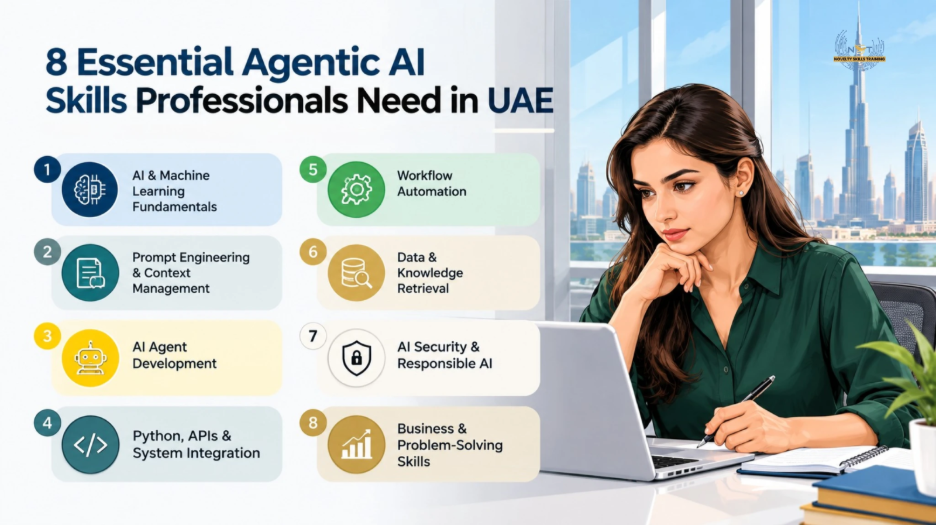
1. AI & Machine Learning Fundamentals
A practical understanding of AI helps professionals understand how intelligent systems work, what they can do, and where their limitations lie.
Professionals should understand:
- Machine learning & deep learning
- NLP & large language models
- Generative AI
- Model training & inference
- AI limitations & hallucinations
For anyone entering the field, this is the starting point. Building these fundamentals helps professionals understand how AI systems learn, process information, and generate outputs, while recognizing their limitations and the role of human judgment. This foundation prepares professionals to understand and work with more advanced AI technologies, including AI agents and autonomous workflows.
2. Prompt Engineering & Context Management
AI agents rely on clear instructions, relevant context, and defined goals to perform tasks effectively.
Professionals should understand:
| Skill Area | Key Focus |
| Structured Prompting | Define tasks, roles, and expected outcomes |
| Objectives & Constraints | Set goals, boundaries, and priorities |
| Context Management | Provide and maintain relevant context |
| Output Formats | Define the required response structure |
| Multi-step Instructions | Break complex tasks into logical steps |
| Prompt Refinement | Test, evaluate, and improve prompts |
Developing prompt engineering and context management skills helps professionals give AI systems clearer direction, improve output quality, and build more reliable workflows.
3. AI Agent Development
Professionals working with AI agents should understand how agents plan tasks, use tools, make decisions, and execute actions.
Professionals should understand:
- Agent architecture
- Planning & reasoning
- Tool & function calling
- Memory
- Multi-agent workflows
- Human-in-the-loop processes
Developing these skills helps professionals understand how AI agents are built from defining objectives and designing the agent to enabling reasoning, connecting tools, managing memory, testing performance, and adding human oversight.
This foundation helps technical professionals build and improve AI agents, while enabling business professionals to identify relevant use cases and understand how agents can support operational workflows.
4. Python, APIs & System Integration
AI agents become more useful when they can interact with applications, databases, APIs, and other business systems. Understanding these connections helps professionals move beyond standalone AI tools and work with AI solutions within existing technology environments.
Technical foundations include:
Python fundamentals • REST APIs & JSON • Authentication • Database connections • AI model APIs • System integration
These skills help professionals connect AI agents with data, applications, and external tools to complete real-world tasks.
5. Workflow Automation
Agentic AI is increasingly being explored for business processes that involve task coordination, automation, and decision-making. This is also reflected in Dubai’s current business initiatives: Dubai Chambers launched specialised Agentic AI training tracks for more than 14,000 member companies to help businesses integrate Agentic AI into their operations. Dubai Chambers
From process to execution:
Workflow analysis → Process automation → Task orchestration → AI-enabled decision-making → Human oversight
Understanding this progression helps professionals identify where AI agents can support processes, reduce manual effort, and improve execution.
6. Data & Knowledge Retrieval
AI agents need access to relevant and reliable information to complete tasks effectively. Knowledge retrieval enables AI systems to access information from controlled sources rather than relying only on their existing knowledge.
The knowledge layer includes:
Structured & unstructured data
• Databases
• Embeddings
• Vector databases
• RAG
• Knowledge bases
• Data quality
These capabilities help professionals connect AI systems with internal documents, databases, policies, product information, and other trusted sources.
7. AI Security & Responsible AI
As AI systems gain access to data, applications, and business processes, professionals need to understand the security, privacy, and governance risks involved. The UAE National Strategy for Artificial Intelligence 2031 highlights the importance of AI governance, ethics, data management, and cybersecurity.
Professionals should understand:
- Data privacy & protection
- AI safety & security
- Access controls
- Transparency & explainability
- Accountability & governance
- Human oversight
- Monitoring & validation
Building these skills helps professionals recognize AI risks, protect sensitive data, apply appropriate safeguards, and support the responsible deployment of AI systems.
8. Business & Problem-Solving Skills
Technical AI skills alone are not enough. As AI adoption grows across the UAE, professionals also need to understand business needs, processes, and outcomes.
Professionals should understand:
- Business process analysis
- AI use-case identification
- Requirements gathering
- Bottleneck analysis
- Outcome & ROI evaluation
- Risk assessment
- Human intervention
These skills help professionals identify practical AI opportunities, evaluate their business value, and apply AI to real problems while keeping human judgment in the loop.
How Businesses in the UAE Are Using Agentic AI
Agentic AI for businesses is moving beyond standalone AI tools toward connected workflows that can automate tasks, support decisions and coordinate actions. In the UAE, businesses can apply AI agents across functions such as customer service, marketing, finance, healthcare, IT and business operations.
- Customer Service
AI agents UAE can classify requests, retrieve relevant information, prepare responses, perform authorized actions and escalate complex cases.
UAE example: The UAE Government’s Customer Happiness AI Agent gives service agents rapid access to relevant information to support faster and more efficient responses.
- Marketing
AI systems can support research, content preparation, customer segmentation, campaign workflows and performance analysis, helping marketing teams automate repetitive activities and work with information more efficiently.
- Finance
AI agents can assist with document processing, information retrieval, verification, reconciliation and reporting, subject to appropriate controls.
UAE example: The UAE Government’s Tax Auditing AI Agent is designed to support data verification and tax-review processes, including improving audit turnaround times and outcomes.
- Healthcare
AI systems can support administrative workflows, documentation, information retrieval and coordination, while appropriate professional oversight remains important.
- IT Operations
AI agents can assist with issue classification, troubleshooting, knowledge retrieval and escalation, helping technical teams resolve issues more efficiently.
UAE example: The UAE Government’s Technical Support AI Agent assists technical teams in resolving system challenges and supporting the continuity of digital government services.
- Business Operations
AI agents can coordinate information across systems and automate defined multi-step processes, helping organizations improve efficiency, productivity, and decision-making.
UAE example: Dubai Chambers has launched specialized Agentic AI training tracks for 14,000 companies from its Business Groups and Business Councils to help businesses integrate Agentic AI into their operations.
- Energy & Industrial Operations
Agentic AI is also being applied to complex industrial workflows.
UAE example: ADNOC’s ENERGYai uses AI agents across its energy value chain for tasks including seismic analysis, geological modelling and real-time process monitoring. ADNOC says the system is designed to integrate with existing workflows and improve operational efficiency.
1. Learn the fundamentals
Build a foundation in AI, generative AI, LLMs, and how AI applications work.
2. Build simple AI applications
Move from theory to practice by creating applications that use models, instructions, external data, and tools.
3. Build your first agents
Use an agent framework to build systems that can combine models, tools, instructions, and workflows.
4. Connect and orchestrate
Extend agents by connecting them with external tools, knowledge sources, handoffs, and multi-step workflows.
5. Test and evaluate
Test agents against different scenarios, identify failures, and evaluate whether they perform their intended tasks reliably.
6. Add security and controls
Introduce permissions, validation, guardrails, and human review before agents perform consequential actions.
7. Optimize and deploy
Improve reliability, performance, latency, and cost before deploying agents in practical environments.
8. Build a project portfolio
Apply the learning to practical projects such as research assistants, document-processing agents, customer-support systems, or workflow automation. Document the problem, approach, tools, evaluation, safeguards, and results.
Agentic AI Career Opportunities in Dubai
As Dubai expands AI adoption across business operations, demand can span AI engineering, AI automation UAE data, architecture, cybersecurity and business transformation. The roles below represent relevant career paths for professionals developing Agentic AI capabilities.
| Career Opportunity | What Professionals Can Work On | Indicative Dubai Salary |
| AI/ML Engineer | Build and deploy AI models and intelligent applications. | AED 7K–19K/month |
| AI Agent Developer/ AI Agent | Develop AI agents that plan tasks, use tools and execute workflows. | Varies by experience |
| AI Automation Specialist | Design and automate multi-step business workflows using AI agents. | AED 6K–10K/month |
| AI Solutions Architect | Design agentic AI architectures connecting models, tools, APIs and enterprise systems. | AED 20K–37K/month |
| AI Data & Knowledge Engineer/ Data Ebgineer | Build RAG systems, knowledge bases and data infrastructure for AI applications. | AED 15K–30K/month |
| AI Product Manager | Identify AI use cases and manage the development of AI-powered products. | AED 30K–36K/month |
| AI Security & Governance Specialist | Work on AI security, privacy, permissions, monitoring and responsible AI. | Varies by experience |
| AI Business Analyst | Identify business processes where AI can improve efficiency and decision-making. | AED 9K–19K/month |
Conclusion
Agentic AI UAE is moving from experimentation to real-world adoption across the UAE, transforming how organizations automate workflows, support decision-making, and deliver services. As Agentic AI dubai adoption continues to expand, professionals will need a combination of AI knowledge, technical expertise, business understanding and practical problem-solving skills.
For professionals looking to build these capabilities, Novelty Skills Training provides a practical pathway to develop relevant AI skills and apply them to real-world business scenarios. The focus should be on moving beyond individual tools to designing, integrating and applying AI solutions that address genuine business needs.
Frequently Asked Questions
1. What is Agentic AI UAE?
Agentic AI UAE refers to AI systems that can understand goals, plan tasks, use tools, take actions and adapt to results.
2. What skills are needed for Agentic AI Dubai careers?
Key skills include AI, prompt engineering, agent development, Python, APIs, automation, knowledge retrieval, security and business problem-solving.
3. How can Agentic AI for businesses improve operations?
It can automate workflows, support decisions, retrieve information and coordinate actions across business systems.
4. What is Autonomous AI UAE?
Autonomous AI UAE refers to AI systems capable of performing defined tasks with greater independence based on goals, tools and permissions.
5. What are AI agents UAE businesses can use?
AI agents UAE applications include customer service, finance, technical support, tax auditing and industrial operations.
6. How is AI automation UAE changing workplaces?
AI automation UAE helps automate repetitive processes, coordinate workflows and support business decision-making.
7. What career opportunities are emerging with Agentic AI in Dubai?
Opportunities include AI/ML Engineer, AI Agent Developer, AI Automation Specialist, Solutions Architect, AI Product Manager and AI Business Analyst