In the modern enterprise landscape, organizations are moving beyond using AI as a basic tool for minor productivity gains to leveraging it as a strategic growth engine. In Dubai, the city has implemented regional frameworks like the Dubai Universal Blueprint for Artificial Intelligence under the D33 Agenda, which aims to add AED 100 billion annually to the economy. Progressive organizations are deploying autonomous, agentic AI ecosystems to redesign operations, maximize revenue, and capture market share.
This rapid evolution has positioned AI as a powerful catalyst for business growth. Organizations are leveraging AI to automate repetitive processes, enhance customer experiences, optimize operations, and uncover new revenue opportunities. According to the latest McKinsey Global Survey on AI, 88% of organizations have already integrated AI into at least one business function, highlighting the growing role of AI in enterprise strategies.
This blog, AI for Business Growth, explores how organizations can strategically use artificial intelligence to create sustainable competitive advantages.
Recent advancements demonstrate the speed and scale of artificial intelligence for busieness adoption. The Stanford HAI AI Index Report highlights how generative AI reached 53% population adoption within three years, surpassing the early adoption pace of technologies like personal computers and the internet.
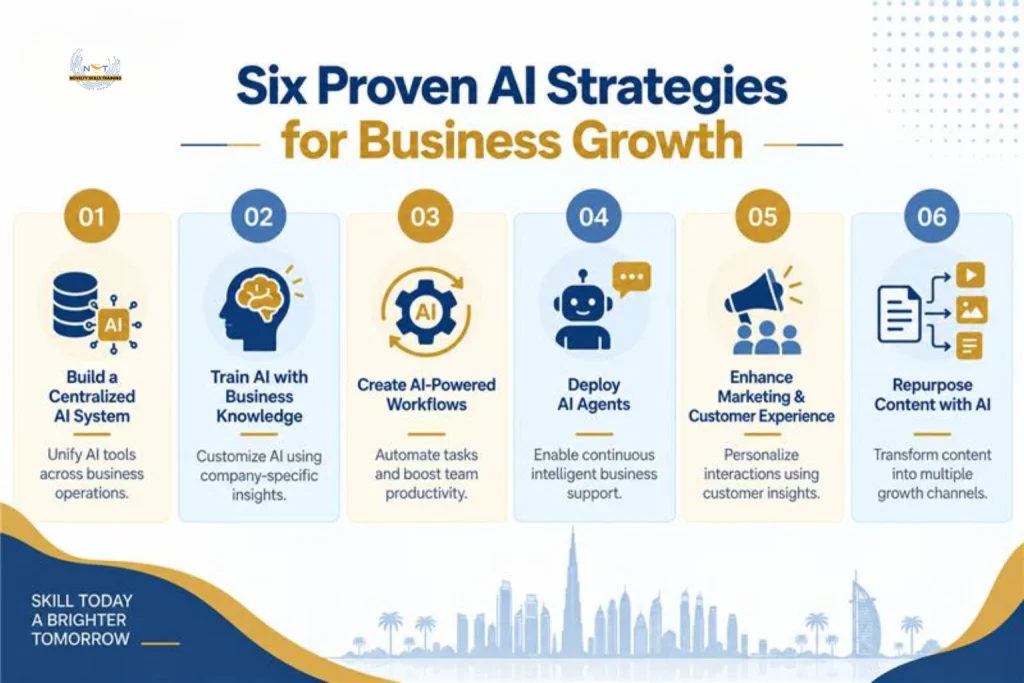
Six Proven AI Strategies for Business Growth
To unlock the true potential of AI for business, leaders need to move beyond small-scale experiments and integrate intelligent solutions into everyday operations. The right AI strategies can help organizations improve efficiency, make smarter decisions, and create sustainable growth opportunities.
According to the PwC AI Business Predictions, 40% of business leaders expect AI to significantly improve productivity, highlighting the growing role of AI in business transformation.
Here are six practical AI for business strategies that one can adopt to improve efficiency and accelerate growth:
1. Build a Centralized AI System for Business Operations
Instead of using separate AI tools across different teams, businesses should create a centralized AI environment where employees can securely access AI solutions based on their needs. This approach improves collaboration, protects business data, and ensures AI is used consistently across departments.
According to the IBM Global AI Adoption Index, 42% of organizations have already deployed AI solutions, showing that businesses are increasingly adopting structured AI systems rather than isolated experiments.
2. Train AI with Business-Specific Knowledge
Generic AI tools may provide general answers, but businesses can achieve better results by connecting AI systems with their own data, processes, brand guidelines, and customer insights. This helps AI generate more accurate outputs that match business goals and maintain consistency across marketing, sales, and customer service activities.
Research from McKinsey’s State of AI Report shows that organizations using AI strategically are more likely to achieve measurable business value through customized AI applications.
3. Create Automated AI-Powered Workflows
Businesses can improve productivity by converting repetitive tasks into automated workflows. AI for business can support activities such as report generation, data analysis, customer communication, content creation, and operational monitoring. These automated systems reduce manual workload and allow employees to focus on higher-value activities.
AI usage has nearly doubled in the past six months, reaching 75% of knowledge workers, according to Microsoft’s annual Work Trend Index. The study is based on a survey of 31,000 people in 31 countries, in addition to Microsoft 365 usage, LinkedIn data, and research conducted with big companies.
4. Use AI Agents for Continuous Business Support
AI-powered agents can monitor information, analyze data, and complete specific tasks with minimal human involvement. Businesses can use AI agents for customer support, sales analysis, cybersecurity monitoring, and operational reporting. These systems help companies respond faster and maintain continuous business operations.
The PwC AI Agent Survey found that 66% of organizations using AI agents reported improved productivity, while 57% reported cost savings, showing the operational benefits of AI automation.
5. Apply AI for Smarter Marketing and Customer Engagement
AI helps businesses understand customer behavior and create personalized experiences. By analyzing customer preferences, purchase history, and online interactions, AI can support targeted marketing campaigns, personalized recommendations, and improved customer journeys.
According to Salesforce’s State of the Connected Customer Report, 73% of customers expect companies to understand their unique needs and expectations, increasing the importance of AI-driven personalization.
6. Transform Existing Content into Multiple Growth Channels
Businesses can use AI tools to repurpose existing content such as webinars, interviews, blogs, and videos into multiple formats for different platforms. AI can identify important sections, create summaries, generate social media content, and optimize content distribution to reach larger audiences.
AI-powered content strategies help businesses improve marketing efficiency while reducing the time required for content production.
By adopting these artificial intelligence for business strategies, leaders can improve operational efficiency, increase employee productivity, deliver better customer experiences, and create new opportunities for growth. AI is becoming a core business capability that helps organizations remain competitive in an increasingly digital marketplace.
Benefits of AI for Business
Embedding centralized machine learning directly into core enterprise architecture shifts operations from reactive to predictive. By converting raw data into a live strategic resource, companies systematically eliminate operational friction, outpace competitors, and unlock highly scalable new revenue streams.
According to the McKinsey Global Survey on AI, 80% of business professionals report that AI has improved their individual productivity, while 50% say AI helps them make better decisions.
- Improves Operational Efficiency and Reduces Costs:
AI automates repetitive and time-consuming tasks such as data processing, reporting, customer queries, and workflow management. This reduces manual effort, minimizes errors, and allows businesses to optimize resources. By improving process efficiency, companies can lower operational expenses and allocate their workforce toward more strategic activities.
According to the PwC AI Agent Survey, 57% of organizations using AI agents reported cost savings, demonstrating the financial impact of AI-driven automation.
- Enables Personalized Customer Experiences:
AI helps businesses understand customer preferences, behaviors, and buying patterns by analyzing real-time data. Companies can use these insights to deliver personalized recommendations, targeted marketing campaigns, and customized services. AI-driven personalization improves customer engagement, increases satisfaction, and supports long-term customer retention.
- Supports Faster and Smarter Decision-Making:
AI-powered analytics transform complex business data into actionable insights. Organizations can use predictive analytics to forecast demand, identify market trends, optimize pricing strategies, and make informed decisions. This allows businesses to reduce uncertainty, improve planning, and respond quickly to market changes.
- Strengthens Customer Support and Business Continuity:
AI chatbots, virtual assistants, and automated support systems enable businesses to provide faster customer service and maintain 24/7 availability. These solutions help manage customer interactions at scale while reducing response times and improving overall service quality.
- Drives Innovation and New Revenue Opportunities:
AI enables businesses to develop new products, improve existing services, and identify untapped market opportunities. By analyzing customer needs and industry trends, organizations can create innovative solutions that support business expansion and long-term growth.
The McKinsey State of AI Report highlights that 37% of organizations attribute measurable EBIT impact to AI adoption, showing the growing financial influence of AI in business strategies.
- Improves Data Management and Security:
AI helps organizations manage large volumes of business data by identifying patterns, detecting risks, and improving data accuracy. Enterprise AI platforms enable companies to build secure, scalable systems for managing information and automating complex workflows.
Conclusion
AI has become a powerful tool for businesses looking to improve efficiency, reduce costs, enhance customer experiences, and make smarter decisions. By integrating AI into their operations, organizations can automate processes, unlock valuable insights, and create new opportunities for innovation and growth. Businesses that strategically adopt AI will be better positioned to remain competitive and achieve sustainable growth in the digital economy.
FAQs
1. How can AI help businesses improve growth and efficiency?
Answer: AI helps businesses improve efficiency through automation, smarter decisions, enhanced productivity, and scalable solutions that drive sustainable growth.
2. What are the benefits of AI for business operations?
Answer: AI benefits businesses by reducing costs, improving workflows, increasing productivity, and enabling faster, data-driven decision-making.
3. How can businesses create an effective AI strategy?
Answer: Businesses can build an AI strategy by identifying goals, evaluating data, selecting solutions, and measuring performance outcomes.
4. What are some examples of AI business solutions used by companies today?
Answer: AI business solutions include chatbots, predictive analytics, automation tools, recommendation systems, and intelligent customer service platforms.
5. How does AI enable business automation and process optimization?
Answer: AI enables business automation by streamlining repetitive tasks, reducing errors, and optimizing workflows across multiple operational areas.
6. How does predictive analytics help businesses make better decisions?
Answer: Predictive analytics helps businesses forecast trends, understand patterns, manage risks, and make informed strategic decisions.
7. Can AI improve customer experience for businesses?
Answer: AI improves customer experience through personalization, faster support, intelligent recommendations, and deeper insights into customer behavior.
8. What challenges should businesses consider before implementing AI solutions?
Answer: Businesses should consider data quality, security, integration challenges, workforce readiness, and ethical practices before implementing AI solutions.