AI in Healthcare Leadership in the UAE is entering a decisive phase of transformation where artificial intelligence is no longer an experimental layer but a core driver of clinical, operational, and strategic decision-making. From smart hospitals to predictive health systems, AI is reshaping how healthcare institution’s function, how leaders make decisions, and how patient outcomes are optimized at scale.
In this rapidly evolving ecosystem, leadership is shifting from traditional administration to intelligence-led governance, where data, algorithms, and real-time insights influence every critical healthcare decision. Supported by national initiatives such as the UAE Strategy for Artificial Intelligence 2031 and strong regulatory frameworks from DHA, MOHAP, and DoH, the UAE is positioning itself as a global benchmark for AI-driven healthcare transformation.
This blog explores how artificial intelligence is redefining healthcare leadership across key impact areas, emerging applications, governance challenges, and the evolving skill sets required to lead in an AI-powered healthcare environment.
For professionals aiming to build future-ready capabilities in this domain, explore our AI & ML Healthcare Training Program at Novelty Skill Training, Dubai and take the next step toward becoming an AI-enabled healthcare leader.
AI Healthcare Leadership in the UAE – Shifting from Traditional Approaches
Healthcare leadership in the UAE is undergoing a structured shift driven by artificial intelligence, where traditional models of decision-making, operations, and governance are being redefined.
The following five key transformations highlight how AI is reshaping healthcare across clinical, operational, and strategic levels in the UAE.
1. Shift from Administrative Leadership to AI-Driven Decision Leadership
Healthcare leadership in the UAE is moving away from static reporting structures toward real-time executive intelligence systems. Hospital performance data analytics that was earlier reviewed periodically is now continuously visualized through AI-enabled dashboards aligned with national health authorities such as DHA, MOHAP, and DoH. This shift enables leaders to act instantly on operational and clinical signals rather than relying on delayed reports or retrospective analysis.
2. Shift from Clinical Intuition to AI-Augmented Medical Decision-Making
Clinical leadership in UAE hospitals is increasingly supported by AI systems that combine electronic health records, imaging data, and laboratory insights into unified decision frameworks. This reduces dependence on isolated interpretation and enables more standardized, evidence-based clinical pathways across specialties such as radiology and oncology. Institutions like Cleveland Clinic Abu Dhabi are integrating such systems to improve diagnostic consistency and speed.
3. Shift from Fragmented Systems to Integrated Smart Healthcare Ecosystems
Healthcare delivery in the UAE is increasingly shifting from siloed departmental systems to fully integrated smart hospital ecosystems. AI platforms unify patient records, imaging systems, and clinical workflows into a single intelligence layer, enabling seamless coordination across departments. This integration improves operational efficiency and supports real-time collaboration between clinical and administrative units.
4. Shift from Periodic Oversight to Continuous AI Governance
Regulatory oversight in UAE healthcare is evolving from periodic manual audits to continuous AI-enabled compliance monitoring. Systems aligned with DHA, MOHAP, and DoH frameworks now track clinical and operational activity in real time, detecting deviations and ensuring adherence to healthcare standards. This strengthens transparency, accountability, and ethical governance across digital healthcare environments.
In Dubai, this transformation is already visible at scale, with the Dubai Health Authority integrating over 9.53 million patient medical records through the unified “Nabidh” system, connecting more than 1,500 healthcare facilities, and enabling real-time data visibility across the ecosystem. This scale of integration reflects how governance in UAE healthcare is becoming deeply data-driven and continuously monitored.
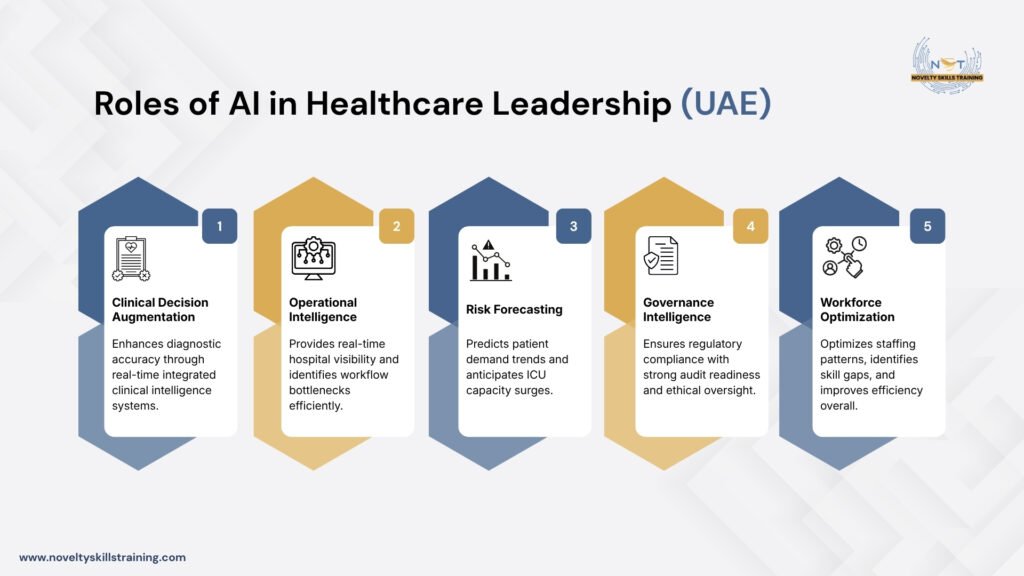
Role of AI in Healthcare Leadership
In the UAE, artificial intelligence is increasingly shaping healthcare leadership by influencing how decisions are made across clinical, operational, and strategic levels of care delivery.
Here are some of the key areas where AI is impacting healthcare leadership in the UAE:
Clinical Decision Augmentation
In the UAE, clinical decision-making is increasingly supported by AI systems that enhance precision, consistency, and speed across complex specialties such as oncology, radiology, and emergency medicine. The core objective is to reduce variability in clinical judgment while strengthening evidence-based, standardized care across healthcare institutions.
Healthcare providers are deploying AI-driven clinical decision support systems that consolidate patient records, imaging data, laboratory results, and historical clinical patterns into a unified intelligence framework. This enables clinicians to access real-time, structured insights that support faster and more accurate diagnostic and treatment decisions.
This transformation demonstrates the future of healthcare in the UAE—where clinical practice is evolving into a pioneering model of medical innovation driven by a technology-first mindset.
Case Study: AI-based clinical decision support systems are being implemented in tertiary care hospitals in the UAE to support radiology and oncology departments in managing high volumes of complex imaging and multi-source patient data. These systems analyze clinical inputs in real time to detect anomalies, support diagnostic interpretation, and improve consistency in decision-making across specialists. In institutions such as Cleveland Clinic Abu Dhabi, AI-assisted imaging tools are integrated into clinical workflows, contributing to faster diagnostic turnaround, improved reporting efficiency, and more standardized clinical evaluations in complex cases, demonstrating the future of healthcare.
B. Leadership-Level Operational Intelligence
Across the UAE’s healthcare ecosystem, AI is reimaging how hospital leadership monitors and manages operations in real time. By delivering live visibility into performance across large, interconnected networks, it enables executives to make faster, more informed decisions — with a focus on driving efficiency at the system level rather than within individual departments.
Healthcare institutions are deploying AI-powered operational intelligence systems that integrate data from multiple hospital functions such as patient flow, bed occupancy, staffing levels, emergency admissions, and service utilization. These systems convert fragmented operational data into unified, real-time dashboards that support faster escalation of issues and proactive intervention in bottlenecks.
This shift reflects a broader transformation in UAE healthcare leadership, where decision-making is becoming continuously data-informed, enabling more coordinated and system-level optimization across healthcare institutions.
Case Study: In advanced UAE healthcare systems, hospital leadership dashboards are being used to monitor operational risks, patient flow efficiency, and resource utilization in real time. In healthcare networks governed under Dubai Health Authority systems, these AI-enabled dashboards support executives in identifying bottlenecks early, improving inter-department coordination, and enhancing overall service delivery efficiency across hospitals. This reflects how the UAE is steadily building operational excellence within its healthcare system, ensuring higher efficiency, responsiveness, and quality of care delivery.
C. Risk Anticipation & System-Level Forecasting
Within the UAE’s healthcare landscape, AI is playing a growing role in detecting systemic risks early, before they evolve into operational or clinical breakdowns. The result is a meaningful shift in how healthcare leadership operates, moving away from reactive crisis management toward anticipation. Abu Dhabi’s Malaffi connects over 1,500 healthcare facilities, while Dubai’s NABIDH integrates around 9.5 million patient records across 1,300+ facilities. At the federal level, Riayati links thousands of providers, creating a unified national healthcare data backbone.
Healthcare institutions are deploying predictive analytics models that continuously process real-time and historical data such as patient admissions, seasonal illness patterns, emergency caseloads, and ICU utilization. These systems generate early warning signals for demand surges, staffing stress, and resource constraints, allowing leadership teams to intervene before bottlenecks impact patient care.
This capability is strengthening operational stability across UAE healthcare networks by enabling more accurate planning, better resource allocation, and improved readiness during high-pressure situations.
Case Study: In the UAE, entities such as the Department of Health – Abu Dhabi (DoH) have explored predictive analytics systems to support healthcare planning and resource optimization across hospital networks. Similarly, healthcare providers under Dubai Health Authority (DHA) frameworks are using data-driven forecasting models to monitor patient inflow trends and emergency demand patterns, helping hospital leadership prepare for capacity fluctuations and reduce system strain during peak periods.
D. Regulatory & Governance Intelligence
In the UAE healthcare ecosystem, AI is increasingly supporting leadership in strengthening regulatory compliance, governance oversight, and institutional accountability across healthcare systems. This is critical in an environment where digital health adoption is rapidly expanding under strict national healthcare regulations.
Healthcare institutions are implementing AI-driven governance systems that monitor clinical workflows, data usage, and operational processes to ensure alignment with regulatory standards. These systems support continuous audit readiness by tracking compliance indicators in real time and flagging deviations that may require intervention.
This is also enhancing ethical oversight of AI deployment in healthcare, ensuring that patient data protection, algorithm transparency, and clinical safety standards are maintained across digital health systems.
Case Study: In the UAE, regulatory bodies such as the Dubai Health Authority (DHA) and the Ministry of Health and Prevention (MOHAP) are strengthening healthcare governance through digital compliance and monitoring frameworks. These systems support hospitals and healthcare providers in maintaining regulatory adherence, improving audit transparency, and ensuring that AI-enabled healthcare solutions operate within approved ethical and clinical guidelines.
E. Workforce & Capability Optimization
In the UAE healthcare ecosystem, AI is increasingly being used to support leadership in optimizing workforce planning, improving staff utilization, and strengthening overall clinical efficiency across hospitals and healthcare networks. This is becoming critical as healthcare demand grows and institutions aim to balance service quality with workforce sustainability.
Healthcare providers are implementing AI-driven workforce analytics systems that analyze staffing patterns, patient load distribution, shift cycles, and departmental demand in real time. These insights help leadership identify inefficiencies in workforce allocation, anticipate staffing shortages, and improve scheduling accuracy across clinical and non-clinical teams.
This is also enabling healthcare institutions to take a more proactive approach toward skill development and workforce readiness, ensuring that teams are better aligned with evolving healthcare demands and digital transformation goals.
Case Study: UAE hospitals, including those under the Dubai Health Authority (DHA) and SEHA Virtual Hospital in Abu Dhabi, are using predictive analytics to forecast patient surges, adjust staffing levels in advance, and prevent clinician burnout. In April 2025, DHA launched a comprehensive AI training programme targeting over 200 employees in technical and analytical roles, with more than 25% of DHA staff already completing the One Million AI Prompters programme, building internal expertise to drive operational efficiency. Dubai Health Authority SEHA further collaborated with G42 Healthcare to deploy AI applications that integrate patient data and generate clinical summary reports for doctors, directly reducing hospital workload.
AI and ML in Healthcare Training Course
Master artificial intelligence and machine learning to transform patient care, clinical research, and medical diagnostics. Learn how healthcare teams deploy predictive models, automate medical coding, and optimize workflows in modern clinical environments.
VIEW COURSEDuration: 6 Months
Skills you’ll gain:
- Healthcare Data Handling & Preparation
- Machine Learning Foundations
- Predictive Analytics in Clinical Settings
- AI for Diagnostics & Risk Stratification
- Model Evaluation & Validation
- Healthcare Data Visualization
- Responsible & Ethical AI Use
Other Courses
- Artificial Intelligence and Machine Learning Training
Key Considerations for AI Adoption in Healthcare Leadership
In the UAE healthcare ecosystem, AI implementation is not only a technological upgrade but a governance-critical transformation that requires strong leadership oversight, regulatory alignment, and long-term institutional planning. Healthcare leaders must ensure that AI adoption enhances care delivery while remaining fully compliant with national healthcare standards. In this context, the UAE AI Strategy for Healthcare Transformation is driving large-scale adoption of AI across healthcare delivery, governance, and system efficiency.
- Regulatory Compliance (UAE Healthcare Authorities)
AI systems in UAE healthcare institutions must operate within strict regulatory frameworks established by the Ministry of Health and Prevention (MOHAP), Dubai Health Authority (DHA), and Department of Health – Abu Dhabi (DoH). These authorities collectively oversee clinical safety, data governance, and digital health transformation across the country. Compliance ensures that AI applications meet approved clinical standards, interoperability guidelines, and national digital health policies, supporting the UAE’s broader vision of becoming a global leader in safe AI adoption in healthcare.
- Data Privacy and Security
Healthcare leaders must ensure robust data protection and cybersecurity frameworks as AI systems increasingly process sensitive patient information. In alignment with UAE data protection regulations and digital health governance policies, institutions are expected to secure electronic health records, prevent unauthorized access, and maintain data integrity across interconnected healthcare systems. With healthcare data breaches globally costing millions annually, strong data governance is now a critical leadership responsibility in UAE hospitals.
- Ethical AI Usage
AI deployment in healthcare must be grounded in ethical principles such as transparency, accountability, and patient safety. Leaders must ensure that AI systems function as decision-support tools rather than autonomous decision-makers. In the UAE, ethical AI adoption is closely aligned with national AI governance principles, reinforcing trust in digital healthcare systems while ensuring that clinical judgment remains human-centered.
- Bias and Fairness in AI Systems
AI models must be continuously evaluated to eliminate bias in diagnosis, treatment recommendations, and patient prioritization. This is especially critical in the UAE, where healthcare systems serve highly diverse populations. Leadership must ensure that AI systems are trained on representative datasets and regularly audited to maintain fairness, accuracy, and equitable care delivery across all patient groups.
- Integration with Existing Healthcare Systems
Effective AI adoption requires seamless integration with existing hospital information systems, electronic medical records (EMRs), and clinical workflows. Poor integration can lead to fragmented data, inefficiencies, and reduced clinical adoption. In UAE healthcare systems, interoperability is a key focus area, ensuring that AI solutions enhance rather than disrupt established healthcare infrastructure.
- Change Management and Workforce Adoption
Successful AI implementation depends heavily on how well healthcare institutions manage organizational change. Leaders must prepare clinicians, administrators, and support staff for AI-enabled workflows through structured training, communication, and capability-building programs. This ensures smoother adoption, reduced resistance, and higher trust in AI-assisted clinical and operational systems.
- Accountability and Governance Structures
Clear governance frameworks are essential to define responsibility for AI-assisted decisions in healthcare institutions. Leaders must establish audit mechanisms, escalation protocols, and oversight committees to ensure transparency and traceability of AI outcomes. Strong governance not only ensures regulatory compliance but also strengthens institutional trust and long-term scalability of AI systems across UAE healthcare networks.
- Bias and Fairness in AI Systems
AI models must be continuously evaluated to prevent bias in diagnosis, treatment recommendations, and patient prioritization. Leadership must ensure fairness across diverse patient populations in the UAE healthcare system.
- Integration with Existing Healthcare Systems
Successful AI adoption requires seamless integration with existing hospital information systems, electronic medical records, and clinical workflows. Poor integration can lead to operational inefficiencies and fragmented decision-making.
- Change Management and Workforce Adoption
Healthcare leaders must manage organizational change effectively by preparing clinical and administrative staff for AI-driven workflows. This includes training, communication, and building trust in AI-assisted systems.
- Accountability and Governance Structures
Clear accountability frameworks must be established to define responsibility for AI-assisted decisions. Strong governance ensures transparency, auditability, and proper oversight of AI systems across healthcare institutions.
AI and ML in Healthcare Training Course
Master artificial intelligence and machine learning to transform patient care, clinical research, and diagnostics. Learn how teams deploy predictive models, automate coding, and optimize workflows in modern environments shaped by AI technology in healthcare.
VIEW COURSEDuration: 6 months
Skills you’ll gain:
- Healthcare Data Handling & Preparation
- Machine Learning Foundations
- Predictive Analytics in Clinical Settings
- AI for Diagnostics & Risk Stratification
- Model Evaluation & Validation
- Healthcare Data Visualization
- Responsible & Ethical AI Use
Other Courses
Skills Required for Healthcare Leaders in AI
Healthcare leadership in the UAE is no longer defined by experience alone—it is defined by the ability to think in data, act through AI insights, and lead in environments where clinical, operational, and digital intelligence converge in real time. As hospitals and healthcare systems become increasingly AI-enabled, leaders must evolve into decision architects who can translate technology into measurable healthcare impact. This shift is already visible through initiatives such as the Global AI Healthcare Academy in Abu Dhabi, which has enhanced the AI skills of over 3,750 healthcare professionals, reflecting the region’s commitment to building future-ready healthcare leadership.
Core Leadership Skills
Effective healthcare leaders must now operate at the intersection of strategy, data, and clinical execution. Decisions are increasingly shaped by AI-generated insights, requiring leaders to think beyond intuition and rely on predictive intelligence to guide outcomes. In the UAE’s rapidly transforming healthcare ecosystem, leadership is about orchestrating systems—not just managing them.
- Turning raw healthcare data into sharp, strategic decisions powered by AI intelligence
- Reading healthcare systems like dynamic ecosystems shaped by digital transformation
- Embedding AI insights directly into financial control and operational precision
- Leading across clinical, technical, and administrative boundaries as one connected force
- Converting real-time data streams into immediate, coordinated leadership action
AI & Digital Skills
AI in healthcare is no longer theoretical in the UAE—it is operational. From predictive diagnostics to workflow automation, leaders must understand how intelligence systems actually function inside hospitals. The ability to interpret data outputs, question model logic, and align AI systems with clinical reality is becoming a core leadership requirement.
- Understanding how AI and machine learning actively shape diagnosis, prediction, and care delivery
- Decoding healthcare data layers—from EHRs to imaging systems to predictive dashboards
- Designing digital health strategies that align with AI-powered healthcare ecosystems
- Governing AI with a sharp lens on ethics, transparency, and clinical responsibility
- Identifying and managing hidden risks such as bias, model drift, and system inaccuracies
UAE-Focused Skills
In the UAE, healthcare leadership operates within one of the most structured digital health environments globally, governed by DHA, MOHAP, and DoH. AI adoption here is not unregulated experimentation—it is a tightly governed, innovation-driven ecosystem where compliance, security, and interoperability define success.
- Navigating UAE healthcare regulations shaped by DHA, MOHAP, and DoH frameworks
- Understanding how smart hospitals and national digital health systems are interconnected
- Ensuring strict compliance with UAE healthcare data protection and digital governance laws
- Securing AI-driven hospital systems against evolving cybersecurity threats
- Aligning leadership decisions with the UAE’s national vision for AI-powered healthcare transformation
Conclusion
Artificial intelligence is no longer an auxiliary tool in healthcare—it has become a defining force reshaping leadership itself. In the UAE, this transformation is particularly visible, where AI is actively redefining how healthcare systems are designed, managed, and optimized across clinical, operational, and strategic levels.
Healthcare leadership is steadily shifting from experience-based decision-making to intelligence-driven governance, where real-time data, predictive insights, and automated systems guide critical choices. This evolution is enabling more proactive, precise, and system-aware healthcare delivery models that improve both efficiency and patient outcomes.
As the UAE continues to advance its national vision for AI-powered healthcare, it is positioning itself as a global benchmark for next-generation healthcare leadership. The future of healthcare leadership—both in the UAE and globally—will be defined by those who can effectively combine human judgment with artificial intelligence to build smarter, safer, and more resilient healthcare systems.
For professionals aiming to build these future-ready capabilities, structured learning becomes essential. Our AI & ML Healthcare Training Program at Novelty Skill Training, Dubai is designed to bridge this gap and prepare learners for real-world AI-driven healthcare roles.
FAQs: Frequently Asked Questions
AI is enabling healthcare leaders in the UAE to make faster, data-driven decisions by analyzing clinical, operational, and patient data in real time.
Because UAE healthcare systems are becoming highly digital, leaders need AI to improve efficiency, patient outcomes, and system-wide coordination.
AI helps reduce diagnostic delays, optimize hospital workflows, predict patient demand, and improve resource allocation.
No, AI acts as a support tool. Final clinical decisions still remain with healthcare professionals.
AI analyzes patient flow, bed occupancy, and staffing data to help hospitals reduce bottlenecks and improve service delivery speed.
Authorities like DHA, MOHAP, and DoH ensure AI systems meet safety, ethical, and data governance standards.
No, AI is gradually being implemented across both large hospitals and growing healthcare networks in the UAE.
Skills like data interpretation, digital health understanding, and AI literacy are becoming essential in modern healthcare roles.
Yes, AI-based forecasting models are used to anticipate demand spikes and support better hospital preparedness.
Healthcare leadership will become more predictive and data-driven, where decisions are guided by AI insights rather than only experience.