Artificial Intelligence in healthcare uses data and intelligent systems to help doctors and healthcare teams analyze information, detect risks early, and make better decisions. It supports diagnosis, patient care, research, and hospital operations while keeping human expertise and final responsibility at the center.
Artificial Intelligence in healthcare is a broad term that includes the many areas where artificial intelligence can be applied to make healthcare systems more efficient, more streamlined, and, most importantly, free up human resources so healthcare professionals can dedicate more time to AI in patient care.
As healthcare systems grow more complex and data-driven, AI in healthcare is being integrated across multiple areas of the industry, from diagnostics and hospital operations to drug discovery and patient management. This shift is not only changing how healthcare organizations operate, but also how healthcare professionals work and the skills they are expected to develop within the evolving AI in healthcare industry.
In this blog, we will look at why AI is being adopted in healthcare, where it is already being used today, how it is changing the day-to-day work of healthcare professionals, and what new career opportunities are emerging at the intersection of AI and life sciences through modern AI healthcare applications and machine learning in healthcare.
Why AI is Being Integrated into Healthcare?
Healthcare is integrating AI in healthcare primarily because the volume of medical data has grown beyond what manual processes can efficiently manage. Patient records, medical images, lab reports, and clinical notes are generated continuously, while clinicians are expected to review and act on this information within limited timeframes. As data increases, relying only on manual review becomes difficult and time-consuming.
Healthcare systems also face growing operational pressure to deliver faster and more consistent decisions while managing large patient volumes. Traditional workflows struggle to scale under this demand, increasing the risk of delays and missed signals.
AI is therefore introduced to manage complexity rather than replace expertise. By analyzing large datasets and highlighting patterns that require attention, AI allows healthcare professionals to focus on interpretation and decision-making while improving efficiency across workflows.
Where AI Is Already Used in Healthcare Today?
Healthcare generates large amounts of data across every stage of care, from research and diagnosis to treatment and long-term monitoring. AI in healthcare is being adopted where this volume makes manual analysis slow or inconsistent. In most cases, AI works within existing systems, supporting professionals by analyzing data and highlighting risks rather than functioning independently, especially across modern AI in hospitals.
AI applications can be understood clearly by looking at where they appear across the healthcare journey.
1. Before Treatment: AI in Drug Discovery and Clinical Research
AI influences healthcare even before patients receive treatment. Drug discovery and clinical research involve analyzing large biological datasets, genetic information, and chemical libraries to identify potential therapies. Medical artificial intelligence helps researchers identify disease targets, screen compounds virtually, and predict safety and effectiveness earlier in development.
In clinical trials, AI supports patient selection, safety monitoring, and data analysis, improving efficiency, and reducing development timelines.
2. During Diagnosis: AI in Medical Imaging and Clinical Decision Support
One of the earliest and most established uses of AI is diagnostic support, particularly through AI-powered medical imaging. Radiology and pathology departments process large volumes of imaging data, including X-rays, CT scans, MRI scans, ultrasound imaging, and mammography. AI systems assist by highlighting abnormalities and helping clinicians prioritize urgent cases such as strokes, fractures, or tumors, strengthening AI in medical diagnosis.
AI-powered clinical decision support systems also analyze patient data to identify early warning signs. Applications include sepsis detection, deterioration alerts, ICU risk prediction, and readmission risk analysis using predictive analytics in healthcare, helping healthcare teams intervene earlier while keeping final decisions with clinicians.
3. During Care Delivery: AI in Electronic Health Records, Documentation, and Hospital Operations
Hospitals generate extensive patient information through electronic health records (EHRs), lab reports, imaging results, and clinical notes. AI helps organize this information by summarizing records, extracting insights from unstructured text, and supporting automated coding and documentation.
AI-powered tools also reduce documentation workload through speech-to-text transcription and structured clinical note generation. At an operational level, AI supports bed forecasting, staff scheduling, operating room utilization, and patient flow planning, helping hospitals improve efficiency and reduce delays.
4. After Treatment: AI in Remote Monitoring and Preventive Care
Healthcare increasingly continues beyond hospital visits, especially chronic disease management and post-discharge monitoring. AI supports continuous monitoring by analyzing data from ICU systems, wearable devices, and remote patient monitoring platforms.
By tracking vital signs such as heart rate, oxygen saturation, and blood pressure over time, AI systems can detect early signs of deterioration, enable timely intervention, and improve long-term patient safety.
How AI Is Changing the Way Healthcare Professionals Work
AI is not changing healthcare by replacing professionals, but by changing how information is handled and decisions are supported. Many of these changes are already embedded within everyday systems such as electronic health records and monitoring platforms, shaping how teams deliver AI in patient care across the modern AI in healthcare industry.
Across healthcare roles, the key shift is from manual data processing toward data-supported decision-making.
From Manual Data Review to AI-Supported Decisions
Healthcare professionals have always relied on data, but the volume and speed of information have increased significantly. AI-powered decision-support systems consolidate patient data, lab results, and imaging findings from X-rays, CT scans, and MRI scans, helping clinicians assess cases more efficiently and reduce oversight risks.
From Manual Analysis to Data-Driven Research
In research environments, AI assists in analyzing large clinical trial datasets, genomic data, and real-world evidence. Researchers increasingly focus on interpreting findings and designing studies rather than managing raw data.
From Administrative Burden to Digitally Assisted Care
AI also supports nurses, care coordinators, and allied health professionals by automating documentation and monitoring workflows. Systems integrated with EHRs can flag patient status changes and reduce repetitive administrative tasks, allowing teams to focus more on patient care.
What This Shift Means in Practice
Healthcare work is gradually moving toward faster information access, reduced manual effort, and stronger coordination between teams. Professionals are not expected to become technologists, but to understand how AI supports decision-making within routine workflows.
Career Opportunities Emerging at the Intersection of AI and Life Sciences
As AI becomes part of routine healthcare systems, new opportunities are emerging as hybrid roles that combine healthcare knowledge with data and digital workflows. Hospitals, research organizations, and healthcare companies increasingly require professionals who can interpret data and ensure AI-supported systems remain clinically meaningful, particularly as regions invest heavily in digital healthcare UAE initiatives and broader smart healthcare UAE transformation programs.
For life science graduates, many of these roles serve as accessible entry points into AI-enabled healthcare environments without requiring advanced programming skills.
Clinical Data and Healthcare Data Roles
These roles focus on managing healthcare datasets, ensuring data quality and compliance, and supporting analytics teams. Work often involves electronic health records, clinical registries, and hospital information systems.
Healthcare Analytics and Reporting Roles
Analytics roles translate clinical and operational data into actionable insights. AI automates parts of processing, while professionals focus on interpretation and decision support within healthcare organizations and consulting environments.
AI-Assisted Research and Clinical Research Support
AI supports clinical trial monitoring, patient selection, and large-scale data analysis, creating opportunities for professionals involved in research coordination and data interpretation.
Digital Health and Healthcare Operations Roles
As hospitals adopt AI-supported systems, professionals are needed to support digital platforms, improve workflows, and ensure smooth technology adoption across healthcare environments.
Medical Documentation, Coding, and AI Validation Roles
Automation has increased the need for human oversight to review AI-generated documentation, validate coding accuracy, and maintain regulatory compliance.
The UAE is actively integrating AI diagnostic and workflow tools into hospital operations, such as AI systems for imaging analysis, predictive patient flow, administrative automation and unified digital health records across major facilities in Dubai and Abu Dhabi, backed by the UAE Artificial Intelligence Strategy 2031 that prioritizes healthcare deployment and supporting data infrastructure. Market reports value the UAE AI healthcare devices ecosystem at around USD 40 million, with ongoing investments to expand use of automated imaging, remote monitoring, and decision support across more hospitals, while unified national digital health platforms are being developed to scale AI adoption.
AI and ML in Healthcare Training Course
Master how artificial intelligence and machine learning are applied in clinical environments. Learn to handle healthcare data, build predictive models, and support smarter patient care decisions.
View CourseDuration: 6 Months
Skills you’ll gain:
- Healthcare Data Handling
- Machine Learning Foundations
- Predictive Analytics
- AI for Diagnostics
- Model Evaluation
- Data Visualization
- Ethical AI Use
Other Courses
- Artificial Intelligence & ML Training
Skills Life Science Students Should Start Learning Now
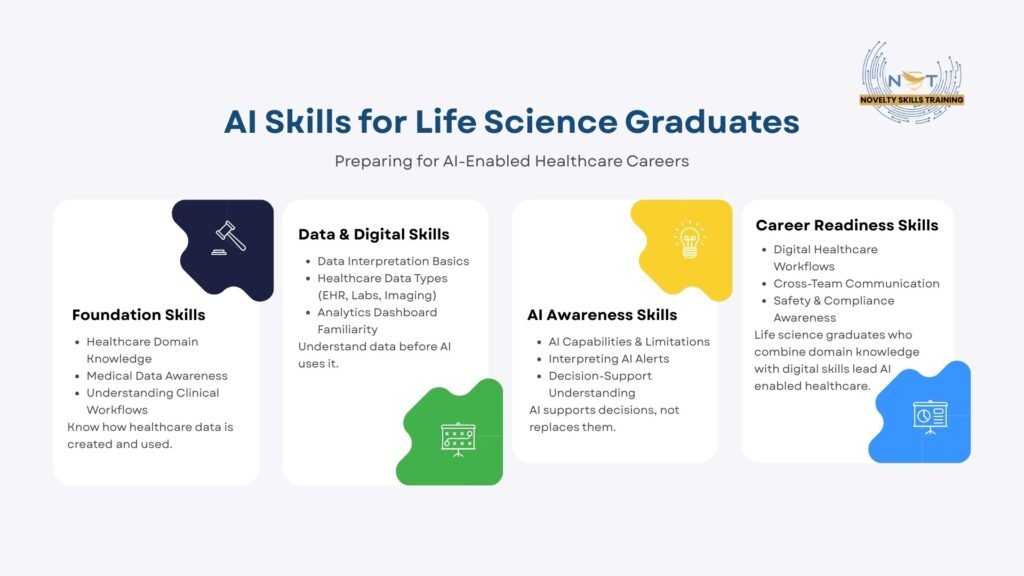
As AI becomes embedded in healthcare workflows, the most valuable skills are practical rather than highly technical. Data literacy enables professionals to interpret trends, understand AI outputs, and recognize data quality issues. Understanding how healthcare data is generated and used, including EHRs, research datasets, imaging outputs, and laboratory data, is equally important.
Basic awareness of AI capabilities and limitations helps professionals understand where AI supports decision-making and where human judgment remains essential. Familiarity with healthcare software platforms, analytics dashboards, and documentation systems further strengthens readiness for modern healthcare roles.
These skills help life science students and early-career professionals move from awareness to practical readiness. Building strong domain understanding alongside data and digital literacy enables professionals to work effectively alongside AI systems and develop sustainable career pathways in evolving healthcare environments.
Conclusion
Artificial intelligence is becoming part of everyday healthcare, influencing medical imaging, patient monitoring, clinical decision support, research, and hospital operations. AI in healthcare helps systems manage growing volumes of data, identify risks earlier, and support more consistent decision-making across care environments.
Responsibility for patient care remains with healthcare professionals. Clinical judgment, experience, and ethical reasoning continue to guide final decisions, with AI enhancing human capability rather than replacing it. As healthcare becomes increasingly data-driven, professionals who understand how AI fits into clinical and operational workflows will be better positioned for emerging roles.
Programs such as the AI and ML in Healthcare course offered by Novelty Skills Training are designed to build this practical understanding, helping learners develop confidence in working alongside AI while maintaining human accountability at the center of healthcare delivery.
Frequently Asked Questions (FAQs)
1. What is artificial intelligence in healthcare in simple terms?
Artificial intelligence in healthcare refers to systems that analyze medical data to help healthcare professionals detect risks, support diagnosis, improve efficiency, and make better decisions while keeping human expertise and responsibility at the center.
2. Is AI already used in hospitals in Dubai and the UAE?
Yes. Many hospitals in Dubai and across the UAE use AI-supported systems in medical imaging, electronic health records, patient monitoring, and hospital operations as part of ongoing digital health and smart healthcare initiatives aimed at improving efficiency and patient outcomes.
3. Will AI replace doctors or healthcare professionals in the UAE?
No. AI is designed to support healthcare professionals by improving data analysis and workflow efficiency. In Dubai and the wider UAE healthcare system, clinical decisions and patient responsibility remain with licensed healthcare professionals.
4. Where is AI currently used in healthcare?
AI is used across medical imaging, clinical decision support, electronic health records, hospital operations, drug discovery, clinical research, and remote patient monitoring systems in healthcare environments worldwide.
5. How does AI improve patient care in UAE healthcare settings?
AI helps healthcare teams identify risks earlier, reduce delays in analysis, and support faster decision-making. In UAE hospitals where digital health systems are widely adopted, AI also helps improve coordination between departments and supports more efficient patient management.
6. What types of healthcare data does AI analyze?
AI systems commonly analyze medical images, electronic health records, laboratory reports, clinical notes, genomic data, and continuous patient monitoring data generated during patient care.
7. Do healthcare professionals in Dubai need programming skills to work with AI systems?
No. Most healthcare professionals in Dubai and the UAE are expected to understand how AI supports workflows and how to interpret AI outputs rather than develop AI systems themselves.
8. What career opportunities are emerging in AI-enabled healthcare in the UAE?
AI adoption is creating opportunities in healthcare data management, healthcare analytics, clinical research support, digital health operations, and AI validation roles. These roles are expanding as Dubai and the UAE continue investing in digital healthcare infrastructure.
9. Why is AI adoption increasing in healthcare systems worldwide?
Healthcare generates large volumes of complex data that are difficult to manage manually. AI helps analyze this data efficiently, improving workflow efficiency and reducing the risk of missed clinical signals across modern healthcare systems.
10. How can life science graduates in Dubai prepare for AI-driven healthcare careers?
Life science graduates in Dubai can prepare by developing data literacy, understanding healthcare workflows, becoming familiar with digital health systems, and learning how AI supports clinical and operational decision-making in modern healthcare environments.