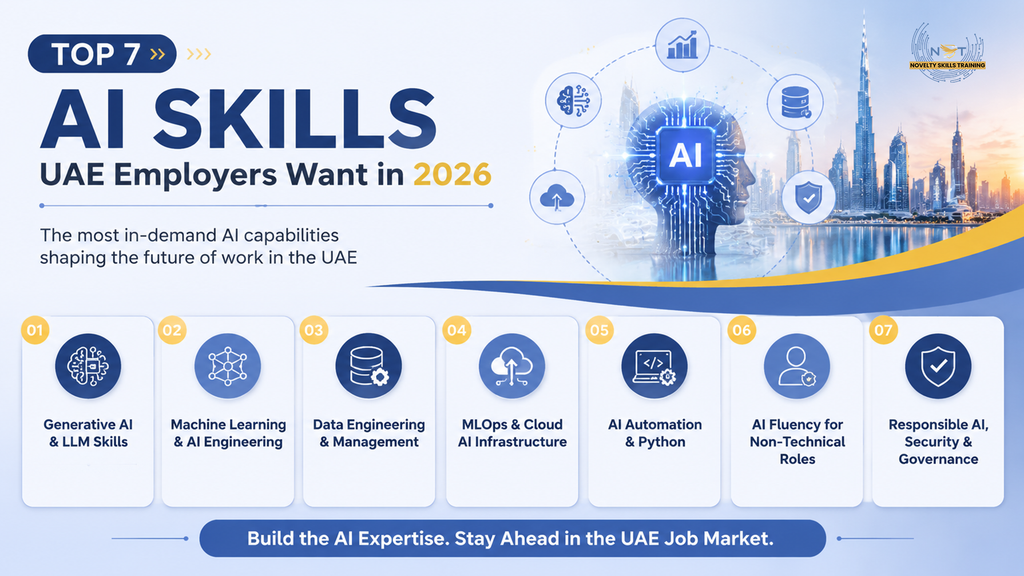
The top AI skills UAE employers are looking for in 2026 include generative AI, machine learning, data analytics, AI automation, cloud computing, and responsible AI practices. Professionals who can apply AI tools to improve productivity, analyze data, automate workflows, and solve industry-specific challenges are expected to have stronger career opportunities across sectors such as healthcare, finance, aviation, technology, and logistics.
Artificial intelligence is becoming a core business capability in the UAE, transforming how organizations operate, make decisions, and deliver services. Across Dubai, Abu Dhabi, and Sharjah, employers are increasingly seeking professionals who can apply AI to improve productivity, automate processes, analyze data, and create measurable business outcomes.
The AI skills UAE employers are looking for in 2026 go beyond basic knowledge of AI tools. Companies are prioritizing professionals who can combine AI expertise with industry knowledge across sectors such as healthcare, finance, aviation, logistics, technology, and government services.
This guide explores the top AI skills UAE employers are seeking in 2026, the industries adopting AI, and the capabilities professionals need to build future-ready careers.
The UAE’s growing focus on AI adoption through initiatives such as the UAE Artificial Intelligence Strategy 2031 is accelerating demand for AI-ready talent. Businesses are investing in AI solutions to improve efficiency, enhance customer experiences, and develop smarter systems.
Why AI Skills Matter in the UAE Job Market
AI is becoming an essential skill in the UAE job market as businesses adopt artificial intelligence to improve efficiency, automate processes, and make better decisions. Employers are increasingly seeking professionals who can apply AI to solve real business challenges and support innovation.
According to the World Economic Forum Future of Jobs Report 2025, AI, big data, and technological literacy are among the fastest-growing skills shaping future careers.
1. Improving Operational Efficiency
AI helps businesses automate repetitive tasks, optimize workflows, and improve productivity by reducing manual processes.
2. Supporting Data-Driven Decisions
Professionals with AI and data skills can analyze information, identify trends, and help organizations make faster, more accurate decisions.
3. Enhancing Customer Experiences
AI-powered solutions enable businesses to deliver personalized services, faster support, and improved customer engagement.
4. Driving Business Innovation
AI adoption is expanding across UAE industries. For example, ADNOC implemented more than 30 AI solutions across its operations, generating $500 million in value in 2023 by improving operational efficiency and decision-making.
The Dubai Universal Blueprint for Artificial Intelligence is also accelerating AI adoption across sectors by encouraging organizations to develop AI capabilities.
As UAE businesses continue integrating AI into their operations, professionals who combine AI skills with industry expertise will be better positioned for future career opportunities.
Top AI Skills UAE Employers Want Most in 2026
As AI adoption expands across UAE industries, employers are looking for professionals who can apply AI to improve productivity, automate processes, analyse data, and support business growth. In 2026, the most valuable AI skills will not be limited to technical expertise; companies will also need professionals who can effectively use AI tools within their roles.
1. Advanced Generative AI and Large Language Model (LLM) Skills
Generative AI has become one of the most important areas of AI adoption, with businesses using large language models (LLMs) for automation, customer engagement, content generation, and knowledge management.
For technical roles, employers are looking for professionals who can develop, customize, and integrate LLM-based solutions for business needs, including applications involving Arabic language processing and regional use cases.
Key skills include:
- LLM application development
- AI model fine-tuning
- Natural Language Processing (NLP)
- Retrieval-Augmented Generation (RAG)
- AI API integration
According to McKinsey’s 2024 Global Survey on AI, 65% of organizations reported regularly using generative AI, showing the rapid adoption of AI tools across business functions.
2. Machine Learning and AI Engineering
UAE employers are increasingly seeking professionals who can develop and implement machine learning solutions rather than only understand AI concepts.
AI engineers and data scientists are expected to work with programming languages and frameworks such as Python, TensorFlow, and PyTorch to build models that support automation, prediction, and intelligent decision-making.
Important skills include:
- Machine learning algorithms
- Model training and evaluation
- Deep learning
- Computer vision
- Predictive analytics
Stanford AI Index Report 2025 highlights continued growth in AI investment, research, and industry adoption.
3. Data Engineering and AI Data Management
Strong AI systems depend on high-quality data. As organisations generate increasing amounts of information, employers need professionals who can build reliable data pipelines and prepare data for AI applications.
Data engineering skills help businesses collect, process, and manage data efficiently for analytics and AI-driven solutions.
Key skills include:
- SQL and NoSQL databases
- Data pipelines and ETL processes
- Apache Spark
- Data warehousing
- Data quality management
4. MLOps and Cloud AI Infrastructure
Deploying AI solutions at an enterprise level requires professionals who understand how to manage AI systems in cloud environments.
Employers value candidates who can deploy, monitor, and maintain AI models using platforms such as AWS, Microsoft Azure, and Google Cloud.
Important skills include:
- Cloud computing fundamentals
- AI model deployment
- Machine learning operations (MLOps)
- Cloud-based AI services
- Model monitoring and optimisation
5. AI Automation and Python Programming
Automation is becoming a major focus for UAE businesses looking to improve efficiency and reduce repetitive processes. Professionals who can combine AI knowledge with programming skills can help organisations automate workflows and create smarter solutions.
Python remains one of the most valuable programming languages for AI development due to its wide use in machine learning, data analysis, and automation.
Key skills include:
- Python programming
- AI automation workflows
- API integration
- Process automation
- AI-powered business applications
6. AI Fluency for Non-Technical Roles
AI skills are no longer limited to developers and data specialists. UAE employers are increasingly looking for professionals across departments who can use AI tools effectively in their daily work.
Professionals in marketing, HR, finance, healthcare, and operations can benefit from AI skills such as:
- Prompt engineering for better AI outputs
- AI-assisted content creation
- Data interpretation and business insights
- AI-powered productivity tools
- Workflow optimisation
The Microsoft Work Trend Index 2024 found that 75% of knowledge workers are already using AI at work, highlighting the growing importance of AI literacy across business functions.
7. Responsible AI, Security, and Governance
As organisations adopt AI systems, they also need professionals who understand the risks associated with AI usage, including data privacy, accuracy issues, and security concerns.
Employers increasingly value awareness of responsible AI practices, especially when handling sensitive business or customer information.
Important skills include:
- Evaluating AI-generated outputs
- Reducing AI errors and hallucinations
- Data privacy awareness
- AI security practices
- Understanding AI compliance requirements
Professionals who combine technical expertise, business understanding, and responsible AI practices will have a stronger advantage as UAE organisations continue expanding their AI adoption in 2026.
Dubai AI Week 2025 brought together global technology companies, government organizations, and AI experts to discuss innovation, talent development, and future AI opportunities.
This combination of industry knowledge and AI capability helps professionals improve efficiency and contribute to better business outcomes.
What Are the Industries Hiring AI-Skilled Professionals in the UAE?
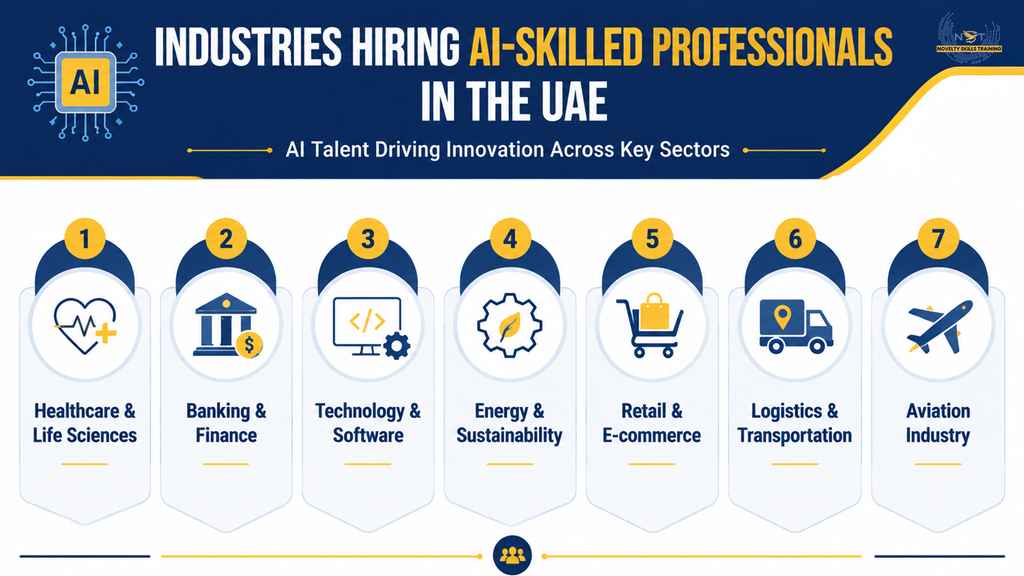
AI adoption is expanding across industries in the UAE as organisations use artificial intelligence to improve efficiency, automate processes, enhance customer experiences, and support better decision-making. This is increasing demand for professionals who can combine AI skills with industry expertise.
1. Healthcare and Life Sciences
The UAE healthcare sector is adopting AI for medical imaging, healthcare analytics, patient care, and operational improvements. AI-skilled professionals with knowledge of machine learning, healthcare data, and health informatics can support better diagnosis, workflow optimisation, and healthcare delivery.
The UAE Ministry of Health and Prevention (MOHAP) highlights the role of AI and digital technologies in improving healthcare services.
2. Banking and Financial Services
Banks and financial institutions are using AI for fraud detection, risk analysis, customer service automation, and financial decision-making. Professionals with skills in AI, data analytics, machine learning, and cybersecurity can help financial organisations improve efficiency and security.
The Central Bank of the UAE’s Digital Transformation Strategy focuses on strengthening innovation and digital capabilities in the financial sector.
3. Technology and Software Development
The UAE’s growing technology sector is creating demand for AI engineers, machine learning specialists, data scientists, and cloud professionals. Skills in generative AI, large language models, cloud computing, and AI development are becoming valuable for building advanced digital solutions.
The Dubai Universal Blueprint for Artificial Intelligence aims to accelerate AI adoption and innovation across sectors.
4. Energy and Sustainability
The UAE energy sector is using AI for predictive maintenance, operational optimisation, safety improvements, and smarter resource management. Professionals with skills in AI analytics, automation, and data modelling can help energy companies improve performance.
For example, ADNOC implemented more than 30 AI solutions across its operations, generating $500 million in value in 2023.
5. Retail, E-commerce, and Customer Services
Retail and e-commerce businesses are adopting AI for personalised recommendations, demand forecasting, inventory management, and automated customer support. Professionals skilled in AI automation, analytics, and generative AI tools can help businesses improve customer experiences and operational efficiency.
6. Logistics and Transportation
The UAE logistics sector is using AI for route optimisation, supply chain management, predictive maintenance, and process automation. AI-skilled professionals help organisations analyse operational data and develop smarter systems for faster and more efficient transportation.
The Dubai Roads and Transport Authority (RTA) has implemented AI solutions as part of its digital transformation initiatives.
7. Aviation Industry
The UAE aviation sector is adopting AI to improve flight operations, predictive maintenance, passenger services, and airport management. Professionals with skills in AI, data analytics, automation, and machine learning can support smarter and more efficient aviation systems.
Organizations such as Emirates Group and Dubai Airports are investing in digital transformation and technology-driven solutions.
What Skills Do UAE Employers Need for AI Jobs?
AI roles in the UAE require a combination of technical expertise, data handling capabilities, and business understanding. Employers are looking for professionals who can develop AI systems, manage data infrastructure, and apply AI solutions to real business challenges.
Core Machine Learning and AI Engineering Skills
These are the essential technical skills required to develop, train, and deploy AI models for real-world applications.
- Deep Learning Frameworks: Knowledge of frameworks such as TensorFlow and PyTorch to build, train, and optimise neural network models.
- Natural Language Processing (NLP): Building AI systems that understand and process human language, including applications involving Arabic language processing for regional markets.
Advanced Data Engineering Skills
AI systems depend on structured and reliable data. Employers need professionals who can manage, process, and prepare large datasets for AI applications.
- Big Data Technologies: Working with platforms such as Apache Spark, Hadoop, and Kafka to process and manage large volumes of data.
- Data Pipelines and ETL: Building automated workflows to collect, clean, transform, and prepare data for AI models using tools such as Apache Airflow.
AI Product Management and Business Strategy
As companies integrate AI into business operations, employers need professionals who can connect technical AI capabilities with business objectives.
- AI Project Management: Managing AI development timelines, resources, and performance goals while balancing technical limitations and business requirements.
- ROI Analysis: Measuring how AI solutions improve efficiency, reduce costs, or create new business opportunities.
Professionals who combine technical AI skills with data expertise and business understanding will be better positioned for AI opportunities in the UAE job market.
What Are the AI Skills Beginners in the UAE Need to Know?
For beginners entering the UAE job market, AI skills are not limited to coding or advanced technical knowledge. Employers increasingly value professionals who can use AI tools effectively, automate tasks, understand data, and apply AI responsibly in real workplace scenarios.
1. Functional AI Literacy and Practical Prompting
Before learning advanced AI development, beginners need to understand how AI tools work and how to communicate effectively with them.
- Effective Prompting Skills: Learning how to create clear, structured prompts to get accurate and useful responses from AI tools.
- Multi-Modal AI Tools: Using AI platforms that work with text, images, documents, and data for workplace tasks.
2. Core Technical Foundations
Beginners do not need advanced programming skills initially, but understanding basic technical concepts can improve career opportunities.
- API Fundamentals: Understanding how AI tools connect with applications, websites, and business systems.
- No-Code AI Automation: Using platforms such as Microsoft Power Automate, Zapier, and Make to automate repetitive workplace tasks.
3. Business-Focused AI Tool Skills
UAE employers value professionals who can apply AI directly to improve daily business operations.
- AI-Assisted Data Analysis: Using tools such as AI-enabled Excel and Power BI features to analyze data and generate insights.
- AI Document Processing: Using AI tools to summarise reports, analyse documents, and extract important information faster.
Building these foundational AI skills helps beginners become more adaptable and prepares them for AI-driven roles across industries in the UAE.
Conclusion
AI is reshaping the UAE job market, creating new opportunities for professionals who can combine artificial intelligence skills with industry expertise. From generative AI and machine learning to automation, data analytics, and responsible AI practices, employers are increasingly looking for talent that can apply AI to solve real business challenges.
Whether you are a beginner, a technical professional, or an experienced industry expert, building AI skills can help you stay competitive and prepare for the future of work in the UAE.
Frequently Asked Questions
1. What are the most important AI skills employers want in 2026?
The AI skills employers want include generative AI, machine learning, data analytics, AI automation, cloud AI infrastructure, and responsible AI practices. Employers are looking for professionals who can apply these skills to improve productivity and solve business challenges.
2. What artificial intelligence skills are required for AI jobs?
Key artificial intelligence skills required for AI jobs include Python programming, machine learning algorithms, deep learning, data management, natural language processing (NLP), AI model deployment, and knowledge of AI tools and platforms.
3. What skills are needed for AI jobs in the UAE?
Skills needed for AI jobs in the UAE vary by role but commonly include machine learning, data engineering, generative AI, cloud computing, automation, and AI security. Professionals who combine AI expertise with industry knowledge are highly valued across sectors.
4. Are AI skills only required for technical professionals?
No, AI skills are becoming valuable across both technical and non-technical roles. Professionals in marketing, finance, healthcare, HR, and operations can benefit from AI skills such as prompt engineering, AI automation, data analysis, and AI-powered productivity tools.
5. What AI skills should beginners learn first?
AI skills for beginners include understanding AI fundamentals, learning effective prompt engineering, using AI productivity tools, exploring no-code automation platforms, and developing basic data literacy. Beginners can gradually build technical skills such as Python and machine learning.
6. What are the key skills for machine learning careers?
Important skills for machine learning careers include Python programming, statistics, data preprocessing, machine learning algorithms, model evaluation, deep learning frameworks such as TensorFlow and PyTorch, and understanding how to deploy AI models.
7. Why are AI skills important for UAE job opportunities?
AI skills are important because UAE organisations are increasingly adopting AI to automate processes, improve decision-making, and enhance business performance. Professionals with AI capabilities can access opportunities across industries such as healthcare, finance, aviation, technology, and logistics.
8. How can professionals develop AI skills for future career growth?
Professionals can develop AI skills by learning AI fundamentals, practising with AI tools, gaining experience in data analysis and automation, learning programming concepts, and applying AI solutions to real-world industry problems.