Artificial intelligence may already be influencing more of your daily routine than you realize.
Can AI really make decisions without being told every step?
Yes. Modern AI systems can learn patterns from data rather than following every instruction manually. Machine learning allows them to analyze previous examples, recognize relationships and apply what they have learned to new situations, such as predicting demand, recommending content or detecting fraud.
If you live in Dubai, you may encounter AI daily: navigating Sheikh Zayed Road, detecting unusual bank transactions, receiving personalized recommendations, or using digital government services.
That quiet presence is what makes artificial intelligence worth understanding.
It is no longer confined to research laboratories or science fiction. It is becoming part of how businesses operate, how governments deliver services and how professionals work.
For students in Dubai, the timing is particularly relevant. Dubai’s Universal Blueprint for Artificial Intelligence aims to contribute AED 100 billion annually to Dubai’s economy through the digital economy and increase productivity by 50% through innovative digital solutions. The blueprint also includes AI incubators, AI-focused initiatives in educational institutions and an AI commercial license.
So, what actually is artificial intelligence? How does it work? Where is it being used? And what does this transformation mean for students preparing for the Dubai job market?
1. Understanding Artificial Intelligence and How It Works
What Is Artificial Intelligence?
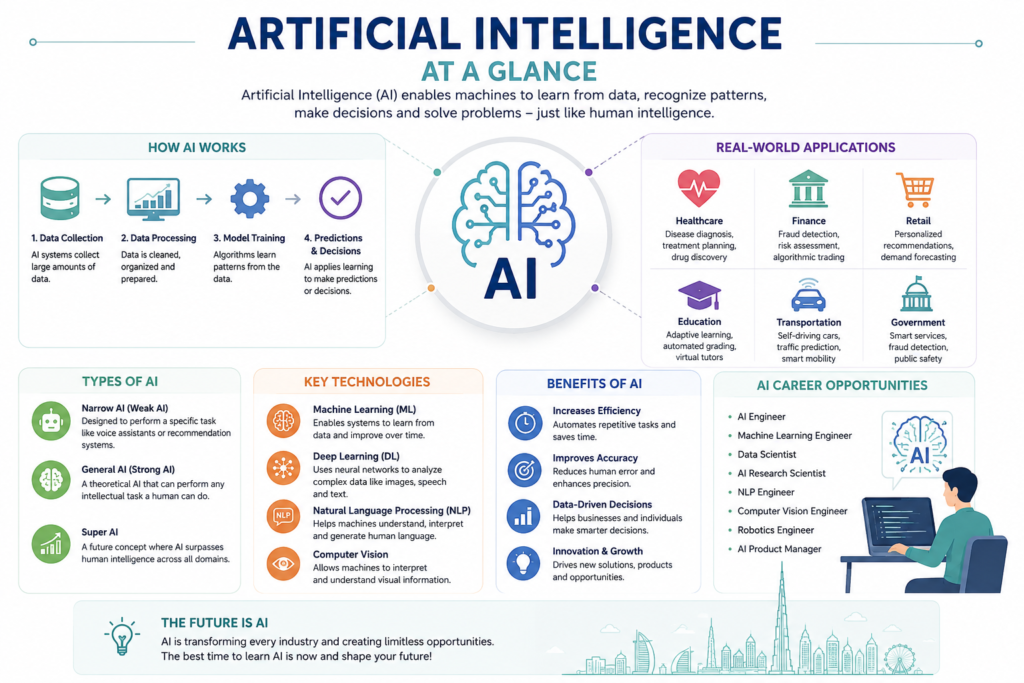
Artificial intelligence is a branch of computer science concerned with developing systems that can perform tasks associated with human intelligence. These include recognizing patterns, analyzing information, understanding language, making predictions, generating content and supporting decisions.
The OECD defines an AI system as a machine-based system that can generate predictions, content, recommendations, or decisions from the inputs it receives.
The difference between conventional software and modern AI is important. Traditional software generally follows rules written by a programmer. An AI model can instead learn patterns from examples and apply those patterns to new information.
AI does not think exactly like humans. Its performance depends on its data, algorithms, computing resources and objectives. Its strength lies in processing vast amounts of information at a scale beyond manual human capacity.
Artificial Intelligence Examples in Daily Life
The easiest way to understand AI is to look at what is already around you.
- When your phone recognizes your face, AI helps interpret visual information.
- When a streaming platform recommends a film, algorithms analyze your viewing behaviour.
- When an email service identifies spam, machine learning helps classify messages.
Dubai offers even more visible examples.
- Intelligent mobility systems can use data to understand traffic conditions.
- Financial institutions can monitor transactions for unusual behaviour.
- Digital services can useDubai AI chatbots and automated workflows.
Dubai’s own government-services strategy illustrates the scale of this digital transition. Its Services 360 policy targets 100% proactive and automated services, 90% integrated services and 90% service provision without the customer’s physical presence. It also projected annual financial savings exceeding AED 1 billion and the elimination of 9 million physical customer visits to service centres annually.
These examples show why AI is no longer an abstract concept. It is increasingly becoming part of the infrastructure through which people live, study and work.
Machine Learning Explained
Machine learning is one of the foundations of modern artificial intelligence. Instead of programming a computer with every possible rule, developers provide data and allow a model to identify useful patterns.
Consider fraud detection. A bank may process millions of historical transactions containing information about amounts, locations, devices and timing. A machine learning model studies these records and learns which patterns are associated with suspicious activity. When a new transaction arrives, the model evaluates it and generates a risk assessment.
This approach allows systems to respond to patterns that may be too complex or numerous to define manually.
The important idea is simple: machine learning allows computers to learn from examples and apply those patterns to new data.
Types of Machine Learning
Machine learning is not one single technique. Different approaches are used depending on the nature of the data and the problem being solved.
Supervised learning uses labelled data. A model may be trained using transactions already classified as legitimate or fraudulent.
Unsupervised learning works without predefined labels. The model searches for patterns, clusters or unusual behaviour within the information.
A third approach is reinforcement learning, where a system learns through feedback from actions and outcomes. This approach has applications in areas such as robotics, game-playing systems and optimization.
The choice depends on the problem. A retailer trying to group customers by purchasing behaviour may use unsupervised learning. A bank predicting whether a transaction is fraudulent may use supervised learning.
Supervised vs Unsupervised Learning
The distinction becomes easier with a simple example.
Imagine a dataset containing thousands of customer transactions. If every transaction has already been marked “fraud” or “not fraud,” the model has labelled examples to learn from. That is supervised learning.
If the transactions have no labels and the system is asked to identify unusual groups or patterns by itself, that is unsupervised learning.
Neither approach is automatically better. The right method depends on the objective, available data and the type of result an organization needs.
Machine Learning Algorithms
Once the learning approach is selected, the next question is which algorithm should be used.
Common machine learning algorithms include linear regression, logistic regression, decision trees, random forests, support vector machines and k-means clustering.
Each serves a different purpose.
- A regression algorithm can estimate a numerical value, such as expected demand.
- A classification algorithm can determine whether an email is likely to be spam.
- A clustering algorithm can group customers according to similarities in their behaviour.
The algorithm is only one part of the process. Data quality, feature selection, model evaluation and the business problem all influence the final result.
This is why learning machine learning is not simply about memorizing algorithms. It is about understanding when and why to use them.
Deep Learning vs Machine Learning
Deep learning is a specialized area within machine learning.
| Traditional machine learning models Traditional machine learning models often rely on selected features within the data. | Deep Learning Deep learning uses multi-layer neural networks that can learn increasingly complex representations directly from large datasets. |
This makes deep learning particularly useful for images, speech, video and natural language.
The relationship is straightforward:
Machine learning is the broader field. Deep learning is a specialized approach within it.
Understanding this distinction becomes important as students move from basic predictive models towards more advanced AI systems.
Artificial Neural Networks Explained
An artificial neural network is a computational structure loosely inspired by biological neurons. It contains interconnected layers that transform information. During training, the model adjusts internal parameters so that its outputs become more accurate. Neural networks are behind many advances in image recognition, speech processing and generative AI.
A facial recognition system, for example, does not simply compare two photographs pixel by pixel. A trained neural network can learn complex visual features that help distinguish one face from another.
For students, neural networks provide an important bridge between foundational machine learning and advanced AI development.
Generative AI Explained
Generative AI has changed how the public interacts with artificial intelligence.
Traditional AI systems may classify an image, predict demand or identify suspicious behaviour. Generative AI can create something new, including text, images, audio, video and computer code.
Its adoption has been exceptionally rapid. Stanford’s 2026 AI Index reports that generative AI reached 53% population adoption globally within three years, faster than the personal computer or the internet. The UAE recorded 64% adoption, placing it among the highest-adoption markets measured in the report.
For students, this creates an important distinction. Knowing how to use a generative AI tool is useful. Understanding the technology, limitations and data behind it provides a stronger foundation.
AI Personal Assistant Guide
An AI personal assistant combines generative and conversational AI to interpret requests, process information and respond appropriately. Newer systems can handle multi-step tasks and interact with tools, marking a shift from simple chatbots towards agentic AI.
Prompt Engineering Guide
Generative AI has also created interest in prompt engineering. A prompt is more than a question. It can define the objective, provide context, establish constraints and specify the desired format.
For example, asking an AI system to “analyze this report” produces a different result from instructing it to identify three major findings, explain their implications for a Dubai-based business and present them in a concise table.
Good prompting does not replace technical AI knowledge. It complements it. As AI becomes embedded into workplace tools, the ability to communicate clearly with intelligent systems can become useful across marketing, finance, healthcare, education and technology.
AI Software Explained
- AI software is the layer that turns AI models into usable applications.
- A machine learning model may predict customer churn. Software can then connect that prediction to a dashboard, customer database or automated workflow.
- Modern AI applications may involve Python, machine learning frameworks, APIs, databases, cloud platforms and deployment tools.
This is why practical AI development extends beyond model theory. A useful system must connect the model to a real problem and operate reliably in a real environment.
2. AI Applications, Tools and Business Impact
AI Applications Across Industries
Artificial intelligence has become valuable because it can be adapted to different problems.
- Healthcare uses AI for medical imaging and clinical support.
- Finance uses AI for fraud detection and risk analysis.
- Retail uses AI for demand forecasting.
- Manufacturing uses computer vision and predictive maintenance.
- Education uses adaptive systems.
- Transportation uses intelligent routing and traffic analysis.
Stanford’s 2025 AI Index provides a useful indicator of this expansion. The US FDA authorized 223 AI-enabled medical devices in 2023, compared with just six in 2015.
The number does not mean every AI application is equally effective. It does show how quickly AI has moved into practical environments.
AI for Business Growth
The strongest business case for AI is not simply automation. It is better decision-making. A business can use AI to forecast demand, identify operational risks, personalize customer experiences, analyze documents or automate repetitive processes.
McKinsey’s 2025 global survey found that 88% of respondents reported regular AI use in at least one business function. However, nearly two-thirds said their organizations had not yet begun scaling AI across the enterprise.
This gap matters. Businesses need people who can identify real AI opportunities and turn them into measurable business value.
AI in Retail
Imagine a retailer operating several stores across Dubai. Demand may differ between locations. Weekend patterns may differ from weekday patterns. Promotions can change purchasing behaviour. Seasonal events can affect inventory requirements.
AI can analyse these variables to support demand forecasting, inventory planning and personalised recommendations. This is where AI in retail helps businesses make more informed decisions.
AI in Finance
AI in finance has become particularly valuable because financial institutions handle enormous volumes of structured data. Machine learning can help identify suspicious transactions, assess risk, support customer service and analyze financial behaviour.
A model can evaluate combinations of transaction value, location, device and spending patterns far faster than manual analysis. The human expert remains important. AI provides another analytical layer.
For Dubai’s financial ecosystem, this intersection of finance, data and AI creates opportunities for students with backgrounds in finance, mathematics, business analytics and computer science.
AI in Education
Education is another area where artificial intelligence can influence both learning and administration. Adaptive learning platforms can use performance data to recommend suitable content. AI tools can assist with feedback, summarization and administrative work.
Dubai is actively developing AI capabilities in education. In 2024, the Dubai Centre for Artificial Intelligence and KHDA launched an initiative to train teachers in AI and its applications. The programme included practical and online training, while the top 10 teachers demonstrating innovative AI applications were set to receive awards totalling AED 1 million at the following AI Retreat.
For students, the implication is significant. AI is changing not only the jobs they may enter, but also the educational environment in which they learn.
AI in Manufacturing
Manufacturing offers a different perspective. A computer vision system can inspect products on a production line and flag possible defects. Predictive models can analyze equipment data and identify patterns that may indicate future failures. This can reduce downtime and improve quality control.
For engineering and technology students in Dubai, these applications demonstrate that AI careers are not restricted to software companies. Intelligent systems are increasingly connected to physical operations and industrial processes.
Best AI Tools in 2026
The AI tools landscape changes rapidly, so students should avoid treating any single tool as a permanent skill. In 2026, major platforms are expanding beyond text generation into research, coding, image creation, data analysis, workflow automation and agentic tasks.
Tools such as ChatGPT and Gemini are increasingly being used for research, writing, coding, learning and productivity. Their capabilities and integrations continue to evolve.
Other categories worth exploring include:
- AI coding assistants
- AI research tools
- Image and video generation platforms
- Data analysis assistants
- AI presentation tools
- Workflow automation platforms
- AI meeting and transcription tools
The better strategy is to learn how to evaluate AI tools, rather than memorizing a list of names.
OpenAI vs Gemini
OpenAI’s ChatGPT and Google’s Gemini illustrate how quickly the generative AI landscape is developing. Both platforms can support writing, learning, research, coding and problem-solving. Their strengths, integrations and model offerings continue to change.
For a student, the more useful AI comparison is not simply “Which one is better?”
It is: Which tool is appropriate for this task, and how can I verify its output?
That approach encourages critical thinking instead of platform dependence.
Explore AI & ML Training at Novelty Skill Training
Course Overview
Build practical expertise in Python for AI, machine learning, deep learning, natural language processing, and AI model deployment. This program prepares learners to develop, optimize, and deploy real-world AI solutions using industry relevant tools, frameworks, datasets, and cloud platforms.
VIEW COURSESkills You’ll Build
- Healthcare Data Analytics
- Machine Learning Fundamentals
- Predictive Modeling
- Clinical Data Interpretation
- AI in Healthcare Applications
- Data Visualization
- AI-Driven Decision Support
3. AI Skills, Careers and Learning Pathways in Dubai
AI Skills Employers Want
The AI job market is becoming more demanding. Python, statistics and machine learning remain important. But employers are increasingly looking for broader capabilities such as model deployment, cloud platforms, data engineering, generative AI, prompt engineering and responsible AI.
A current Dubai AI Engineer listing from AIQU seeks skills in Python, TensorFlow, PyTorch, Pandas, NumPy, deep learning, NLP, computer vision, Docker and Kubernetes. The takeaway is simple: building models matters, but deploying them in real environments matters more.
AI Career Roadmap UAE
A practical AI career roadmap can be viewed in stages.
Stage 1: Build the foundation.
Learn Python, mathematics, statistics and data handling.
Stage 2: Understand machine learning.
Study supervised and unsupervised learning, algorithms, model evaluation and feature preparation.
Stage 3: Move into advanced AI.
Explore deep learning, neural networks, NLP, computer vision and generative AI.
Stage 4: Build practical projects.
Apply the concepts to real datasets and business problems.
Stage 5: Learn deployment.
Understand APIs, cloud platforms, containers and model monitoring.
Stage 6: Build a portfolio.
Document what you built, why you built it and what the results showed.
AI Engineer Career
AI Engineers work across data preparation, model development, APIs, deployment and monitoring. In Dubai, roles increasingly seek skills in Python, TensorFlow, PyTorch, LLMs, cloud platforms, RAG, APIs and MLOps. The career is shifting from building models to developing complete, production-ready AI systems.
AI Projects for Beginners
Projects provide the bridge between theory and practical ability.
- A beginner could start with a customer churn predictor or house-price prediction model. A slightly more advanced project might classify images or analyze customer sentiment.
- A student interested in Dubai’s business environment could build a demand forecasting model for a fictional retail chain or create a chatbot for a simulated service centre.
The project needs to demonstrate a complete thought process:
Problem → Data → Model → Evaluation → Result
That is what turns theoretical learning into evidence of practical capability.
AI Interview Questions
AI interviews increasingly test whether candidates understand concepts rather than simply memorizing definitions.
Questions may include:
- What is the difference between supervised and unsupervised learning?
- When would you use a classification model?
- How does overfitting occur?
- What is a neural network?
- How is deep learning different from traditional machine learning?
- How would you evaluate an AI model?
- What would you do if training data were biased?
- How would you deploy a model into production?
The strongest answers usually include examples. If asked about supervised learning, explaining fraud detection is more convincing than reciting a textbook definition.
AI Certifications in UAE
Certification can demonstrate that you completed structured training. It can strengthen a CV, particularly when it is backed by practical work. But certification alone does not establish competence.
When evaluating an AI certification in the UAE, look at the curriculum, assessment method, practical projects, instructor expertise, and technologies covered. A certificate supported by a strong project portfolio tells a stronger story than a certificate standing alone.
AI Salary in Dubai
AI salaries in Dubai vary by experience and technical expertise. Current listings show AED 12,000–15,000/month for an AI Engineer and AED 15,000–18,000/month for a Principal AI Engineer, highlighting the value of advanced skills and production experience.
AI Learning Pathways: From an AI Course to Advanced Study
The right AI learning format depends on your starting point.
- A foundational AI course can introduce Python, statistics, machine learning and practical applications.
- An artificial intelligence online course can provide flexibility for students balancing studies, internships or work.
- Instructor-led artificial intelligence classes can provide direct mentorship and hands-on guidance.
For students with technical foundations, an advanced artificial intelligence course can cover neural networks, generative AI, optimisation and deployment. AI training courses suit targeted upskilling, while artificial intelligence master’s programmes offer deeper academic study. The right choice depends on the skills you need next.
4. Future of Artificial Intelligence, Trends and Responsible Use
Future of Artificial Intelligence
The future of artificial intelligence will probably not be defined by one breakthrough. Instead, AI is becoming embedded into the software and workflows people already use.
- Generative systems are becoming more capable.
- AI agents are beginning to handle multi-step tasks.
- Businesses are redesigning workflows around AI.
- Governments are exploring intelligent public services.
The UAE has been preparing for this shift for years. Its UAE Strategy for Artificial Intelligence was launched in October 2017 and aims to position the country as a leader in AI investment and adoption. The strategy covers sectors including transport, healthcare, education, technology and traffic. It also targets 100% reliance on AI for government services and data analysis by 2031.
Dubai’s Universal Blueprint takes this further by targeting AI adoption across strategic sectors, supporting AI companies and talent, and introducing initiatives such as AI incubators and educational AI programmes. For students, this means the technology they learn today may evolve considerably before they reach senior positions. The ability to keep learning may therefore become as important as the initial technical skill.
AI Trends 2026
Several developments are shaping the current AI landscape.
Generative AI is moving into workflows.
– Companies are moving beyond experimentation and exploring how AI can become part of everyday operations.
AI agents are gaining attention.
– These systems can plan and execute multiple steps rather than simply respond to a prompt. McKinsey’s 2025 survey found that 62% of respondents said their organizations were at least experimenting with AI agents.
AI talent is growing rapidly in the UAE.
– Stanford’s 2026 AI Index reports that UAE AI talent concentration increased by 121%increased by 121% between 2019 and 2025, the fastest growth among the countries included in its comparison.
AI is becoming a workplace capability.
– Stanford’s latest AI Index also reports that organizational AI adoption reached 88% in 2025, while generative AI was used in at least one business function by 70% of surveyed organizations.
These developments point towards a workplace where AI literacy will increasingly extend beyond dedicated AI teams.
AI Ethics
Greater capability also brings greater responsibility. AI systems can reproduce bias in training data. They can generate inaccurate information. They can expose sensitive data if poorly designed. Automated decisions can also affect people without sufficient human oversight. That makes AI ethics part of technical competence.
The UAE Charter for the Development and Use of Artificial Intelligence explicitly addresses ethical and responsible AI, privacy, data security, transparency, accountability, algorithmic bias and human oversight.
For students entering AI-related fields, this is not simply a policy issue. A technically strong professional should understand not only how to build a system, but also where it may fail, what data it uses and when human judgement should remain involved.
What AI Means for Students in Dubai
This is where the entire discussion comes together.
- A computer science student can add machine learning and AI engineering to a technical foundation.
- A business student can learn how AI supports forecasting, automation and decision-making.
- A finance student can explore fraud detection, risk analytics and intelligent financial systems.
- A healthcare student can combine domain expertise with medical AI.
- An engineering student can work with computer vision, predictive maintenance or industrial automation.
The strongest combination is often:
Domain expertise + AI skills + practical experience.
Conclusion
Artificial intelligence has moved remarkably quickly from an emerging research field to everyday technology. It now influences how transactions are assessed, how products are recommended, how medical images are analyzed, how students learn and how businesses make decisions.
At Novelty Skill Training in the UAE, we deliver industry-aligned training programs such as – Artificial Intelligence and Machine Learning Training, designed to empower professionals with practical, career-ready skills. Explore our comprehensive suite of tech courses and step confidently into the future of intelligent technology.
Frequently Asked Questions
Do you need programming experience before joining an AI course?
Not necessarily. A foundation in Python can be developed progressively, while basic mathematics and logical reasoning can help you understand machine learning concepts more easily.
Can you take an artificial intelligence online course while studying or working?
Yes. An artificial intelligence online course can provide greater flexibility around university, internships or professional commitments.
What skills can you gain from artificial intelligence classes?
You can develop skills in Python, machine learning, deep learning, NLP, data preparation, model evaluation and AI deployment.
How long does an artificial intelligence course take?
The duration depends on the programme. Short courses may focus on specific capabilities, while comprehensive programmes can run for several months and include practical projects.
Can beginners join an advanced artificial intelligence course?
It depends on the programme. If you are new to AI, foundational knowledge of Python, mathematics and machine learning can make advanced topics easier to understand.
How should you choose an AI course in Dubai?
Look at the curriculum, practical projects, industry tools, instructor expertise, mentorship and deployment experience rather than choosing a programme based only on its certification.
Can AI training help you prepare for AI jobs in the UAE?
Yes. Structured training can help you build skills relevant to roles such as AI Engineer, Machine Learning Engineer, Data Scientist, AI Developer and AI Business Analyst.
Is an artificial intelligence certification enough to get an AI job?
Usually not. Certification can demonstrate structured learning, but employers also value practical projects, programming ability, problem-solving and hands-on experience.
What is the difference between an AI course and artificial intelligence master’s programmes?
An AI course generally provides focused practical training, while master’s programmes offer deeper academic study across machine learning, advanced AI, research and specialized applications.
Can you learn about artificial intelligence without a computer science degree?
Yes. You can build AI knowledge progressively through Python, mathematics, data analysis, machine learning and practical projects, even if your original degree is in another discipline.