
Bias in AI healthcare models causes unequal outcomes across patient groups. In the UAE’s diverse system, it can affect diagnosis and treatment when data is incomplete or unrepresentative. Reducing bias requires high-quality data, continuous validation, fairness testing, and strong governance.
Introduction
Artificial Intelligence (AI) is transforming healthcare in the UAE, with initiatives like the UAE National AI Strategy 2031 and platforms such as Malaffi Abu Dhabi Health Information Exchange and NABIDH Dubai Health Information Exchange driving a shift toward data-driven, connected care.
Amid this progress, a critical challenge is emerging, bias in AI models. When algorithms are trained on incomplete or unrepresentative data, they can produce skewed outcomes that directly affect diagnosis, treatment decisions, and patient safety. This becomes especially important in a diverse healthcare environment like the UAE, where populations differ widely in ethnicity, genetics, and health profiles.
Real-world insights further highlight this risk. AI systems trained on limited datasets often underperform across diverse populations, leading to inconsistencies in diagnosis and care outcomes. As AI adoption accelerates across hospitals and national health systems in the UAE, even small gaps in data representation can scale into significant clinical biases.
This blog examines the risks of bias in healthcare AI and what steps are taken by UAE government to address it effectively.
Healthcare AI Bias Stats You Should Know
- Most healthcare AI systems are trained on data from high-income countries, leaving nearly 5 billion people underrepresented in models. Over 80% of genetic studies focus on European populations, limiting global accuracy and fairness.
- Around 84% of AI models do not report racial data, and 31% lack gender information in their training datasets. Additionally, only 16% use publicly available data, limiting transparency and validation.
- Most healthcare AI systems are trained on data from high-income countries, leaving nearly 5 billion people underrepresented in models. Over 80% of genetic studies focus on European populations, limiting global accuracy and fairness.
As a result, AI tools may misdiagnose or perform poorly across diverse populations, reinforcing existing health inequalities instead of reducing them.
What is Bias in Healthcare AI and Why It Matters to UAE
Bias in healthcare AI occurs when algorithms do not perform consistently across different patient groups. This typically happens when the system learns data that does not fully represent real-world diversity or when certain patterns are overemphasized during model training. As a result, the model may not generalize well across all populations.
The impact of this is significant. Instead of supporting uniform clinical decisions, biased AI systems can introduce variability in diagnosis, risk assessment, and treatment recommendations. In practice, this means that two patients with similar conditions may receive different outcomes based on how well the system has learned from data related to their demographic or clinical profile.
In the United Arab Emirates, this risk is further amplified by the country’s highly diverse population and its large-scale, connected healthcare infrastructure. Platforms like Malaffi Abu Dhabi Health Information Exchange connect thousands of healthcare providers and consolidate patient records into a unified system, enabling real-time data sharing and coordinated care. In such an environment, even small inconsistencies in model performance can scale quickly, influencing care delivery across the entire network.
As AI continues to be integrated into clinical workflows and decision-support systems, bias becomes more than a technical limitation, it directly affects consistency, reliability, and patient safety across the healthcare ecosystem.
AI & ML Healthcare Training Program
Course Overview
Learn how artificial intelligence and machine learning are transforming healthcare systems, clinical decision-making, and medical data analysis. This program focuses on real-world applications such as predictive analytics, patient data insights, and AI-driven healthcare solutions relevant to modern healthcare environments.
VIEW COURSESkills You’ll Build
- Healthcare Data Analytics
- Machine Learning Fundamentals
- Predictive Modeling
- Clinical Data Interpretation
- AI in Healthcare Applications
- Data Visualization
- AI-Driven Decision Support
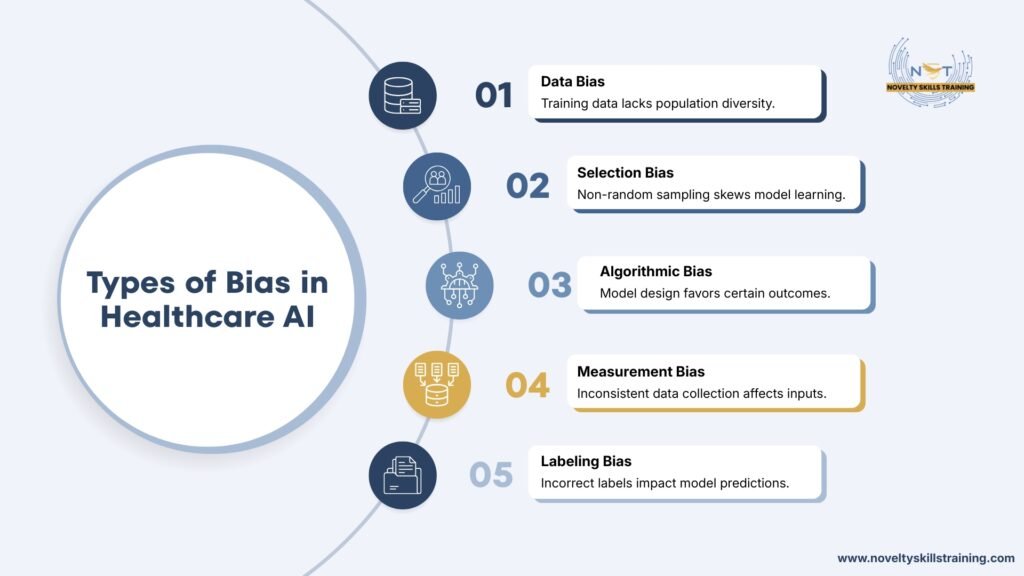
Types of Bias in Healthcare AI
Bias in healthcare AI can enter a system at different stages, from data collection to model deployment. Each type affects performance in a distinct way.
1. Data Bias
This occurs when the training data does not reflect the true diversity of the patient population. It usually results from gaps in data collection, such as missing clinical records or limited coverage of certain demographic groups. Data bias in healthcare AI occurs when training data does not accurately represent real-world populations, leading to uneven model performance. AI systems learn from datasets such as electronic health records and imaging data, and if these datasets are incomplete or skewed, the model can inherit those imbalances. This includes sampling bias (underrepresentation of certain groups), measurement bias (inconsistent data collection), historical bias (existing inequalities), and labeling bias (subjective annotations).
Case Study: Data Bias in a Healthcare Risk Prediction Algorithm (BMJ Study)
A BMJ study found that a widely used U.S. healthcare algorithm used spending as a proxy for illness, which led to bias.
Black patients were often assigned lower risk scores despite having equal or greater health needs. The issue came from relying on cost data instead of real clinical indicators. This highlights how biased data can lead to inequality in large-scale healthcare AI systems.
2. Selection Bias
Selection bias in healthcare AI occurs when training data is drawn from a limited or non-representative subset of the population, causing certain groups to be overrepresented while others are underrepresented. This prevents the model from learning patterns that apply universally, leading to inconsistent performance across different patient groups. In healthcare, this often happens when data is sourced from specific hospitals, regions, or demographics, rather than a diverse population. As a result, AI systems may deliver accurate predictions in one setting but fail in others, creating disparities in diagnosis and treatment outcomes.
Case Study: Selection Bias in Clinic-Based Healthcare Research
A clinic-based study highlighted on Scribbr shows how selection bias can affect healthcare research. Researchers studying a disease recruited participants only from hospital patients, excluding individuals who did not seek medical care. As a result, the sample did not represent the general population, leading to skewed findings about disease prevalence and severity. This demonstrates how limited or non-representative sampling can distort outcomes and reduce the reliability of healthcare insights.
3. Algorithmic Bias
Algorithmic bias occurs when the design or functioning of an AI model itself leads to unfair or inconsistent outcomes across different patient groups, even when the training data appears balanced. This can happen due to the way features are selected, how variables are weighted, or how the model optimizes predictions. In healthcare, such bias can influence diagnosis, risk scoring, and treatment recommendations, causing the system to favor certain patterns over others.
Case Study: Algorithmic Bias in Healthcare AI (Science Study)
A Science study found that a widely used healthcare algorithm showed algorithmic bias by using healthcare costs as a proxy for medical need. Because less money was historically spent on Black patients, the system falsely predicted they were healthier than equally sick White patients. This led to fewer Black patients being identified for additional care, reinforcing existing healthcare inequalities. The case highlights how flawed algorithm design can systematically disadvantage certain populations.
4. Measurement Bias
Measurement bias in healthcare AI occurs when the data used to train models is inaccurate, inconsistent, or systematically distorted due to differences in how information is recorded, measured, or interpreted. This often happens when hospitals or healthcare providers use varying diagnostic tools, coding practices, or reporting standards, leading to inconsistencies in the same clinical variables. As a result, AI systems learn from flawed or non-uniform inputs, which reduces their ability to generalize effectively across different healthcare settings. This can directly impact the reliability of predictions, leading to incorrect risk assessments, misclassification of conditions, or uneven treatment recommendations for patients with similar health profiles. Over time, such bias can reduce trust in AI systems and affect clinical decision-making quality across institutions.
Case Study: Measurement Bias in Pulse Oximeter Readings
A study published in the New England Journal of Medicine found that widely used pulse oximeters showed measurement bias by overestimating oxygen levels in certain patients. This led to cases of “occult hypoxemia,” where patients actually had low oxygen levels that were not detected by the device. The issue arose because the measurements were affected by factors like skin pigmentation rather than true clinical condition. This highlights how inaccurate or biased measurements can lead to incorrect clinical assessments and impact treatment decisions in healthcare systems.
5. Labeling Bias
Labeling bias in healthcare AI occurs when the output labels used to train a model, such as diagnoses, disease severity, or risk categories, are inconsistent, subjective, or influenced by human judgment. Since many healthcare datasets rely on manual annotation by clinicians, variations in expertise, interpretation, and clinical guidelines can lead to differences in how the same condition is labeled. This introduces noise into the training data, causing the AI system to learn flawed or inconsistent patterns. As a result, the model may produce unreliable predictions or misclassify patient conditions, affecting diagnosis and treatment decisions
Case Study: Labelling Bias in the ImpactPro Algorithm
The ImpactPro healthcare algorithm used historical clinical data to identify patients with complex health needs, but bias emerged from how patient data was labeled. These labels were influenced by subjective clinical judgments, existing healthcare practices, and inconsistencies in how conditions were recorded. As a result, the system learned from biased labels and produced skewed predictions about patient needs. This highlights how human-driven labeling in datasets can introduce bias into AI systems and affect fairness in healthcare decision-making.
AI and Digital Transformation in Healthcare
Course Overview
Understand how AI and digital technologies are reshaping healthcare delivery, hospital operations, and patient engagement. This program focuses on real-world applications such as digital health systems, AI-driven decision-making, healthcare automation, and data-driven transformation in modern healthcare environments.
VIEW COURSESkills You’ll Build
- Digital Health Systems
- AI in Healthcare Operations
- Healthcare Data Strategy
- Process Automation
- Clinical Decision Support
- Healthcare IT Integration
- Digital Transformation Frameworks
Risks of AI Bias in Patient Care
AI bias in healthcare can directly influence how patients are diagnosed, treated, and prioritized for care. When these systems are not trained on diverse and accurate data, they can create unequal outcomes across different patient groups.
- Unequal diagnosis accuracy
AI may misidentify or miss diseases in underrepresented patient groups due to limited training data.
- Incorrect risk assessment
Patients may be wrongly classified as low or high risk, affecting timely care decisions.
- Delayed treatment interventions
Bias in predictions can slow down necessary medical actions, especially in critical cases.
- Variation in clinical recommendations
Similar cases may receive different treatment plans due to biased model learning.
- Amplification of healthcare disparities
Existing gaps in access and care quality can be reinforced by AI systems.
- Poor overall patient outcomes
Combined effects of bias can lead to lower quality care and worse health results.
Identifying and Mitigating Bias in Healthcare AI – How UAE is Doing It
The Censinet says that identifying bias requires more than measuring overall accuracy; it involves evaluating how models perform across diverse populations and real-world scenarios. Methods such as subgroup performance analysis help detect variations in prediction quality, while data representativeness checks ensure training data reflects real clinical diversity. Error analysis further reveals patterns in misclassification, and external validation testing confirms whether models remain reliable when applied to new datasets.
Mitigating bias requires a lifecycle-based approach. Strengthening data quality and standardization ensures models are built on consistent and representative datasets. Continuous auditing during development helps detect and correct bias early, while external validation improves real-world reliability. In addition, ongoing monitoring and governance frameworks are essential to maintain fairness, safety, and accountability after deployment, ensuring healthcare AI systems remain trustworthy in clinical use.
In the UAE, this approach aligns with a broader digital transformation strategy focused on standardized data ecosystems, interoperability, and strong governance. Initiatives such as the Dubai State of AI Report highlight how integrated digital infrastructure supports consistent and scalable AI deployment across healthcare systems. This structured foundation reduces data fragmentation, enhances oversight, and ensures that healthcare AI operates with transparency, reliability, and alignment to system-wide quality standards.
UAE Government Efforts to Address Bias and Ensure Fair AI (with Examples)
- Unified Health Data Ecosystem (Riayati + Malaffi + NABIDH)
The UAE government has integrated national platforms like Riayati, Malaffi, and NABIDH to create a centralized health data system. This system includes billions of medical records across diverse populations, helping reduce data fragmentation and minimize bias caused by incomplete or inconsistent datasets. By improving data standardization and representation, these platforms support more equitable AI-driven outcomes.
- AI Governance & Ethical Oversight
The UAE has implemented AI governance frameworks that emphasize fairness, transparency, and accountability, directly addressing the risk of algorithmic bias. These frameworks ensure that AI systems are evaluated for performance across diverse populations, reducing the chances of unequal outcomes in healthcare delivery.
- AI-Driven Healthcare Innovation Partnerships
The Department of Health Abu Dhabi collaborates with global partners to build AI systems for anomaly detection and regulatory oversight. These initiatives help identify irregularities and hidden biases in healthcare data, ensuring that AI applications remain fair, consistent, and aligned with diverse patient needs.
Conclusion
Bias in healthcare AI is not a single-stage issue, it emerges from data, model design, and real-world deployment, and can influence clinical decisions if not properly addressed. As healthcare systems become more AI-driven, the focus is shifting from adoption to ensuring that these systems are reliable, fair, and safe for all patient groups.
In the UAE, where healthcare is increasingly supported by integrated digital platforms and strong governance frameworks, addressing bias becomes even more critical. The emphasis on structured data systems, ethical oversight, and responsible AI deployment reflects the need to balance innovation with patient safety and trust.
Ultimately, building fair healthcare AI is not a one-time effort but a continuous process of monitoring, validation, and improvement. When done effectively, it ensures that AI strengthens clinical decision-making while maintaining consistency, transparency, and equitable care across the healthcare ecosystem.
For professionals aiming to build these future-ready capabilities, structured learning becomes essential. Our AI and Digital Transformation in Healthcare Training Program at Novelty Skill Training, Dubai is designed to bridge this gap and prepare learners for real-world AI-driven healthcare roles.