
Cloud security is the practice of protecting cloud-based data, applications, and infrastructure from cyber threats, unauthorized access, and data exposure. It combines security technologies, policies, and controls such as access management, encryption, monitoring, and compliance measures to help organisations secure their digital operations and cloud environments.
Cloud security in the UAE is becoming increasingly important as businesses move critical data and operations to the cloud. SAP reports that 67% of UAE enterprises already host core business functions and digital assets in the cloud, while another 22% plan to make the move within 15 months. This rapid adoption is also increasing the need to protect cloud environments from emerging security risks.
Greater reliance on cloud infrastructure can introduce risks such as misconfigured services, weak identity controls, excessive access permissions, data exposure, and third-party vulnerabilities. This article explores cloud security in the UAE, covering key risks, protection measures, security solutions, compliance considerations, emerging trends and best practices for businesses.
53% of Middle East executives identify cloud attacks as their top cyber threat concern, according to PwC Middle East’s Digital Trust Insights Survey.
What Is Cloud Security and Why Does It Matter in the UAE?
Imagine a Dubai-based business where customer data, employee systems and critical applications run entirely through the cloud. Even without physical servers on-site, protecting this information remains essential.
This is the practice of protecting cloud-based data, applications and infrastructure from cyber threats, unauthorized access and data exposure. It involves security measures such as identity management, encryption, monitoring and compliance controls.
Unlike traditional cybersecurity, cloud extends beyond an organization’s own systems. It involves multiple elements, including users, devices, applications and cloud providers. Weak access controls, excessive permissions or misconfigured services can create vulnerabilities.
A key principle is the shared responsibility model cloud providers secure the underlying cloud infrastructure, while organisations remain responsible for protecting their data, applications and access controls.
This is increasingly important in the UAE, where sectors such as healthcare, banking, government and technology are adopting cloud solutions to accelerate digital transformation. Businesses must ensure their data remains visible, protected and accessible only to authorised users.
The UAE National Cloud Security Policy supports secure cloud adoption through guidance on governance, data protection, identity management and resilience.
This is no longer just an IT function. It is a business priority that enables organisations to build trust, maintain control and operate securely in a cloud-driven economy.
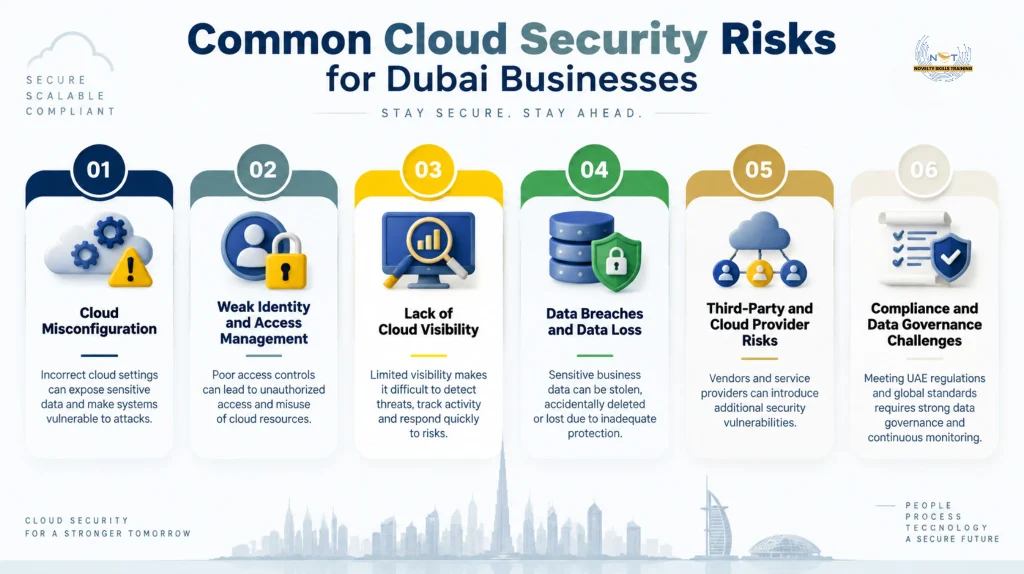
Common Cloud Security Risks for Dubai Businesses
Unlike traditional IT environments, cloud involves providers, users, applications, devices and third-party services. This creates new risks where a simple mistake such as incorrect permissions or a misconfigured service can expose sensitive business information.
1. Cloud Misconfiguration
Cloud misconfiguration occurs when cloud services, resources or security settings are incorrectly configured, potentially exposing sensitive data, applications or infrastructure to unauthorized access.
2. Weak Identity and Access Management
Weak identity and access management occurs when users, applications or devices have inappropriate access to cloud resources due to excessive permissions, weak authentication or outdated access privileges.
3. Lack of Cloud Visibility
Lack of cloud visibility refers to limited awareness of data, users, applications, workloads and access permissions across cloud environments, making it harder to identify security gaps and suspicious activity.
4. Third-Party and Cloud Provider Risks
Third-party and cloud provider risks arise when external providers, vendors or technology partners introduce security vulnerabilities through weak controls, inadequate security practices or unclear responsibilities.
Cloud Protection – Best Practices for UAE Businesses
For UAE businesses, effective security requires layered protection across identities, data, endpoints, applications and infrastructure. The goal is to prevent threats, detect unusual activity quickly and maintain operations when incidents occur.
Key Cloud Security Solutions and Best Practices
- Strengthen Identity & Access: Use MFA, role-based access and least-privilege controls so users only access the resources required for their roles.
- Protect Sensitive Data: Use encryption, data classification and DLP controls to protect information across its lifecycle.
- Monitor Cloud Activity: Centralized logging, continuous monitoring and SIEM can help identify suspicious activity and support faster incident response.
- Strengthen Endpoint Protection: Cloud-based protection can use threat intelligence, AI and machine learning to identify emerging threats rapidly. Microsoft states that Defender Antivirus cloud protection can provide real-time protection and identify new threats before an endpoint is infected.
- Review Configurations Regularly: Continuously assess cloud computing settings, permissions and security policies to identify misconfigurations and security gaps.
- Maintain Backup & Recovery: Keep secure backups and recovery procedures for critical systems to reduce disruption following security incidents.
- Follow Applicable UAE Requirements: Businesses should align their cloud governance, security controls and provider arrangements with the requirements applicable to their sector. For UAE-regulated financial institutions, this includes relevant Central Bank cloud-computing requirements. The Central Bank rulebook page is currently access-restricted, so I have not attributed specific controls to it here.
For UAE businesses, this should be treated as an ongoing process, combining prevention, monitoring, response and recovery rather than relying on a single security tool.
Cloud Security Solutions and Tools Used in the UAE
UAE organizations use cloud-native and third-party technologies to secure cloud environments. These solutions support cloud posture management, workload protection, infrastructure security, network security, and identity and access management.
1. Cloud Posture and Workload Security
CNAPP and CSPM platforms help identify risks such as misconfigurations, vulnerabilities, exposed resources, excessive permissions, and compliance gaps.
- Wiz: Provides cloud visibility, posture management, risk prioritization, and exposure analysis.
- Prisma Cloud: Protects cloud workloads, containers, and applications while supporting vulnerability and compliance management.
2. Cloud Provider Security Services
Cloud providers offer integrated tools to protect resources on their platforms by centralizing findings, assessing risks, monitoring configurations, and detecting threats.
- AWS Security Hub: Consolidates and prioritizes security findings across AWS services.
- Microsoft Defender for Cloud: Assesses security posture and protects workloads across Azure, hybrid, and multicloud environments.
- Google Security Command Center: Provides security visibility, risk management, vulnerability assessment, and threat detection.
UAE organizations may also use Moro Hub and G42 Cloud (Core42) where sovereign cloud, local hosting, or data residency is important.
3. Network and Access Security
SASE, CASB, and Zero Trust solutions secure connections between users, devices, applications, and cloud services, particularly in remote and distributed environments.
Examples include:
- Zscaler: Provides secure internet access, cloud application security, and Zero Trust Network Access.
- Prisma Access: Provides cloud-based network security, secure remote access, and SASE capabilities.
- Cisco Secure Access: Supports Zero Trust access, secure connectivity, and policy-based protection.
These solutions help organizations control access, secure remote connections, manage SaaS usage, and enforce security policies across distributed environments.
The Future of Cloud Cybersecurity in the UAE
As cloud adoption continues to expand across the UAE, cybersecurity is evolving from incident response to proactive threat prevention. Businesses are increasingly focusing on identifying risks earlier, improving visibility and strengthening their ability to respond to emerging cyber threats.
A recent development reported by The Asian Banker highlighted a partnership between Cyble and the UAE Cyber Security Council to enhance national threat-intelligence capabilities. The initiative focuses on strengthening cyber threat visibility, intelligence sharing and collaboration across the cybersecurity ecosystem.
For cloud environments, this shift will drive greater adoption of:
- AI-powered threat detection: Using advanced analytics to identify suspicious activity and emerging threats faster.
- Continuous cloud monitoring: Maintaining real-time visibility across users, applications and cloud resources.
- Threat intelligence sharing: Enabling organizations and cybersecurity bodies to collaborate and respond to evolving threats.
- Cloud resilience strategies: Strengthening backup, recovery and security controls to maintain business continuity.
As UAE organizations continue moving critical operations to the cloud, the future of cloud cybersecurity will depend on building intelligent, adaptive and resilient security frameworks.
Conclusion
As cloud adoption continues to expand across the UAE, securing digital infrastructure has become a key priority for protecting sensitive data, ensuring business continuity and maintaining customer trust. Effective cloud security requires a proactive approach that combines strong access controls, continuous monitoring, data pro
tection and rapid threat response.
To support this evolving cybersecurity landscape, organizations need professionals with practical knowledge of security, threat detection and risk management. Novelty Skills Training helps learners develop industry-relevant cybersecurity skills through hands-on, career-focused training aligned with real-world security challenges. By building the right expertise, businesses can strengthen their cloud capabilities and confidently embrace the UAE’s digital future.
Frequently Asked Questions
1. What are the major Cloud security UAE challenges businesses face?
Businesses adopting Cloud security UAE solutions face challenges like data protection, access control, compliance, and threat management. A strong Cloud security strategy helps organisations reduce these risks.
2. What are the common Cloud security risks for UAE businesses?
Common Cloud security risks include misconfigurations, weak access controls, data exposure and third-party vulnerabilities. Effective Cloud protection and monitoring help businesses improve security.
3. What are the best Cloud security solutions for businesses?
Cloud security solutions protect business data, applications and infrastructure through encryption, identity management, threat detection, and backup strategies.
4. How does Cloud protection help businesses?
Cloud protection helps prevent unauthorized access, detect cyber threats and secure sensitive information using encryption, monitoring and access controls.
5. How can businesses improve their Cloud security strategy?
Businesses can strengthen their Cloud security strategy by implementing MFA, reviewing permissions, monitoring activities and conducting regular cloud security assessments.
6. Why is Cloud security UAE important for regulated industries?
Cloud security UAE is essential for regulated industries like healthcare, banking and government to protect sensitive data, maintain compliance and support secure digital transformation.
7. How do Cloud security solutions support digital transformation?
Cloud security solutions help businesses adopt cloud technologies securely by improving visibility, managing risks and strengthening digital resilience.