Cyber Threat Intelligence (CTI) gives organizations visibility into emerging cyber risks by revealing threat patterns, attacker behavior, and potential attack paths. It helps security teams turn threat information into timely intelligence, allowing them to prioritize risks, strengthen defenses, and prepare for attacks before they disrupt critical systems or business operations.
Organizations in the UAE face a staggering volume of cyber threats, with cyber attacks recently reaching 640,000 to 800,000 in a single day. With the UAE being the major victim for a significant share of cyberattacks across the Middle East and regional data breaches costing millions, cybersecurity teams need more than reactive defenses. Cyber Threat Intelligence provides security teams with greater visibility into the threat landscape, helping them understand threat actors, anticipate their tactics, identify warning signals, and make proactive security decisions rather than simply reacting to incidents.
As Dubai businesses aggressively adopt cloud platforms, connected devices, and AI-driven technologies, Cyber Threat Intelligence (CTI) has transitioned from a specialized luxury into an operational necessity. To defend this expanding infrastructure, the local market urgently requires skilled professionals capable of converting threat data into proactive security actions. This strategic shift is underscored by the UAE Cyber Security Council, which recently formed partnerships with global firms at GISEC Global Dubai to expand national threat intelligence sharing and establish early warning defenses against complex regional risks.
What is Cyber Threat Intelligence?
Cyber Threat Intelligence (CTI) is the process of collecting, analyzing, and using information about potential or existing cyber threats to help organizations detect, prevent, and respond to cyberattacks. It transforms raw cybersecurity data into actionable insights that help security teams understand attackers, their techniques, and the risks they pose.
Key aspects of Cyber Threat Intelligence include:
- Proactive Security: Identifies potential threats before they impact an organization, moving beyond traditional approaches that primarily respond after an incident occurs.
- Threat Monitoring: Helps security teams monitor attacker activities, analyze emerging threats, identify vulnerabilities, and strengthen defense strategies.
- Data Collection: Gathers information from multiple sources, including security systems, threat reports, malware analysis, vulnerability databases, and dark web monitoring platforms.
- Threat Analysis: Examines collected data to identify Indicators of Compromise (IoCs), attacker behaviors, and Tactics, Techniques, and Procedures (TTPs) used by cybercriminals.
- Actionable Insights: Converts raw and analyzed threat data into useful intelligence that supports threat detection, prevention, response, and informed security decisions.
Cyber Threat Intelligence is generally used by Security Operations Centers (SOCs), incident response teams, threat analysts, and cybersecurity professionals to improve threat detection and response. By providing a deeper understanding of cyber risks and attacker methods, CTI plays an important role in building stronger cybersecurity defenses.
Why is Cyber Threat Intelligence Important?
- Mitigating Exponential Financial Damage
Cyber Threat Intelligence provides financial visibility into real-world incident economics, enabling enterprises to transition security budgets from speculative cost sinks into precise, risk-calculated business enablers. Without baseline CTI metrics, organizations struggle to quantify risk or justify defensive spending until an active breach occurs.
Global average data breach costs reached an unprecedented high of $4.99 million in the 2026 IBM Cost of a Data Breach Report, presenting a massive financial challenge to unprotected enterprise infrastructures.
- Neutralizing AI-Enabled and Machine-Speed Attacks
Threat actors are utilizing automated workflows and generative AI to quickly scan network edges and build active exploits. CTI serves as a vital tool to map out these artificial intelligence behavioral models, giving defenders the tactical context needed to patch flaws before automated malware begins mutating inside the network perimeter.
- Prioritizing Vulnerability Remediation Pipelines
Modern IT systems face a massive influx of software updates, leading to patching backlogs and severe operational friction for security engineering teams. CTI reduces this friction by providing threat-hunting teams with real-time indicators showing which software flaws are being actively exploited globally, allowing security teams to patch the most critical gaps first.
Threat actors have shifted away from standard credential abuse, with a staggering 31% of data compromises now originating from direct software vulnerability exploits, according to the 2026 Verizon Data Breach Investigations Report.
- Combatting Pervasive Ransomware Deployments
Ransomware has evolved from simple file encryption into multi-tier extortion campaigns that halt business operations and compromise supply chains. Organizations rely heavily on operational threat feeds to study active threat groups’ Tactics, Techniques, and Procedures (TTPs), helping them recognize early network compromises before corporate assets are permanently locked down.
High-impact ransomware incidents continue to dominate the cybercrime landscape, accounting for 48% of all data breaches recorded in the 2026 Verizon DBIR Dataset.
Types of Threat Intelligence
Cyber Threat Intelligence is divided into different types because organizations require different levels of information depending on their security goals, teams, and decision-making needs. A security analyst monitoring daily attacks requires different intelligence compared to an executive planning long-term cybersecurity strategies. These intelligence types help convert threat data into actionable insights for detection, prevention, and response.
- Strategic Threat Intelligence:
Strategic intelligence helps organizations understand the broader cyber threat landscape, including emerging risks, threat actor motivations, industry trends, and potential business impact. It supports long-term cybersecurity planning and helps leadership make informed decisions about security investments and risk management.
- Tactical Threat Intelligence:
Tactical intelligence focuses on the Tactics, Techniques, and Procedures (TTPs) used by attackers. It helps security teams understand how cybercriminals conduct attacks and improve defensive measures such as threat hunting, security monitoring, and prevention strategies.
- Operational Threat Intelligence:
Operational intelligence provides insights into active or upcoming cyber campaigns, threat actor activities, and attack patterns. It helps incident response teams prepare for potential attacks, prioritize investigations, and respond more effectively to security incidents.
- Technical Threat Intelligence:
Technical intelligence focuses on detailed and immediate threat indicators, such as Indicators of Compromise (IoCs), malware signatures, malicious IP addresses, domains, and file hashes. It enables Security Operations Centers (SOCs) to detect threats faster and improve automated security responses.
Using these different types of threat intelligence together allows organizations to gain a complete understanding of cyber threats — from high-level risks affecting business decisions to technical indicators required for immediate threat detection and response.
Who Benefits from Threat Intelligence?
Cyber threat intelligence is not a one-size-fits-all solution; different teams within an organization require distinct data formats to protect assets, manage risk, and make informed business decisions. By translating raw threat data into actionable insights, threat intelligence serves everyone from the technical staff handling daily alerts to executives safeguarding corporate revenue.
- Security Operations & Incident Response (SOC/IR): Technical teams use machine-readable intelligence to automatically block malicious infrastructure, respond swiftly to live intrusions, and filter out false alarms.
- Threat Hunters & Security Architects: Tactical and operational intelligence allows defense engineers to proactively search networks for stealthy adversaries and patch system vulnerabilities before they are actively exploited.
- Chief Information Security Officers (CISOs) & Executive Leadership: Strategic intelligence delivers a bird’s-eye view of geopolitical risks, competitor targeting, and industry trends. This helps leadership allocate budgets effectively and align cybersecurity maturity with global business objectives.
5 Best Practices to Make Effective Use of Cyber Threat Intelligence
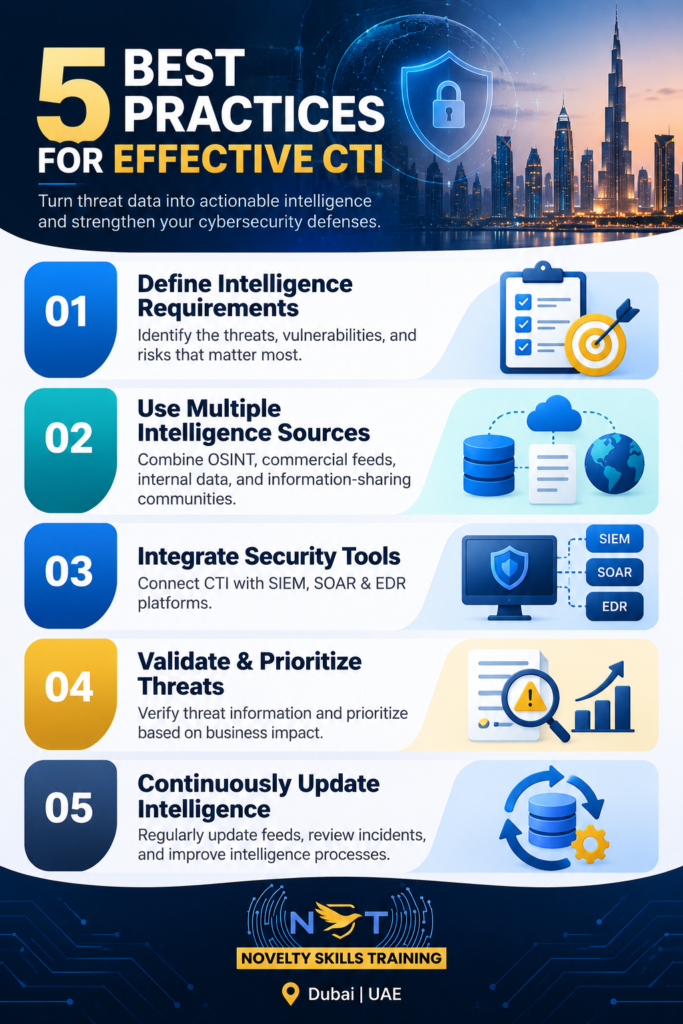
1. Define Clear Intelligence Requirements
Organizations should identify what threat information is most valuable for their security goals. This includes understanding targeted threat actors, attack methods, vulnerabilities, and industry-specific risks before collecting intelligence. A clear direction helps security teams focus on actionable data instead of unnecessary alerts.
Cyber threat intelligence programs should follow a structured lifecycle involving planning, collection, processing, analysis, and dissemination. According to NIST (2020), organizations should maintain continuous threat awareness and integrate security intelligence into risk management processes.
2. Use Multiple Threat Intelligence Sources
Relying on a single intelligence source can create visibility gaps. Organizations should combine internal security data with external threat feeds to build a complete threat picture. Trusted sources such as government advisories, industry reports, and security platforms help improve detection accuracy.
Types of Threat Intelligence Sources:
- Open-Source Intelligence (OSINT) – Publicly available threat reports and security research.
- Commercial Intelligence Feeds – Paid feeds providing specialized threat data.
- Internal Intelligence – Logs, incident reports, and security monitoring data.
- Information Sharing Communities – Threat data shared among organizations and security groups.
Organizations increasingly combine open-source intelligence (OSINT), commercial feeds, and internal security data to improve threat visibility. The Cybersecurity and Infrastructure Security Agency (CISA) provides regularly updated vulnerability and threat information through its Known Exploited Vulnerabilities (KEV) catalog.
3. Integrate Threat Intelligence with Security Tools
Threat intelligence becomes more effective when connected with security solutions such as SIEM, SOAR, and Endpoint Detection and Response (EDR) platforms. Integration allows teams to automatically correlate threat indicators with security events and respond faster.
Common Integrations:
- SIEM Integration – Detects suspicious activity by correlating threat data with logs.
- SOAR Integration – Automates investigation and response workflows.
- EDR Integration – Identifies endpoint-based threats using updated indicators.
Security teams use frameworks such as MITRE ATT&CK to map attacker behaviours, techniques, and procedures (TTPs), helping threat intelligence analyst
understands real-world attack patterns. The framework was introduced in 2013 and continues to be widely adopted for threat modelling and detection improvement.
4. Validate and Prioritize Threat Information
Not every threat indicator requires immediate action. Security teams should verify intelligence quality, check relevance, and prioritize threats based on business impact. Frameworks such as MITRE ATT&CK help map attacker behaviors’ and improve threat analysis.
Security teams use frameworks such as MITRE ATT&CK to map attacker behaviours, techniques, and procedures (TTPs), helping threat intelligence analyst understands real-world attack patterns. The framework was introduced in 2013 and continues to be widely adopted for threat modelling and detection improvement.
5. Continuously Update and Improve Intelligence Processes
Cyber threats evolve constantly, so threat intelligence programs must be reviewed regularly. Organizations should update threat feeds, analyze previous incidents, and improve intelligence workflows to maintain effective defense capabilities.
Threat intelligence requires continuous monitoring because cyber threats evolve rapidly. The 2023 Verizon Data Breach Investigations Report (DBIR) analyzed thousands of security incidents and highlighted the importance of understanding attack patterns for improving defensive strategies.
Conclusion
As the threat landscape becomes more targeted and complex, organizations need cybersecurity professionals who can interpret threat intelligence and translate it into timely security action. Upskilling in areas such as threat analysis, IoCs, TTPs, vulnerability assessment, and security monitoring can help professionals build the practical capabilities required to work with modern threat intelligence.
Novelty Skills Training (NST) helps professionals strengthen these capabilities through industry-focused cybersecurity training that combines technical concepts with practical application. Developing these skills can help cybersecurity professionals stay current with evolving threats and prepare for roles that increasingly require threat intelligence expertise.
FAQs
1. What is Cyber Threat Intelligence?
Ans. Cyber Threat Intelligence collects and analyzes threat information to provide actionable insights for proactive cybersecurity and informed decisions.
2. What is the threat intelligence lifecycle?
Ans. The threat intelligence lifecycle involves planning, collection, processing, analysis, dissemination, and feedback to continuously improve intelligence outcomes.
3. Why is threat intelligence important for organizations in the UAE?
Ans. Threat intelligence UAE helps organizations identify emerging risks, protect critical infrastructure, manage vulnerabilities, and strengthen cybersecurity operations.
4. What does a threat intelligence analyst do?
Ans. A threat intelligence analyst investigates threat data, monitors threat actors, analyzes attack patterns, and provides actionable security recommendations.
5. What are the common threat intelligence tools used by cybersecurity professionals?
Ans. Common threat intelligence tools include Recorded Future, Mandiant Threat Intelligence, IBM X-Force Exchange, MISP, SIEM, and intelligence platforms.
6. What are the different types of threat intelligence?
Ans.The four major types are strategic, tactical, operational, and technical threat intelligence, each supporting different cybersecurity objectives.
7. How does Cyber Threat Intelligence improve cybersecurity?
Ans.Cyber Threat Intelligence enables earlier threat detection, faster response, stronger vulnerability management, and better-informed cybersecurity decisions.
8. What skills are required to become a threat intelligence analyst?
Ans.Threat intelligence analysts need cybersecurity, threat analysis, network security, malware analysis, SIEM, TTP, and MITRE ATT&CK knowledge.