
Healthcare research careers in the UAE offer strong entry-level opportunities in clinical research, data management, pharmacovigilance, and healthcare analytics. With AI skills like Python, machine learning, and data analysis, freshers can contribute to faster clinical trials, better data insights, and improved drug safety, making them more competitive in a rapidly evolving, data-driven healthcare industry.
Introduction
Breaking into a career in healthcare research can feel challenging at first. In the UAE, growing opportunities and AI-driven roles are making it easier for freshers to get started in entry-level healthcare research jobs UAE. With the expansion of clinical trials, healthcare data systems, and drug safety processes, there is a growing demand for entry-level professionals with AI and healthcare data skills across the UAE healthcare research sector. For graduates from life sciences, pharmacy, IT, and related fields, this domain provides a clear pathway to build a meaningful, future-ready career aligned with global healthcare demands.
At the same time, expectations from these roles are evolving. Across clinical trials, data management, and drug safety, many routine tasks are now supported by automation and AI, shifting the focus toward data interpretation, quality checks, and decision support. At the same time, organizations are increasingly using integrated digital platforms and centralized data systems, making it essential for professionals to work across tools, not in isolated tasks. As a result, freshers entering this field are expected to have practical exposure to data-driven workflows and a basic understanding of AI in healthcare, making them more effective in modern research environments.
In the UAE, Insilico Medicine, in collaboration with the Emirates Drug Establishment and supported by the Abu Dhabi Investment Office, has demonstrated how AI can reduce drug discovery timelines from years to months, highlighting how AI is becoming essential to accelerate healthcare research, improve efficiency, and enable faster development of new treatments.
In this blog, we are going to see how healthcare research careers serve as a strong starting point, how AI is reshaping these roles, the key skills required, and the opportunities available in this evolving field.
The Role of AI in Modern Healthcare Research in UAE
To identify where career opportunities are growing, it is important to first understand how AI is applied across different areas of healthcare research and how it is changing the way work happens.
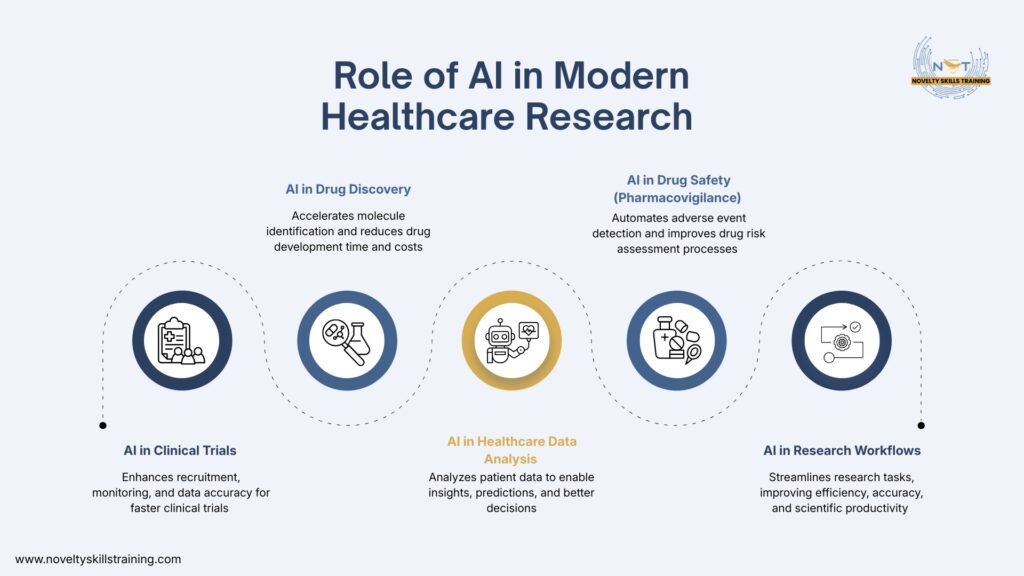
AI in Clinical Trials
The UAE is advancing toward a digitally enabled research ecosystem where clinical trials are faster and more precise with AI. Earlier, fragmented patient data, slow participant identification, and manual monitoring delayed approvals and extended timelines. These gaps are overcome through predictive analytics platforms, EHR mining tools, and risk-based monitoring systems, enabling efficient participant identification and real-time tracking to detect deviations early and improve trial quality. This shift was demonstrated by G42 Healthcare during COVID-19 vaccine trials, where AI streamlined recruitment and enhanced data analysis, improving speed, accuracy, and overall trial efficiency.
AI in Drug Discovery
AI is accelerating drug discovery in the UAE by making research more targeted and efficient. Traditional development relied on lengthy experimental cycles with high failure rates due to complex biological systems, often taking 10–15 years to reach clinical stages. AI-driven approaches leverage machine learning models, molecular simulation platforms, and genomic analysis tools to interpret biological data, understand molecular behavior, and identify promising candidates earlier. For example, Insilico Medicine has reduced preclinical timelines from the standard 3–6 years to around 12–18 months, significantly accelerating early-stage discovery and improving research efficiency.
AI in Healthcare Data Analysis
AI is transforming healthcare data analysis in the UAE by converting large volumes of patient and clinical data into actionable insights. Earlier, fragmented systems and manual processing limited pattern recognition and accurate outcome prediction. Today, this shift is enabled by data integration platforms, predictive analytics engines, and clinical decision support systems that combine structured and unstructured data for faster analysis, risk prediction, and improved decision-making. A key example is PureHealth’s AI-driven “PureNet” platform, which integrates data across hospitals and laboratories to detect early disease indicators, automate data management, and support clinical research, enabling faster, more accurate, and data-driven healthcare innovation.
AI in Drug Safety
In the UAE, drug safety is evolving into a proactive, data-driven model where risks are identified earlier and managed effectively. Pharmacovigilance previously depended on manual adverse drug reaction (ADR) reporting and delayed data sharing, which slowed the detection of safety signals. AI enhances this domain through Natural Language Processing (NLP), signal detection algorithms, and pharmacovigilance automation systems, supporting real-time monitoring, faster data processing, and early identification of potential risks. A strong example is Malaffi, which integrates patient records across providers and enables continuous monitoring, creating a strong foundation for improved drug safety outcomes.
AI in Research Workflows
In the UAE, research workflows are becoming more efficient and digitally driven, with streamlined processes and reduced delays. Previously, manual data entry, documentation, and disconnected systems led to inefficiencies and slower collaboration. Workflow efficiency is improved using automation systems, clinical documentation assistants, and data processing platforms, which standardize processes, reduce manual effort, and accelerate report generation. A strong example is the AI physician assistant Amal, introduced by Emirates Health Services, which collects patient data and generates structured summaries, improving accuracy, reducing administrative burden, and enhancing overall workflow speed.
Entry-level Healthcare Research Careers in the UAE Job Market
The UAE’s healthcare sector is rapidly expanding, driven by investments in digital health and AI, creating strong demand for healthcare research careers at the entry level. This growth makes it an ideal starting point for freshers looking to enter the industry.
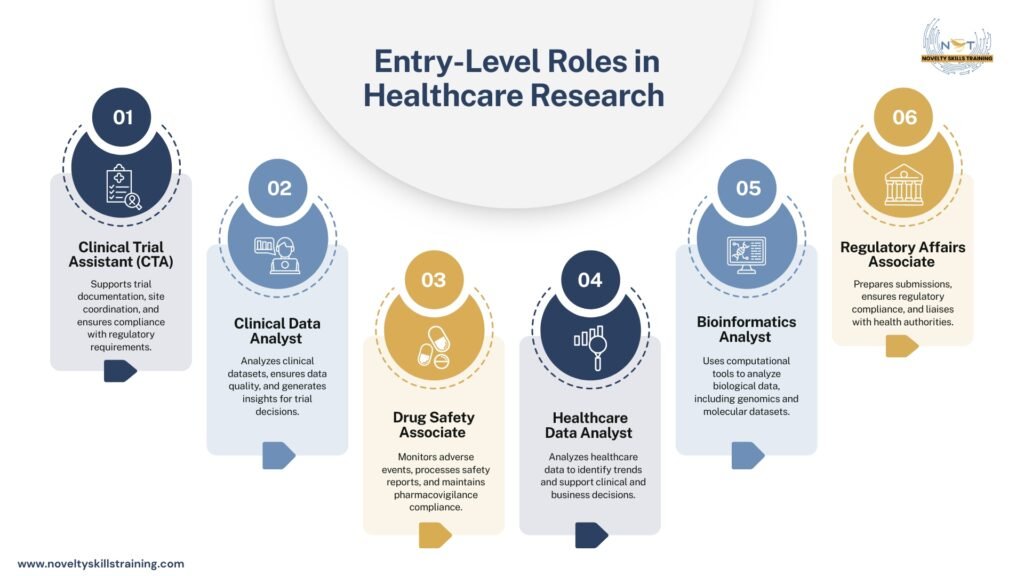
Clinical Research Career
- Clinical research, as a core part of healthcare research careers in the UAE, is growing rapidly due to the country’s focus on becoming a global hub for medical innovation.
- Professionals in this field manage clinical trials, coordinate patient recruitment, ensure protocol compliance, and handle data collection and validation.
- Several global pharmaceutical companies and CROs such as IQVIA, Parexel, ICON plc, and Syneos Health are actively hiring for healthcare research careers in clinical research across the UAE.
- For example, platforms like LinkedIn and Glassdoor often show approximately 200–600+ active job listings for clinical research roles across the UAE and Gulf region at a given time.
- This demand is expected to grow further as the UAE clinical trials market is projected to expand at around 8.9% CAGR through 2033, creating strong entry-level opportunities for freshers with clinical and AI-driven skills.
Clinical Data Management Career
- Clinical data management, as a key part of healthcare research careers in the UAE, is expanding rapidly with the country’s focus on digital health and data-driven research.
- Professionals in this field collect, clean, validate, and manage clinical trial data to ensure accuracy, consistency, and regulatory compliance.
- Several global pharmaceutical companies and CROs such as IQVIA, Parexel, ICON plc, and Syneos Health are actively hiring for healthcare research careers in clinical data management across the UAE.
- For example, platforms like LinkedIn and Glassdoor often show approximately 150–400+ active job listings for clinical data management and related roles across the UAE and Gulf region at a given time.
- This demand is expected to grow steadily, supported by the UAE clinical data analytics market projected to grow at around 6.4% CAGR (2024–2030), highlighting rising demand for data management, validation, and analytics roles in healthcare research.
Pharmacovigilance (Drug Safety) Career
- Pharmacovigilance (drug safety), as a critical part of healthcare research careers in the UAE, is growing steadily with increasing focus on patient safety and regulatory compliance.
- Professionals in this field monitor adverse drug reactions (ADRs), review safety data, perform signal detection, and ensure timely reporting to regulatory authorities.
- Several pharmaceutical companies and service providers such as Pfizer, Novartis, Roche, and AbbVie are actively hiring for healthcare research careers in pharmacovigilance across the UAE.
- For example, platforms like LinkedIn and Glassdoor often show approximately 100–300+ active job listings for pharmacovigilance and drug safety roles across the UAE and Gulf region at a given time.
- This demand is expected to grow steadily, supported by the UAE pharmacovigilance market projected to expand at around 7.11% CAGR through 2030, reflecting increasing emphasis on drug safety, risk management, and AI-driven signal detection in healthcare research
Healthcare Data Analytics Career
- Healthcare data analytics, as a fast-growing segment of healthcare research careers in the UAE, is gaining momentum with the country’s shift toward data-driven decision-making and digital health systems.
- Professionals in this field analyze large volumes of clinical and patient data to generate insights, support predictions, and improve healthcare outcomes.
- Several organizations such as Cerner (Oracle Health), IBM, Optum, and GE HealthCare are actively hiring healthcare research careers in healthcare data analytics across the UAE.
- For example, platforms like LinkedIn and Glassdoor often show approximately 200–500+ active job listings for healthcare data analytics and related roles across the UAE and Gulf region at a given time.
- This demand is expected to grow steadily, supported by the UAE healthcare analytics market projected to expand at around 12.4% CAGR (2024–2030), reflecting strong demand for data analysis, predictive modeling, and AI-driven healthcare insights
Bioinformatics & Drug Discovery Research Career
- Bioinformatics & drug discovery research, as an advanced segment of healthcare research careers in the UAE, is growing with the country’s increasing focus on genomics, precision medicine, and AI-driven research.
- Professionals in this field analyze genomic and molecular data, build computational models, and support drug discovery by identifying potential targets and predicting molecular behavior.
- Several organizations such as G42 Healthcare, M42, Illumina, and Thermo Fisher Scientific are actively hiring for healthcare research careers in bioinformatics and drug discovery across the UAE.
- For example, platforms like LinkedIn and Glassdoor often show approximately 80–250+ active job listings for bioinformatics and drug discovery roles across the UAE and Gulf region at a given time.
- This demand is expected to grow rapidly, supported by the UAE genomics market projected to expand at around 11.8% CAGR (2025–2033), reflecting increasing investment in bioinformatics, AI-driven drug discovery, and precision medicine
Regulatory Affairs & Clinical Documentation Career
- Regulatory affairs & clinical documentation, as a vital part of healthcare research careers in the UAE, is growing with the country’s increasing focus on compliance, faster approvals, and structured healthcare systems.
- Professionals in this field manage regulatory submissions, maintain clinical documentation, ensure compliance with guidelines, and support approval processes for drugs and clinical trials.
- Several organizations such as Pfizer, Novartis, Roche, and AstraZeneca are actively hiring for healthcare research careers in regulatory affairs and clinical documentation across the UAE.
- For example, platforms like LinkedIn and Glassdoor often show approximately 120–300+ active job listings for regulatory affairs and documentation roles across the UAE and Gulf region at a given time.
- This demand is expected to grow steadily, supported by the UAE regulatory affairs outsourcing market projected to expand at around 2.6% CAGR (2024–2030), reflecting increasing need for compliance, documentation, and faster approval processes in healthcare research
AI & ML Healthcare Training Program
Course Overview
Learn how artificial intelligence and machine learning are transforming healthcare systems, clinical decision-making, and medical data analysis. This program focuses on real-world applications such as predictive analytics, patient data insights, and AI-driven healthcare solutions relevant to modern healthcare environments.
VIEW COURSESkills You’ll Build
- Healthcare Data Analytics
- Machine Learning Fundamentals
- Predictive Modeling
- Clinical Data Interpretation
- AI in Healthcare Applications
- Data Visualization
- AI-Driven Decision Support
Key Skills for Entry-Level Healthcare Research Careers
Healthcare research careers require a mix of technical and domain skills to manage data-driven workflows effectively. Below are the essential skills needed to begin your journey in this field.
AI & Technical Skills for Healthcare
To start a career in healthcare research, freshers need practical exposure to tools used in data analysis and AI-driven workflows
- Python Programming
Used for analyzing datasets, automating workflows, and building scalable solutions across research and clinical environments
- NumPy & Pandas
Essential libraries for cleaning, transforming, and structuring complex datasets for analysis and machine learning tasks
- SQL & Database Handling
Enables efficient extraction, querying, and organization of large-scale clinical and hospital information
- Machine Learning Fundamentals
Helps develop predictive models to uncover patterns, risks, and trends for informed decision-making
- Deep Learning Basics
Supports advanced use cases such as medical imaging and complex pattern recognition using neural networks
- Data Visualization (Power BI / Tableau)
Converts complex information into interactive dashboards that support clear insights and faster decisions
- Statistics for Healthcare Data
Provides techniques to validate findings, test hypotheses, and ensure accuracy in research outcomes
- AI in Healthcare Applications
Applies intelligent systems to enhance diagnostics, predict outcomes, and optimize patient care strategies
Healthcare Domain skills
Along with technical expertise, understanding healthcare processes is equally important for applying these skills effectively.
- Healthcare Data Understanding
Builds the ability to handle structured and unstructured medical information across diverse healthcare environments
- Clinical Workflow Awareness
Provides clarity on how hospitals, clinical trials, and healthcare systems operate in real-world settings
- AI in Clinical Decision Support
Focuses on using AI-generated insights to assist in diagnosis, risk assessment, and treatment planning
- Digital Health Systems Awareness
Develops familiarity with EMR/EHR systems and integrated platforms used to manage patient information
- Medical Data Interpretation
Enables extracting meaningful insights by connecting clinical context with analytical outputs and research findings
Entry-Level Salary Trends in Healthcare Research
Career progression in healthcare research is becoming more dynamic, with clear pathways from foundational roles to specialized positions. As expertise develops, professionals can move into advanced areas that focus on innovation, optimization, and strategic contributions to healthcare outcomes.
General Management in Healthcare
Course Overview
Learn how healthcare organizations are managed across operations, administration, and patient services. This program focuses on real-world healthcare management practices such as hospital operations, resource planning, quality management, and leadership in modern healthcare systems.
VIEW COURSESkills You’ll Build
- Healthcare Operations Management
- Hospital Administration
- Resource Planning
- Quality & Compliance Management
- Healthcare Leadership
- Patient Experience Management
- Process Optimization
Future Trends in Healthcare Research with AI in UAE
Healthcare research is entering a transformative phase driven by AI, data intelligence, and precision medicine. Future trends are shifting healthcare from reactive treatment to predictive, personalized, and intelligent systems that improve decision-making and patient outcomes.
“Sovereign AI” and National Data Rails
The UAE’s healthcare ecosystem is moving toward a future built on sovereign AI and unified national data intelligence, where healthcare data is securely governed, locally processed, and transformed into actionable clinical insight. In this direction, models like Falcon LLM are expected to function as a core intelligence layer, enabling advanced clinical decision support, automating documentation at scale, and delivering care that is context-aware and culturally aligned with the population it serves.
At the same time, integrated health information systems such as Malaffi and NABIDH will evolve into a seamless national data backbone, allowing real-time exchange of clinical information across providers. This unified infrastructure is expected to unlock deeper research insights, strengthen system-wide efficiency, and enable a highly connected, intelligent-led healthcare ecosystem.
Large-Scale Genomics and Precision Medicine
The UAE’s investment in genomics is shaping a future where healthcare shifts decisively from generalized treatment models to deeply personalized and predictive medical care at scale. Through initiatives like the Emirati Genome Program, AI will increasingly power early identification of genetic risk patterns, enabling intervention long before disease onset.
Over time, this will redefine the entire care model into one that is prevention-first and precision-driven, where treatment pathways are dynamically tailored to an individual’s genetic makeup, biological risk factors, and long-term health predictions. This evolution is expected to significantly elevate clinical precision, reduce disease burden, and transform how chronic and complex conditions are managed.
Agentic AI and Smart Hospital Operations
Healthcare systems in the UAE are progressing toward a future where AI evolves from supportive intelligence into autonomous clinical collaborators capable of executing complex healthcare workflows. Agentic AI systems, along with ambient clinical scribes, are expected to understand clinical conversations in real time, structure medical documentation intelligently, and integrate seamlessly into hospital ecosystems, significantly transforming administrative and clinical efficiency.
At the same time, predictive intelligence will become deeply embedded in hospital operations, continuously analyzing patient data streams to detect deterioration patterns and enable earlier, faster, and more precise clinical intervention. Initiatives such as Smart Dubai are accelerating this shift toward intelligent, responsive, and continuously learning healthcare environments that proactively support clinicians and improve patient outcomes.
Ethical Governance and Explainable AI (XAI)
As AI becomes foundational to healthcare delivery, the UAE is actively shaping for a future where innovation is matched with strong ethical governance, transparency, and clinical accountability frameworks. Regulatory systems are expected to require AI models to be fully explainable, ensuring that every recommendation, alert, or prediction can be clearly interpreted by clinicians, strengthening trust in AI-driven healthcare decisions.
Alongside this, the establishment of structured leadership roles such as Chief AI Officers across public sector healthcare entities reflects a forward-looking governance model designed to ensure responsible deployment, continuous oversight, and alignment of AI systems with national healthcare priorities. This ensures that as AI capabilities expand, they remain safe, transparent, and clinically reliable at every level of adoption.
Strengthen Learning with Certifications
In the UAE’s healthcare sector, certifications go beyond formal recognition—they demonstrate job readiness and industry relevance. Programs in AI, healthcare data management, and analytics, combined with hands-on training and mentorship, help professionals build practical skills, gain credibility, and transition more effectively into entry-level roles.
Choosing the right course is essential when starting your career. Focus on programs that prioritize real-world application, industry alignment, and practical exposure over theory. At Novelty Skills Training, programs are designed to match the UAE’s growing demand for skilled healthcare professionals, helping you build a strong and career-ready foundation.
Conclusion
Healthcare research is entering a major transformation, driven by AI, data intelligence, and evolving healthcare systems. Across clinical research, drug safety, genomics, and healthcare analytics, AI is not replacing roles but redefining them into more analytical, data-driven, and decision-focused careers. This shift is creating stronger opportunities for professionals who can work with data, understand healthcare processes, and apply AI tools in real-world environments.
For aspiring professionals, success in this evolving landscape depends on early clarity of direction, consistent practical learning, and strong alignment with industry expectations. Building the right mix of technical and domain skills will be essential to stay relevant in AI-powered healthcare ecosystems. With a focused approach and continuous skill development, healthcare research offers a future-ready career path where innovation, AI, and human expertise work together to improve patient outcomes and healthcare efficiency.