Dubai is no longer experimenting with the future of artificial intelligence. It is building around it. Agentic systems, sovereign cloud, Arabic-first AI, predictive models, robotics, digital twins, and AI-enabled regulation are being woven directly into the emirate’s core infrastructure, marking a shift from isolated pilots to production-scale deployment. This shift is powered by the compute, data, governance, and workforce capabilities needed to sustain AI at scale.
The result is intelligence that extends well beyond government, quietly shaping decisions across the private sector too. Rather than treating AI as a standalone technology, Dubai is building an interconnected ecosystem, one that is redefining the future of artificial intelligence in the region.
Core AI Trends Shaping Dubai’s Transformation
Dubai is building an AI-native operating model connecting government, infrastructure and business, shaping the future of artificial intelligence through autonomous, predictive and scalable AI.
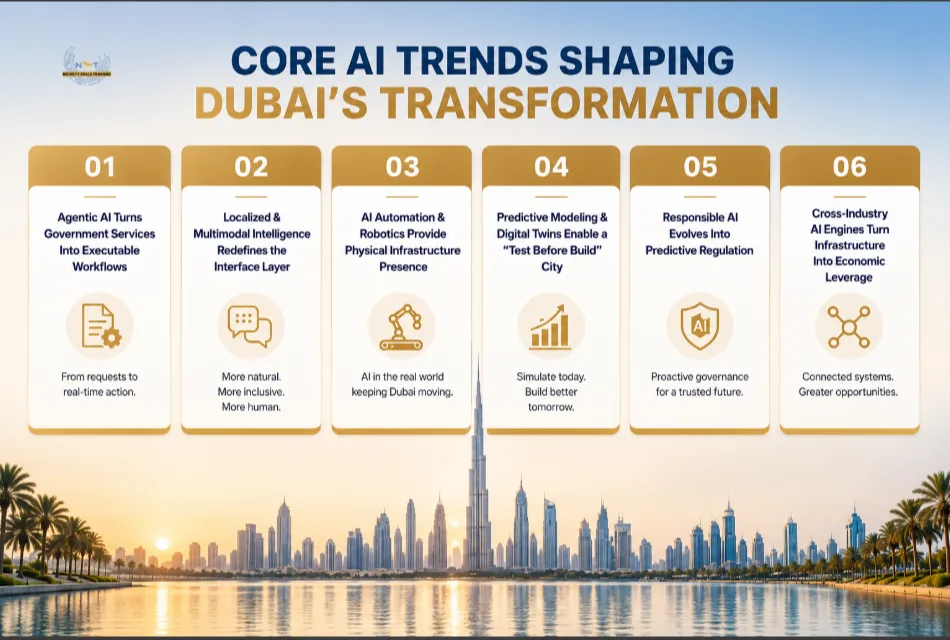
1. Agentic AI Turns Government Services Into Executable Workflows
Agentic AI transforms government services by converting complex processes into autonomous workflows, specifically targeting permits, citizen requests, healthcare access, and business registrations. This autonomous delivery directly supports the UAE’s strategic goal to transition half of all government operations into agentic workflows within two years.
2. Localized & Multimodal Intelligence Redefines the Interface Layer
In Dubai, multimodal AI is reshaping digital services by combining voice, vision, and data understanding to power smarter government interactions, automated inspections, and context-aware solutions across healthcare and business ecosystems.
| Local AI Capability | Dubai-Specific Application |
|---|---|
| Arabic-First Intelligence | Arabic-language citizen services and government information retrieval |
| Regulatory Understanding | Municipal rules, zoning requirements and commercial regulations |
| Contextual Content Generation | Creating, translating and summarizing government and business documents |
3. AI Automation & Robotics Provide Physical Infrastructure Presence
AI is transforming Dubai’s physical infrastructure by automating baggage handling, cargo movement, warehouse operations, delivery logistics, port activities, and inspections through robotics, drones, and autonomous systems.
4. Predictive Modeling & Digital Twins Enable a “Test Before Build” City
Physical Environment → IoT Sensors & Data Collection → Digital Twin Model → AI-Based Simulation & Prediction → Intelligent Optimization & Decision Execution
Combining predictive AI with digital twins allows Dubai to anticipate near-term demand and test long-term urban scenarios. This can help model traffic, water consumption, and infrastructure strain while stress-testing development plans before major capital or construction commitments.
5. Responsible AI Evolves Into Predictive Regulation
Data Collection → AI Processing → Regulatory Context Analysis → Compliance Recommendations → Human Decision-Making
The UAE’s Regulatory Intelligence Office uses regulatory data, legislation, judicial rulings, and government procedures to support regulation. The UAE government says the approach can accelerate the legislative process by up to 70%, demonstrating, while final legislative authority remains with human decision-makers.
6. Cross-Industry AI Engines Turn Infrastructure Into Economic Leverage
Dubai’s AI transformation is anchored by local compute, connected data and shared AI infrastructure. Platforms such as du Tech’s National Hypercloud provide an in-country foundation for high-density AI workloads while supporting data residency requirements.
This infrastructure can support targeted applications across:
- Logistics: Predictive supply-chain routing and intelligent trade operations
- Real Estate: Spatial intelligence, construction modelling and market forecasting
- Healthcare: Population analytics and genomic applications
- Finance: Real-time risk intelligence and fraud monitoring
AI and Dubai’s Workforce: Impact on Jobs and Skills
Dubai’s AI transformation is reshaping work, embedding AI across sectors and defining the future of artificial intelligence. The shift is less about replacing professions and more about changing where human expertise creates value.
| Workforce Shift | Role Change | Valuable Skills | Opportunity |
|---|---|---|---|
| Executor → Workflow Architect | Design and improve AI-enabled workflows instead of manually executing processes. | AI literacy, process design | AI operations |
| Specialist → AI-Augmented Specialist | Use AI to extend existing domain expertise. | Domain expertise + AI | Healthcare AI, smart logistics |
| Data Compiler → Decision Evaluator | Evaluate AI insights instead of manually compiling information. | Data literacy, judgement | Decision-support roles |
| Executor → AI Supervisor | Validate outputs, monitor systems, and handle exceptions. | Critical thinking, AI governance | AI oversight |
| Individual → Human-AI Collaborator | Focus on strategy, creativity, and complex decisions while AI handles routine cognitive work. | Leadership, creativity, problem-solving | Higher-value roles |
| Fixed Skills → Continuous Capability | Continuously adapt as AI tools and workflows evolve. | Generative AI, automation, cybersecurity | Continuous career progression |
The Conclusion: The Future of AI in Dubai
Dubai’s next AI challenge is no longer proving what technology can do; it is redesigning how people, processes and intelligent systems work together. The future of artificial intelligence depends on this transition as organizations rethink workflows, establish human oversight and build infrastructure to move AI from isolated applications into everyday operations.
This makes workforce readiness a strategic requirement. Professionals will need continuous training to collaborate with intelligent systems, evaluate AI-generated outputs and adapt to new problem-solving models. Novel skills training can help bridge this gap by combining emerging technologies with practical workplace capabilities. If Dubai can align technology, talent and execution, AI can evolve from a productivity tool into a core economic capability supporting its next phase of growth.
Frequently Asked Questions
1. What is the future of artificial intelligence in Dubai?
Dubai is moving toward AI-native government, infrastructure and businesses, powered by autonomous and predictive systems.
2. What future of Artificial Intelligence technologies will shape Dubai?
Future AI technologies include agentic AI, Arabic AI, multimodal AI, robotics, predictive systems, and digital twins.
3. What are the key AI predictions for Dubai?
AI predictions point toward autonomous services, predictive regulation, intelligent infrastructure, and wider enterprise adoption.
4. How will AI change Dubai’s workforce?
AI will automate routine tasks while increasing demand for AI, data, critical-thinking, and domain-specific skills.
5. What will the AI future mean for Dubai businesses?
The AI future will see intelligence embedded into logistics, real estate, healthcare and finance workflows.
6. Why is sovereign infrastructure important for AI?
Sovereign cloud provides local compute, data control and secure infrastructure for scaling sensitive AI workloads.
7. Will AI replace jobs in Dubai?
AI will primarily transform tasks and roles, increasing demand for professionals who can work effectively with intelligent systems.