Generative AI creates new text, images, code, audio, and video by learning patterns from large datasets. Its rapid adoption is evident, with 79% of surveyed organizations using it in at least one business function in 2025.
Generative AI is no longer just a buzzword—it is rapidly becoming part of how the world works. From creating content and writing code to analyzing information, generating images, and supporting decision-making, generative artificial intelligence is changing what people can accomplish with technology.
For a generative AI explained perspective, the reason is simple: it is moving rapidly from experimentation to real-world adoption. Businesses across industries are integrating AI into everyday workflows, while companies and governments are investing heavily in AI. At the same time, conversations around AI agents, automation, regulation, safety, and its impact on jobs are shaping the global conversation.
This generative AI explained guide covers how the technology works, its major models, and practical applications. The numbers show this momentum. Stanford’s 2026 AI Index reports that Generative AI reached 53% population adoption within just three years, faster than the personal computer or internet. In 2025, 79% of surveyed organizations reported regularly using Generative AI in at least one business function.
This growing adoption explains why professionals are taking an interest in Generative AI. It can help save time, automate repetitive tasks, improve productivity, and expand existing capabilities. As AI becomes increasingly embedded in workplaces, upskilling in Generative AI is becoming important for professionals who want to adapt, stay relevant, and remain competitive in an AI-driven world.
How Generative AI Works: Understanding Its Core Components
Generative artificial intelligence is a type of artificial intelligence that creates new content such as text, images, code, audio, and video by learning patterns from large amounts of data. Behind these outputs are multiple layers of technology that work together to process information, recognize patterns, and generate relevant responses based on a user’s prompt. To understand how this process works, there are five key components to look at:
- Neural Networks: Computational AI models inspired by the human brain. They consist of interconnected layers of nodes (neurons) that process data, recognize complex patterns, and pass information forward.
- Deep Learning: A subset of machine learning that utilizes deep neural networks (networks with many hidden layers). This architecture allows the AI to learn deep, abstract patterns from massive datasets without human supervision.
- Foundation Models: Massive AI models built using deep learning and trained on vast, generalized datasets. They possess a wide understanding of language, code, or imagery, which can then be adapted for specific tasks.
- Fine-Tuning: The process of taking a pre-trained foundation model and training it further on a smaller, specialized dataset. This teaches the AI to excel at a specific task, such as understanding legal terminology or medical coding.
- Retrieval-Augmented Generation (RAG): A framework that connects a GenAI model to an external, trusted database. When a user asks a question, RAG retrieves relevant facts from the database and hands them to the model, ensuring the AI’s response is accurate, up-to-date, and free of fabrications.
- Effective prompt engineering also helps guide the model toward more relevant outputs.
Generative AI attracted $33.9 billion in global private investment in 2024 , representing an 18.7% increase from 2023, according to Stanford’s 2025 AI Index.
Generative AI Models: Types and Examples
The types of generative AI models are categorized based on the type of content they generate, the data they work with, and the way they are built to process that data. Some models specialize in text or code, while others can work across multiple formats or use different architectures to generate realistic data.
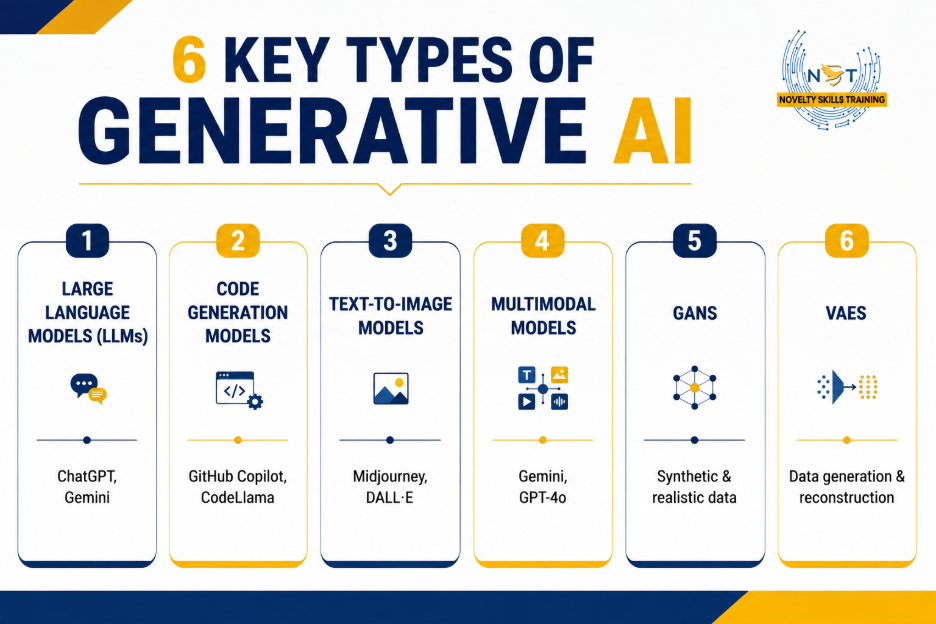
These models can be grouped into six major types, each designed for different capabilities and applications. The key types and examples are:
- Large Language Models (LLMs): These AI models are trained on immense amounts of written human communication to understand and generate text. They support AI text generation, understand context, answer questions, summarize documents, and write coherent content. Leading examples include ChatGPT, Google’s Gemini, and Anthropic’s Claude.
- Code Generation Models: These specialized systems are language models trained and optimized specifically on programming syntax and repositories. They assist developers by automatically writing functional code, translating logic between different programming languages, and identifying hidden bugs. Prominent examples include GitHub Copilot and CodeLlama.
- Text-to-Image Models: These tools use diffusion-based architectures for AI image generation, converting descriptive human sentences into detailed visual assets. They map textual descriptions to visual patterns, allowing users to create graphics, digital art, or prototypes instantly. Popular examples include Midjourney, DALL-E 3, and Stable Diffusion.
- Multimodal Models: These represent the next frontier of AI, capable of processing and generating multiple types of data inputs simultaneously. Instead of being limited to text or images, they can combine and generate text, audio, images, and video, including AI video generation, in a unified workflow. Advanced implementations can be found in the latest versions of Gemini and GPT-4o.
- Generative Adversarial Networks (GANs): This neural network architecture uses two competing models: a Generator that creates fake data and a Discriminator that evaluates it against real data. Through this constant competition, the generator learns to produce hyper-realistic data, making GANs highly effective for deepfakes, image-to-image translation, and enhancing video resolution.
- Variational Autoencoders (VAEs): These models work by compressing input data into a smaller, simplified mathematical representation called a latent space and then reconstructing new data from it. They focus on learning the smooth, underlying probability distribution of the training data. This makes VAEs exceptionally good for tasks like removing noise from signals, compressing data, and generating clean, structured data variations.
Nearly 90% of notable AI models in 2024 originated from industry, compared with 60% in 2023, highlighting the growing role of technology companies in developing advanced AI models.
Generative AI Applications Across Domains
To see how these concepts translate into career fields, explore how different business domains deploy generative AI applications:
1. Generative AI in Software Development — Code Generation and Testing
It is increasingly used to write code, debug programs, document code, and generate tests. In Stack Overflow’s 2024 Developer Survey, 84.76% of professional developers using AI tools reported using them to write code, while 56.74% used them for debugging and getting help and 29.65% for testing code. A 2024 GitHub randomized controlled study involving 202 developers also found that developers using GitHub Copilot were 53.2% more likely to pass all 10-unit tests in the coding task.
2. Generative AI in Cybersecurity — Security Investigation and Incident Response
It can support cybersecurity teams by summarizing security incidents, analyzing scripts, investigating threats, generating remediation recommendations, and helping analysts interpret complex security data. In a Microsoft randomized controlled trial, security professionals using Copilot were 22% faster and 7% more accurate across the tested security tasks; 97% said they wanted to use Copilot again for the same task. The study was reported by Microsoft in 2024.
3. Generative AI in Healthcare — Clinical Documentation and Medical Research Summarization
In healthcare, it is being used for summarizing medical research, creating clinical documentation, generating chart summaries, and drafting patient communications. According to the American Medical Association’s 2026 Physician Survey on Augmented Intelligence, 81% of physicians surveyed reported using AI professionally in 2023. Among the surveyed physicians, 39% used AI to summarize medical research and standards of care, 30% to create discharge instructions/care plans/progress notes, and 28% for medical-chart or visit-note documentation.
How Novelty Skills Training Can Help You?
At Novelty Skills Training, we help professionals and students develop practical expertise in generative artificial intelligence, Artificial Intelligence, and Machine Learning. Our AI ML Course covers Machine Learning and Predictive Modeling, along with Deep Learning and Neural Networks for image, speech, and text applications. You’ll also build skills in Natural Language Processing (NLP) for applications such as sentiment analysis and chatbots, as well as AI deployment using Flask, Docker, and AWS to create scalable, industry-ready solutions.
Conclusion
As AI continues to shape how businesses operate and innovate, developing practical skills in Artificial Intelligence, Machine Learning, and generative artificial intelligence can help professionals stay relevant in a rapidly evolving technology landscape. With the right training and hands-on exposure, you can move beyond understanding AI concepts to applying them in real-world projects and building solutions that create measurable value.
Frequently Asked Questions (FAQs)
1. Is Generative AI difficult to learn for beginners?
No. Basic machine learning knowledge helps, but beginners can start with practical tools and gradually learn advanced AI concepts.
2. Can Generative AI create content in different formats?
Yes. Modern AI models can generate text, images, code, audio, and video, depending on their capabilities.
3. What is the difference between ChatGPT and other AI tools?
ChatGPT is based on large language models (LLMs) and primarily supports tasks such as AI text generation, summarization, reasoning, and conversation.
4. Do I need coding skills to use Generative AI?
Not always. Many tools work through natural-language prompts, while coding becomes more useful for building customized generative AI applications.
5. What skills are useful for a career in Generative AI?
Along with AI fundamentals, useful skills include prompt engineering, machine learning, deep learning, and natural language processing.
6. Is Generative AI useful across different careers?
Yes. Generative AI applications are expanding across software development, cybersecurity, healthcare, marketing, research, and other professional fields.