Machine learning algorithms form the foundation of how AI systems learn from data, recognize patterns, generate predictions, and support decisions. They enable computers to identify relationships within data and use what they learn to perform tasks without requiring every outcome to be explicitly programmed. From Linear Regression and Decision Trees to Neural Networks, different algorithms are suited to different types of data, problems, and expected outcomes.
The importance of machine learning is becoming more evident as AI adoption accelerates across businesses and industries. In its 2025 UAE CEO Survey, PwC reported that 93% of UAE CEOs had adopted AI in the previous 12 months, while 93% expected to integrate AI into their technology platforms over the following three years. PwC — 28th CEO Survey: UAE Findings This growing adoption is also translating into demand for AI capabilities: PwC’s 2026 AI Jobs Barometer found that AI-related job postings in the UAE increased from 1.0% of all job postings in 2021 to 3.2% in 2025, more than tripling in share. PwC — 2026 AI Jobs Barometer: UAE Analysis
For AIML career aspirants in Dubai, this makes understanding machine learning algorithms an important part of building practical AI knowledge. As organizations increasingly use AI across business functions, professionals need to understand not only what machine learning can do, but also how different algorithms are selected for specific problems and applied to real-world use cases. This article explores the major types of machine learning algorithms, how they differ, and where they are used.
What are Machine Learning Algorithms?
Machine learning algorithms are the computational procedures used to train models to learn patterns or relationships from data and produce predictions, classifications, or decisions. The algorithm determines how the learning process takes place, while the resulting trained model applies what it has learned to new data.
The key difference from traditional rule-based programming is where the logic comes from. In conventional programming, developers explicitly define rules and instructions. In machine learning, the algorithm uses training data to adjust the model so it can learn a useful relationship between inputs and expected outputs or discover patterns within the data.
| Traditional Programming | Machine Learning Algorithms |
|---|---|
| Rules are explicitly programmed | Patterns are learned from data |
| Logic comes primarily from predefined instructions | Logic is derived during training |
| Best suited to clearly defined rules | Useful when patterns are difficult to specify manually |
The learning approach also varies according to the problem. Supervised learning uses known outcomes to train models for tasks such as classification and regression, while unsupervised learning identifies patterns or structures in data without predefined answers. Reinforcement learning instead of learning through actions, feedback, and rewards.
How Do Machine Learning Algorithms Work?
Machine learning algorithms work through a series of steps that transform raw data into a trained model capable of producing useful results on new data.
1. Data Ingestion and Structuring
The algorithm receives a structured dataset that has been cleaned and formatted. It recognizes the data split, separating the information into distinct subsets for training, validation, and testing.
2. Framework Mapping
The system operates within the mathematical rules of its chosen algorithm. Depending on its design, it aligns its architecture to either plot numerical trends (regression) or map boundaries between categories (classification).
3. Pattern Optimization (Training)
The algorithm systematically scans the training data, looking for recurring features and weights. With each iteration, it runs mathematical feedback loops to minimize error and adjust its internal parameters until it unlocks the core patterns.
4. Generalization Testing (Validation)
The algorithm applies its newly discovered logic to an independent validation dataset. This step tests if the system truly understands the underlying patterns or if it has simply memorized the training data (overfitting).
5. Automated Inference (Output)
Once the error rate stabilizes at an acceptable level, the finalized model processes entirely new, live data. It instantly runs this data through its optimized math formulas to output accurate predictions, classifications, or choices.
Example:
Customer data → Data preparation → Algorithm training → Pattern learning → Model evaluation → New customer data → Predicted behaviour
The exact learning process varies across supervised, unsupervised, and reinforcement learning, because each uses a different approach to learning from data.
Main Types and Use Cases of Machine Learning Algorithms
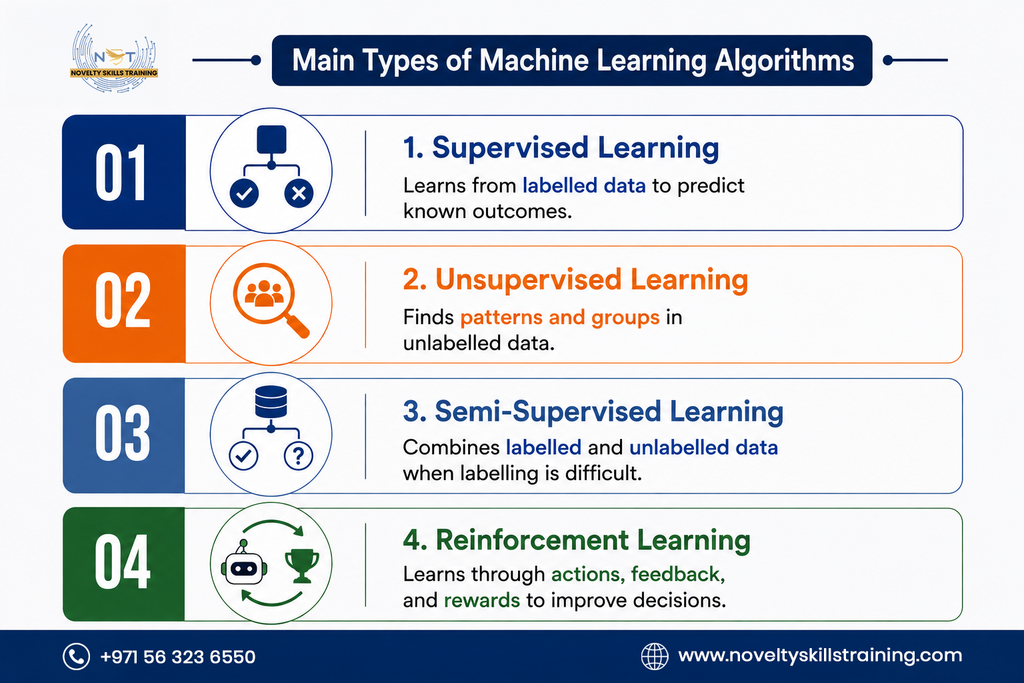
Machine learning is commonly grouped according to how an algorithm learns from data and feedback. The four approaches below illustrate how these learning strategies are applied to real-world problems.
1. Supervised Learning
Supervised learning uses labelled data, where the expected outcome is already known. The algorithm learns the relationship between inputs and outputs and applies it to new data. A practical example is spam detection, where models learn from emails labelled as “spam” or “not spam.” Industry leaders like IBM identify spam detection as a standard, textbook application of supervised learning.
2. Unsupervised Learning
Unsupervised learning works with unlabelled data and identifies patterns or natural groupings within it. For example, K-Means clustering can group customers or users with similar characteristics, helping businesses create customer segments. Amazon Web Services demonstrated this approach using population segmentation and noted its application to customer and user segmentation.
3. Semi-Supervised Learning
Semi-supervised learning combines labelled and unlabelled data, making it useful when obtaining labels for large datasets is difficult or expensive. Healthcare is one relevant application: Google’s medical AI research has explored learning approaches that reduce dependence on large quantities of labelled medical data. Its 2023 research highlighted the challenge of obtaining and annotating clinical datasets and investigated more data-efficient approaches for medical imaging.
4. Reinforcement Learning
Reinforcement learning allows an agent to learn through interaction, trial and error, and rewards. A well-known example is Google DeepMind’s AlphaGo, which used reinforcement learning through self-play to improve its Go-playing strategy. In 2016, AlphaGo defeated world champion Lee Sedol 4–1, demonstrating the potential of reinforcement learning for complex decision-making.
Machine Learning Algorithms at a Glance
| Algorithm | Type | Main Purpose |
|---|---|---|
| Linear Regression | Supervised | Predict numbers |
| Logistic Regression | Supervised | Classify data |
| Decision Tree | Supervised | Make decisions |
| Random Forest | Supervised | Improve prediction using multiple trees |
| KNN | Supervised | Predict using similar examples |
| SVM | Supervised | Separate different groups |
| Naive Bayes | Supervised | Classification using probability |
| K-Means | Unsupervised | Create groups |
| Hierarchical Clustering | Unsupervised | Create groups in levels |
| DBSCAN | Unsupervised | Find dense groups and unusual points |
| PCA | Unsupervised | Reduce data complexity |
| Reinforcement Learning | Reinforcement | Learn through rewards and penalties |
Popular Machine Learning Models
Machine learning models use algorithms to analyse data, generate useful insights, and make predictions. They play an important role in solving complex business problems and identifying new opportunities for growth. Some of the most commonly used machine learning models include:
Linear Regression
Linear Regression is used to predict numerical values. For example, it can be used to estimate house prices, sales, or demand based on available information.
Logistic Regression
Logistic Regression is mainly used for classification. It can help determine which category a particular piece of data belongs to, such as whether an email is spam or not.
Decision Tree
A Decision Tree makes predictions by following a series of questions or conditions. It works much like a flowchart and can be used for both classification and prediction.
Random Forest
Random Forest combines the results of multiple Decision Trees to make a prediction. Using several trees instead of one can help the model make more reliable predictions.
K-Nearest Neighbours (KNN)
KNN makes predictions by looking at similar examples in the available data. Data points that are more similar to each other are likely to have similar results.
K-Means
K-Means is used to group similar data points together. For example, it can help divide customers into groups based on similar purchasing behaviour.
Support Vector Machine (SVM)
SVM is mainly used for classification. It works by finding a suitable boundary that separates different groups of data.
How Novelty Skills Training Can Help You?
At Novelty Skills Training, we help professionals and students build practical skills in Generative AI, Artificial Intelligence, and Machine Learning. Our AI ML Course provides hands-on learning in Machine Learning and Predictive Modeling, along with Deep Learning and Neural Networks for image, speech, and text-based applications. The course also covers Natural Language Processing (NLP) for use cases such as sentiment analysis and chatbots, while introducing AI deployment with Flask, Docker, and AWS to help learners develop scalable and industry-relevant AI solutions.
Conclusion
Machine learning algorithms are the foundation of machine learning systems. They help businesses analyse data, identify useful patterns, make predictions, improve operations, and better understand their customers. Data scientists use these algorithms as building blocks to solve problems and develop effective data-driven solutions.
Machine learning algorithms are important in Artificial Intelligence (AI) because they help create models that can identify patterns and trends in data. These models allow businesses to gain useful insights, make better predictions, improve customer experiences, and address various business challenges.
Frequently Asked Questions
1. What are machine learning algorithms?
Machine learning algorithms are computational procedures that enable systems to learn patterns and relationships from data and use that learning to make predictions, classifications, or decisions. Different ML algorithms are designed for different types of problems, such as prediction, classification, clustering, and pattern recognition.
2. What are the main types of machine learning algorithms?
The main types of machine learning algorithms are supervised learning, unsupervised learning, semi-supervised learning, and reinforcement learning. These machine learning techniques differ in how they learn from data, whether labelled data is available, and how feedback is provided to the model.
3. What are some common machine learning algorithms?
Some common machine learning algorithms include Linear Regression, Logistic Regression, Decision Trees, Random Forest, K-Nearest Neighbours (KNN), Support Vector Machines (SVM), K-Means, and Naive Bayes. The appropriate algorithm depends on the type of data, problem, and expected outcome.
4. Are large language models the same as machine learning algorithms?
No. Large language models (LLMs) are AI models trained on large amounts of data to understand and generate human-like text. They are built using machine learning and deep learning techniques, but an LLM itself is not simply a single machine learning algorithm. ChatGPT, for example, is an AI system built using large language model technology.
5. What is the difference between machine learning and deep learning?
Machine learning is a broad field that includes many algorithms and learning approaches, while deep learning is a specialised area of machine learning that uses multi-layered neural networks. Deep learning is particularly useful for complex applications involving images, speech, text, and other large-scale datasets.
6. How are machine learning algorithms used in generative AI?
Machine learning and deep learning provide the foundation for many generative AI systems. Modern AI models can use these techniques to create AI-generated content, including AI text generation, AI image generation, and AI video generation. Technologies such as LLMs, foundation models, and generative neural networks enable these systems to generate new content based on learned patterns.
7. Is natural language processing a machine learning algorithm?
No. Natural language processing (NLP) is a broader field of AI that enables computers to process and understand human language. NLP applications can use machine learning and deep learning algorithms to perform tasks such as sentiment analysis, translation, text classification, summarization, and chatbot development.
8. Why are machine learning algorithms important for AI careers?
Understanding machine learning algorithms gives AI and ML professionals a foundation for understanding how AI models learn from data and produce outputs. It also provides useful context for advanced areas such as deep learning, natural language processing, LLMs, foundation models, and prompt engineering, which are increasingly used in modern AI applications.