Python vs Java depends on your career goals and project requirements. Python is ideal for AI, machine learning, data science, and automation, while Java is widely used for enterprise applications, banking systems, and backend development. Both languages offer valuable career opportunities.
In Dubai’s rapidly evolving digital economy, the Python vs Java comparison has become increasingly relevant as businesses accelerate AI adoption and enterprise cloud modernization. While Python is widely used for machine learning, data science, and AI agent development because of its readable syntax and extensive library ecosystem, Java continues to power large-scale enterprise systems and high-concurrency financial applications. According to Microsoft’s Java and AI Developer Survey, 97% of surveyed enterprise Java engineers choose Java to build and deploy AI-powered applications in production using frameworks such as Spring AI and LangChain4j. This highlights how both languages are evolving to support AI innovation, enterprise applications, and Dubai’s growing technology ecosystem.
Dubai’s growing developer ecosystem, supported by events such as GITEX Global 2026 and the Dubai AI Festival, reflects the region’s increasing focus on software development, AI, and enterprise technology. Globally, Python and Java remain widely used programming languages. According to the TIOBE Programming Community Index, Python holds a 20.86% rating, while Java records 8.89%. This trend highlights Python’s growing role in AI and Java’s continued relevance in software engineering. Understanding Java vs Python differences can help aspiring developers answer the question, “Should I learn Java or Python?” based on their interests and career goals.
Furthermore, the Stack Overflow Developer Survey 2026 reveals that Python leads AI development with 39% usage, compared with Java at 15%, highlighting Python’s growing adoption in artificial intelligence and machine learning while Java continues to support enterprise software development.
What is Python?
Python is a high-level, interpreted, general-purpose programming language created by Guido van Rossum and first released in 1991. Governed by the Python Software Foundation and designed around code readability and clean, indentation-based syntax, Python enables developers to express complex logic in fewer lines than languages such as C++ or Java. It supports object-oriented, procedural, and functional programming paradigms, using dynamic typing and automatic memory management. Backed by its extensive standard library and a large package ecosystem (PyPI), featuring frameworks and libraries such as Django, FastAPI, NumPy, and PyTorch, Python powers enterprise web backends, cloud automation, data science, and artificial intelligence. In the Python vs Java comparison, Python stands out for its readable syntax and extensive ecosystem, making it a popular choice for beginners and AI-focused development.
Findings from the Python Developers Survey by the PSF indicate that 51% of Python users rely on the language specifically for data exploration and processing, and tech hiring analysis by eSparkBiz reveals that Python is listed as a core requirement in 66% of data science job postings.
Case Study: Instagram (Meta) – Using Python to Manage a Large-Scale Web Application
Meta introduced a Python runtime improvement to reduce memory consumption across Instagram’s server infrastructure. This demonstrates how Python can be optimised to support large-scale web applications and improve resource utilisation.
The Problem
Instagram handles millions of user interactions, including feed loading, profile visits, and post engagement. As the platform expanded, Meta’s engineering team faced challenges with memory consumption.
Instagram uses Python with the Django framework to power its server infrastructure. Its multi-process architecture shared Python objects across processes, but reference counting and garbage collection operations triggered additional memory copying, increasing private memory usage.
How Instagram Used Python
Meta’s engineering team introduced Immortal Objects (PEP 683) to improve memory sharing across processes.
- Engineers identified Python objects that remained unchanged but were still modified through reference-counting operations.
- Immortal Objects allowed selected objects to avoid repeated reference-count modifications.
- This reduced unnecessary memory copying and improved shared memory utilisation.
- Meta contributed this improvement to the wider Python ecosystem.
The Impact
Instagram reduced private memory usage and improved shared memory utilisation through this implementation.
According to Meta’s research, the solution introduced an approximately 2% performance regression as a trade-off for the additional checks.
This case demonstrates how Python supports large-scale web development and how runtime improvements can help address performance and memory-management challenges.
What is Java?
Java is a high-level, object-oriented programming language created by James Gosling at Sun Microsystems in 1995 and currently maintained through Oracle and the global OpenJDK community. Built around the principle of “Write Once, Run Anywhere” (WORA), Java compiles source code into platform-independent bytecode that runs on the Java Virtual Machine (JVM), with Just-In-Time (JIT) compilation supporting runtime performance optimisation. Its static typing, automatic memory management, and built-in concurrency features make it suitable for developing reliable and scalable applications. Supported by enterprise frameworks such as Spring Boot, Jakarta EE, and Quarkus, Java remains widely used in financial systems, distributed cloud microservices, big data processing, and Android applications. When comparing Java Vs Python, Java stands out for its structured development environment, concurrency support, and extensive enterprise application ecosystem.
Primary industry benchmarks underscore Java’s deep entrenchment across global enterprise software engineering. According to the Stack Overflow 2026 Developer Survey (polling over 30,000 technologists across 169 countries), 27.6% of developers actively build with Java, ranking it among the top seven programming languages worldwide. Within large-scale organizations, the OpenLogic 2026 State of Open Source Report (produced with the Open Source Initiative and Eclipse Foundation) shows that 37.44% of surveyed technology professionals use Java, with 70% of those deployments concentrated inside enterprises employing 500 to over 5,000 staff.
Case Study: LinkedIn – Using Java to Improve Application Performance
As LinkedIn’s platform expanded, its engineering team upgraded its Java applications to improve response times, processing capacity, and overall system performance.
The Problem
LinkedIn manages a large professional networking platform with millions of users connecting, sharing content, and searching for jobs. As user activity increased, maintaining application performance and handling growing requests became a priority.
How LinkedIn Used Java
LinkedIn upgraded its applications from Java 8 to Java 11 to benefit from runtime and garbage collection improvements.
- Tested Java 11 across 20 applications to evaluate performance.
- Evaluated garbage collectors, including G1, to improve memory management.
- Planned the migration of approximately 500 libraries and 1,100 applications.
- Used automated tools to simplify migration and monitor performance.
The Impact
After analyzing more than 200 applications, LinkedIn reported:
- 10% reduction in average P99 latency, improving application response times.
- 20% increase in maximum throughput, allowing systems to handle more requests.
- Up to 200% performance gains in the best-performing test cases.
This case demonstrates how Java’s runtime optimization capabilities can help improve the performance and scalability of large-scale enterprise applications.
Python vs Java – Key Features and Differences Compared
| Comparison Factor | Python | Java |
|---|---|---|
| Syntax | Clean, concise, and English-like; relies on indentation to define code blocks with minimal boilerplate. | Verbose and explicit; uses curly braces {} and semicolons;, enforcing strict structural conventions. |
| Learning Curve | Gentle; beginners can write functional scripts immediately without learning object-oriented architecture first. | Steeper; requires upfront understanding of classes, data types, access modifiers, and OOP principles. |
| Typing | Dynamically typed (with optional type hints via typing); variable types are checked at runtime. | Statically typed (with var local type inference); type errors are caught strictly at compile time. |
| Execution Model | Source code is compiled to bytecode and interpreted at runtime by the Python Virtual Machine (CPython). | Source code is compiled via javac into platform-independent bytecode executed by the Java Virtual Machine (JVM). |
| Runtime Performance | Can be slower for CPU-intensive tasks, depending on implementation and libraries. | Often offers better performance for long-running applications due to JVM optimization. |
| Memory Management | Automatic memory management combining reference counting with a cyclic garbage collector. | Automatic memory management using generational garbage collectors (G1GC, ZGC) tuned for low-latency scale. |
| Portability | Cross-platform across Windows, macOS, and Linux, provided a matching Python interpreter and dependencies are installed. | True “Write Once, Run Anywhere” (WORA); compiled .class/.jar files run identically on any OS with a JVM. |
| Development Speed | High velocity; expressive syntax and rich built-in data structures enable rapid prototyping in fewer lines of code. | Slower initial setup due to boilerplate, but strict contracts accelerate maintenance across large engineering teams. |
| Multithreading | Standard CPython builds have GIL-related limitations for CPU-bound threading. | Supports multithreading and concurrent programming through built-in APIs. |
| Concurrency & Multithreading | Traditionally constrained by the Global Interpreter Lock (GIL) for CPU-bound threads (though experimental free-threaded builds exist in Python 3.13+); relies on asyncio or multiprocessing. | True hardware-level multithreading backed by OS threads, the java.util.concurrent API, and lightweight Virtual Threads (Project Loom). |
| Ecosystem & Frameworks | AI/Data: PyTorch, TensorFlow, NumPy, Pandas, Scikit-learn. Web: FastAPI, Django, Flask. | Enterprise/Cloud: Spring Boot, Quarkus, Jakarta EE, Hibernate. Build/Test: Maven, Gradle, JUnit. |
| Primary Use Cases | Artificial intelligence, machine learning, data engineering, scripting, DevOps automation, and rapid web APIs. | High-throughput financial systems, distributed cloud microservices, big data engines (Kafka, Spark), and Android apps. |
| Best Suited For | Fast prototyping, data-intensive pipelines, AI/ML workflows, and small-to-midsize backend teams. | Mission-critical, large-scale enterprise systems requiring strict type safety, high concurrency, and long-term maintainability. |
Advantages of Python
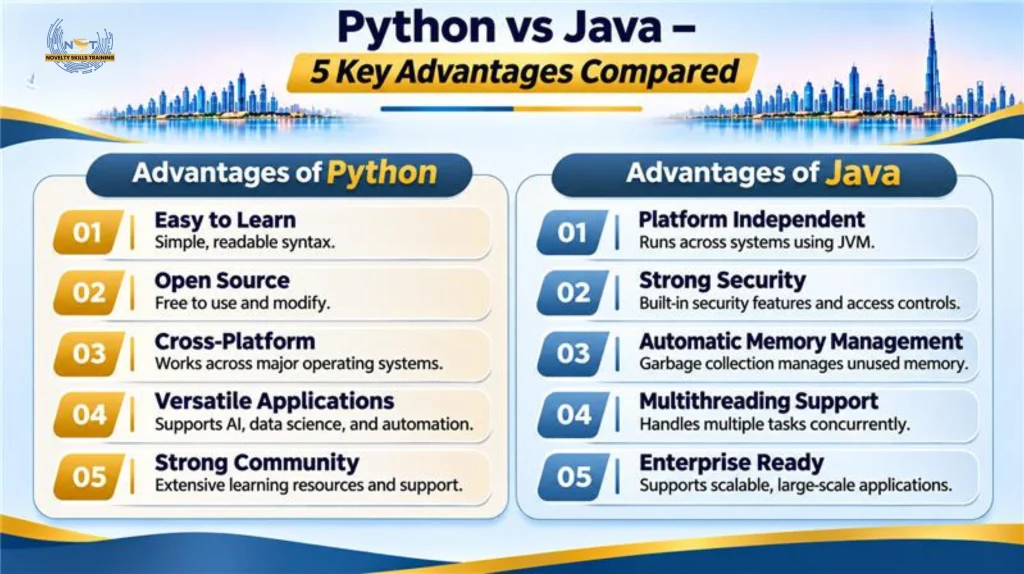
Python is one of the most widely used programming languages because of its simple syntax, readability, and versatility. In the Python vs Java comparison, Python stands out for its ease of learning and wide range of applications, from web development and data analysis to task automation and artificial intelligence.
According to the 2025 Stack Overflow Developer Survey, Python adoption increased by 7 percentage points compared with 2024, showing its growing popularity among developers.
Let’s look at the major advantages of Python.
1. Easy to Learn and Understand
Python has simple, readable syntax, making it easier for beginners to understand programming concepts and write code with fewer lines. This improves code readability, reduces learning complexity, and helps developers build applications faster.
2. Free and Open Source
Python is free to download, use, and distribute. Developers can access its source code and contribute to its development without paying language licensing fees. This makes it accessible to individuals, startups, and businesses.
3. Cross-Platform Compatibility
Python supports multiple operating systems, including Windows, macOS, and Linux. Developers can run programs across these platforms with the required environment and dependencies, reducing the need to rewrite code.
4. Applications Across Multiple Industries
Python is used across different industries to solve various technical problems, making it useful for exploring different technology fields.
- Healthcare: Medical data analysis and research.
- Finance: Financial analysis and process automation.
- E-commerce: Customer behaviour analysis and product recommendations.
- Cybersecurity: Network monitoring and threat detection.
- AI and Machine Learning: Chatbots and predictive models.
- Web Development: Websites and web applications.
- This versatility allows developers to explore multiple career paths using a single programming language.
5. Strong Community Support
Python has a large developer community that provides documentation, tutorials, libraries, and discussion forums. These resources help beginners troubleshoot coding errors, learn new concepts, and improve their programming skills.
Learning Python can also be a useful starting point for those exploring how to learn Java and Python. Understanding Python fundamentals, including variables, loops, functions, and object-oriented programming, can build a foundation for learning Java and other programming languages.
Advantages of Java
Java is widely used for developing websites, mobile applications, banking systems, and enterprise software. In the Java Vs Python comparison, Java stands out for its platform independence, multithreading capabilities, and ability to support large-scale applications across different operating systems.
According to the 2026 Stack Overflow Developer Survey, 27.6% of respondents reported using Java for development work in the past year, demonstrating its continued presence in the developer community.
Let’s understand the major advantages of Java.
1. Platform Independence
Java follows the principle of “Write Once, Run Anywhere.” Developers can write a Java program once and run it across operating systems such as Windows, macOS, and Linux using a compatible Java Virtual Machine (JVM). This simplifies application deployment and reduces the need to rewrite code for different platforms.
2. Strong Security Features
Java provides built-in security features such as bytecode verification, access controls, and encryption APIs. These features help developers protect sensitive information, manage user access, and build secure applications, particularly in banking and financial services.
3. Automatic Memory Management
Java uses a feature called Garbage Collection to identify objects that are no longer needed and reclaim their memory. This reduces the need for manual memory management and helps developers avoid certain memory-related errors.
4. Supports Multithreading
Java supports multithreading, allowing applications to perform multiple tasks concurrently. For example, an online shopping application can retrieve product details, update shopping carts, and process customer requests simultaneously, helping improve application responsiveness.
5. Suitable for Large-Scale Applications
Java’s JVM, concurrency support, performance optimisation features, and extensive development ecosystem make it suitable for complex enterprise applications. For example, banking platforms use Java to manage transactions, retrieve account information, and handle multiple customer requests. This makes Java a strong option for large-scale software development.
For those exploring how to learn Java and Python, starting with Java can help develop a strong understanding of object-oriented programming, data types, and application development. These fundamentals can make it easier to learn Python and work across different programming environments.
What are the Disadvantages of Python?
Although Python is easy to learn and widely used across industries, it has certain limitations related to execution speed, memory consumption, and application development. Understanding these limitations helps when evaluating Python vs Java for different project requirements.
1. Slower Execution Speed
Python can be slower than compiled languages such as C and C++ when performing CPU-intensive tasks. For example, applications involving millions of complex calculations may require additional optimization to achieve faster processing. This can make Python less suitable for certain performance-critical applications.
2. High Memory Consumption
Python can consume more memory than some lower-level programming languages, particularly when processing large datasets or running complex applications. For example, loading millions of customer records into memory can increase RAM requirements and affect application performance.
3. Limitations in Multithreading
Standard GIL-enabled CPython builds use a mechanism called the Global Interpreter Lock (GIL), which restricts multiple threads from executing Python bytecode simultaneously. This can limit the performance of CPU-intensive tasks that require parallel processing across multiple CPU cores.
4. Runtime Errors Due to Dynamic Typing
Python uses dynamic typing, meaning variable types are determined during execution rather than explicitly declared. As a result, certain type-related errors may only appear when the program runs. These errors can become harder to identify and manage in large applications without proper testing.
5. Managing Dependencies Can Be Challenging
Python offers thousands of libraries and packages, but managing their versions and compatibility can become complicated across multiple projects. Different applications may require different library versions, and installing or updating packages without proper dependency management can lead to compatibility issues.
Disadvantages of Java
Although Java is widely used for enterprise applications, banking systems, and software development, it has certain limitations related to memory consumption, startup time, and code complexity. Understanding these limitations helps when evaluating Java Vs Python for different development requirements.
1. High Memory Consumption
Java applications run on the Java Virtual Machine (JVM), which requires additional memory for runtime operations and application data. This can increase resource consumption, particularly when running large applications or multiple services on systems with limited RAM.
2. Slower Application Startup
Java applications need to initialise the JVM before execution. This can increase startup time, particularly for smaller applications that need to start and finish quickly. JIT compilation also requires time before frequently executed code reaches its optimised performance.
3. Garbage Collection Can Affect Performance
Java uses Garbage Collection to identify unused objects and reclaim memory. However, certain garbage collection activities can temporarily pause application execution, potentially affecting response times in applications that require consistent performance.
4. More Code for Simple Programs
Java follows a structured programming approach involving classes, objects, and methods. As a result, even simple programs may require more code than languages such as Python. This can increase the initial learning effort and development time for smaller applications.
5. Requires More Performance Tuning
Java applications may require adjustments to JVM settings, memory allocation, and garbage collection depending on their workload. Without proper configuration, applications handling large numbers of requests may experience unnecessary resource consumption or performance issues.
Conclusion
The Java Vs Python comparison shows that both programming languages offer valuable career opportunities, but their applications and strengths differ. Python is widely used in data science, artificial intelligence, machine learning, and automation, while Java remains important for enterprise applications, banking systems, and large-scale software development. As Dubai continues to strengthen its position as a technology and innovation hub, professionals need to keep pace with evolving industry requirements. Upskilling in programming and emerging technologies can help aspiring developers and working professionals build relevant technical capabilities and prepare for changing career opportunities.
Whether you choose Python, Java, or eventually learn both, developing practical programming skills is an important step towards building a career in technology. Novelty Skills Training, Dubai, offers learning opportunities designed to help individuals strengthen their technical knowledge and develop industry-relevant skills. Explore the Python Programming Course at Novelty Skills Training to build your programming foundation and take the next step towards your technology career.
Frequently Asked Questions (FAQs)
1. What is the difference between Python and Java?
Python offers simple syntax for AI, data science, and automation, while Java supports enterprise applications and backend development.
2. Which is better, Java or Python?
Neither is universally better. Python suits AI and beginners, while Java supports enterprise development; choose based on your goals.
3. Should I learn Java or Python as a beginner?
Python is generally easier for beginners, while Java is suitable for those interested in structured programming and enterprise applications.
4. Is Java faster than Python?
Java often delivers better execution speed in long-running applications, while Python performance depends on workload, libraries, and implementation.
5. Can I learn both Java and Python?
Yes. You can learn Python and Java because they support different types of applications. Python helps you explore data science, AI, and automation, while Java builds skills in enterprise application and backend development.
6. How long does it take to learn Java and Python?
Basic concepts may take weeks to learn, but proficiency in Java and Python requires consistent practice and project experience.
7. What are the career opportunities after learning Java or Python?
Python offers roles in data science and AI, while Java supports careers in backend and enterprise software development.
8. Can I learn Java and Python at the same time?
Yes, but beginners should learn one language first before exploring the second to build strong programming fundamentals.
9. Which is better to learn Java or Python for future career opportunities?
Python suits AI, machine learning, and data careers, while Java supports enterprise and backend development. Choose based on your career goals.