
A SOC Analyst monitors security systems, investigates suspicious activities, analyzes security alerts, and helps organizations detect and respond to cyber threats. Discover the essential skills, career progression, salary expectations, and future opportunities for SOC Analysts in the UAE cybersecurity landscape.
Protecting digital infrastructure requires more than advanced security tools. Organizations also need professionals who can identify suspicious activity, investigate security alerts, and determine appropriate responses to potential threats. These responsibilities make the SOC Analyst essential to security operations. The GCC cybersecurity market was valued at USD 6.92 billion in 2025, reflecting growing investment in protecting digital businesses and infrastructure.
Yet, 90% of UAE companies surveyed by Deloitte report a cybersecurity workforce shortage, highlighting the need for skilled professionals as organizations expand their digital operations.
Professionals considering a SOC Analyst career in the UAE, may have questions such as, what the role involve, which skills do employers value, how one can enter the field, what one can earn, and what does the future hold?
This guide explores the SOC Analyst career, jobs, skills, salary, and future scope in the UAE.
What Does a SOC Analyst Do and Where Can the Career Lead in the UAE?
A Security Operations Center (SOC) continuously monitors an organization’s IT environment for potential cyber threats. A SOC Analyst reviews security alerts, investigates suspicious activity, and determines whether an event poses a genuine security risk.
For example, repeated failed login attempts followed by a successful login from an unfamiliar location could signal a compromised account. The analyst would examine authentication logs and related security events to determine what happened and whether the incident needs to be escalated.
SOC teams often use a Security Information and Event Management (SIEM) platform to collect and correlate security events from multiple sources. However, analysts must interpret the evidence, prioritize potential threats, and decide on the appropriate response.
Factors Driving Demand for SOC Analyst Careers in UAE
- AI-Driven Cyber Threats
According to Check Point’s Threat Intelligence Report, UAE organizations faced an average of 2,521 cyberattacks per week, a 47% year-on-year increase. This rising threat landscape increases the need for SOC Analysts to investigate alerts, identify genuine threats, and support rapid incident response.
- Stricter Cybersecurity Regulations: UAE cybersecurity frameworks, including DESC’s Information Security Regulation and the Personal Data Protection Law, increase the need for effective security monitoring, incident detection, and SOC professionals who support compliance.
- Expanding Digital Infrastructure: The Middle East cybersecurity market is growing alongside government investments in cloud services and smart cities. This expansion increases the need for SOC Analysts to monitor digital infrastructure, detect threats, and protect critical systems around the clock.
Experienced SOC Analysts, particularly at L2 and L3 levels, are increasingly sought after as UAE employers look for specialized cybersecurity talent. According to ManpowerGroup, persistent talent shortages make it challenging for organizations to recruit professionals with advanced security investigation skills.
What Skills Do You Need to Become a SOC Analyst?
While SOC tools may vary across organizations, essential SOC analyst skills include detecting, investigating, prioritizing, and responding to security threats. In the UAE market, the key skills include:
1. SIEM Operations & Alert Triage
Use SIEM (Security Information and Event Management) platforms such as Splunk and Microsoft Sentinel to investigate alerts, correlate events, and use SPL or KQL to identify threats. EDR/XDR knowledge is also valuable.
2. Networking & Operating Systems
Understand TCP/IP, DNS, HTTP/HTTPS, ports, firewalls, Windows, and Linux to recognize suspicious system and network activity.
3. Threat & Log Investigation
Investigate phishing, malware, suspicious logins, and unusual network activity by correlating evidence across logs and systems.
4. UAE Compliance & IT/OT Awareness
Understand relevant UAE and DESC security requirements, along with IT/OT and Industrial Control Systems (ICS) for critical-sector environments.
5. Phishing & Email Analysis
Analyze email headers, SPF, DKIM, and DMARC to identify suspicious messages and recognize AI-driven phishing and social-engineering techniques.
6. Cloud & Security Automation
Develop knowledge of AWS and Azure security, alongside basic Python, PowerShell, Bash, and SOAR (Security Orchestration, Automation and Response) to support monitoring and automate repetitive tasks.
7. Analytical Thinking
Strong attention to detail, critical thinking, and prioritization help analysts manage high alert volumes and make evidence-based decisions.
Together, these skills help SOC Analysts progress from alert handling to effective threat investigation and response.
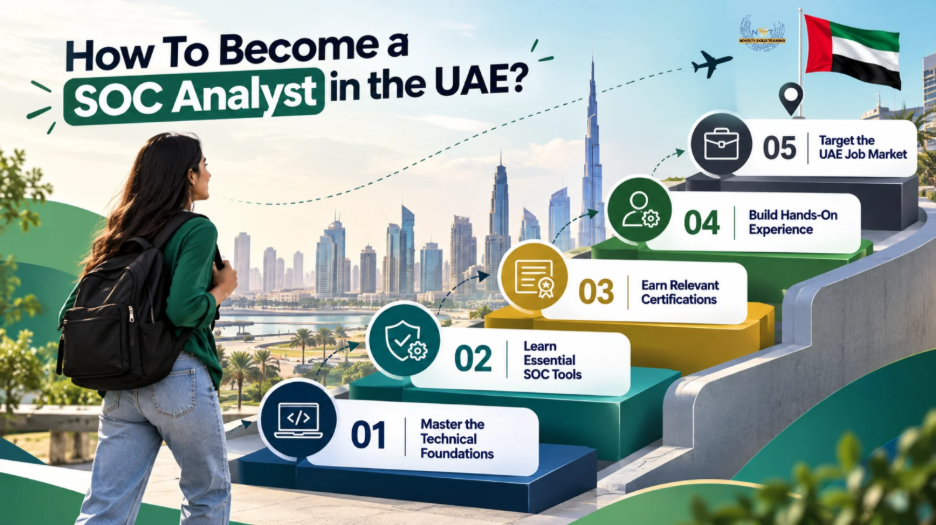
How To Become a SOC Analyst in the UAE?
There is no single route to becoming a SOC Analyst. A practical pathway is to build the right foundation, develop hands-on experience, earn relevant credentials, and prepare specifically for the UAE job market.
Step 1: Master the Technical Foundations
- Build a solid foundation in networking, Windows, Linux, system logs, Active Directory, and cybersecurity fundamentals.
- Understand how the systems and infrastructure you will protect work before moving into security operations.
Step 2: Learn Essential SOC Tools
- Gain practical exposure to SIEM platforms such as Splunk, Microsoft Sentinel, and Elastic, along with EDR/XDR and network-analysis tools.
- Focus on investigating security events and interpreting findings, rather than simply learning how each tool works.
Step 3: Earn Relevant Certifications
- Start with foundational certifications such as CompTIA Security+ or ISC2 Certified in Cybersecurity (CC).
- For a more SOC-focused profile, consider EC-Council Certified SOC Analyst (CSA) or CompTIA CySA+.
- Choose certifications that align with your current experience and target role.
Step 4: Build Hands-On Experience
- Practise SOC investigations through platforms such as TryHackMe, LetsDefend, and Blue Team Labs Online.
- Build a home lab using tools such as Wazuh or Elastic and practise investigating simulated incidents.
- Document your work through GitHub or a professional portfolio to demonstrate what you can do.
Step 5: Target the UAE Job Market
- Apply for SOC Analyst L1, Junior Cybersecurity Analyst, and Security Operations Analyst positions.
- Match your CV to the requirements listed in UAE job descriptions and highlight relevant projects, tools, and certifications.
- UAE nationals cyber security can also explore Emiratization-focused cybersecurity opportunities.
- If a direct SOC role is not immediately available, IT support or network roles can provide relevant experience for a later transition into security operations.
The goal is to progress from learning the fundamentals to demonstrating practical capability, giving employers clear evidence that you are ready to work in a SOC environment.
What Is the SOC Analyst Salary in the UAE?
A SOC Analyst jobs uae salary depends largely on experience, level of responsibility, technical specialization, employer, and location. Currently Naukrigulf data reports an average SOC Analyst salary of AED 8,414 per month, while Senior SOC Analysts average around AED 14,452 per month.
SOC Analyst Salary UAE by Role and Responsibility
| Role / Tier | Indicative Monthly Salary (AED) | Primary Responsibility |
| L1 – SOC Analyst | AED 5,000–10,000+ | Monitor alerts, perform initial triage, filter false positives, and escalate incidents |
| L2 – SOC Analyst | AED 10,000–18,000+ | Conduct deeper investigations, correlate events, and support incident response |
| L3 – Senior SOC Analyst | AED 15,000–26,000+ | Handle complex incidents, advanced analysis, and threat hunting |
| Security Engineer / Architect | Varies by seniority | Build and optimize security infrastructure, SIEM/SOAR environments, and security architecture |
These are indicative market bands; actual offers vary by employer, experience, skills, and role scope.
Location can also influence pay. Current reported averages are approximately AED 8,432 in Dubai and AED 9,393 in Abu Dhabi, although these figures come from different sample sizes and should not be treated as a guaranteed “Abu Dhabi premium.”
What drives higher salaries?
The biggest difference comes from technical depth and responsibility. Basic alert monitoring tends to sit at the lower end of the market, while expertise in cloud security, threat hunting, incident response, security engineering, and automation can open higher-value roles.
The UAE’s lack of personal income tax on individuals can also make headline salaries attractive, although overall take-home value still depends on an individual’s circumstances and living costs.
Relevant certifications such as CompTIA Security+, Microsoft SC-200, or Splunk credentials can strengthen a candidate’s profile, but they are most valuable when backed by practical experience.
The progression is therefore clear: greater technical responsibility and specialization generally create greater earning potential.
What Is the Future Scope of a SOC Analyst Career in the UAE?
The future of SOC careers in the UAE is closely tied to the country’s rapid digital transformation. As organizations expand their use of cloud, AI, IoT, and connected digital services, the need for effective cyber risk defense and continuous monitoring is also increasing. The UAE has established dedicated cybersecurity policies covering areas such as cloud, AI, IoT, and critical information infrastructure.
- Stronger Cybersecurity Requirements: UAE frameworks increasingly focus on secure digital infrastructure, resilience, and data protection. The National Cloud Security Policy, for instance, addresses data sovereignty, incident management, and cloud forensics.
- A Growing Talent Gap: Demand for cybersecurity professionals is also rising. Deloitte’s 2026 analysis found that 90% of UAE companies surveyed face a cybersecurity workforce shortage, highlighting the need for skilled talent.
- Rapid AI Adoption: AI is transforming both cyberattacks and defense. While attackers can use it to scale scams and social engineering, security teams can use it to improve threat detection and response. The UAE Cyber Security Council reported that 50% of surveyed respondents believed they had encountered an AI-related scam in the previous year.
How Will the SOC Role Evolve?
Automation is likely to take on more repetitive alert-processing tasks, allowing analysts to focus on complex incidents, contextual analysis, and decisions that require human judgement.
As a result, the future SOC will rely less on manual alert handling and more on the combination of human expertise, AI, automation, and intelligent security systems.
For aspiring professionals, this means the SOC Analyst role is likely to remain relevant while becoming more technology-driven, specialized, and important to the UAE’s growing digital economy.
Conclusion
A SOC Analyst career in the UAE can be a strong entry point into cybersecurity, offering practical exposure to modern security operations. Becoming career-ready, however, requires more than completing a course or certification. It requires the ability to apply knowledge in real-world situations.
Novelty Skill Training (NST) can help bridge that gap through practical, industry-focused learning and hands-on training. For aspiring professionals targeting the UAE cybersecurity market, this approach can provide a stronger foundation to enter and grow in the SOC field.
Frequently Asked Questions
1. What does a SOC Analyst do?
A SOC Analyst monitors security alerts, investigates suspicious activity, detects cyber threats, and supports incident response to protect IT infrastructure.
2. Is a SOC Analyst career a good choice UAE?
Yes, a SOC Analyst career offers opportunities as UAE organizations invest in cybersecurity, cloud security, and digital infrastructure.
3. What are the most important SOC Analyst skills?
Essential SOC Analyst skills include SIEM operations, alert triage, network security, log analysis, threat detection, incident response, and analytical thinking.
4. What are the available SOC Analyst jobs UAE?
SOC Analyst jobs in the UAE include L1 SOC Analyst, Junior Cybersecurity Analyst, Security Operations Analyst, L2 Analyst, and Senior SOC Analyst.
5. What is the average SOC Analyst salary UAE?
According to Naukrigulf data cited in this guide, the average SOC Analyst salary in the UAE is approximately AED 8,414 monthly, depending on experience and expertise.
6. How to become a SOC Analyst in the UAE?
Learn networking and cybersecurity fundamentals, practise SIEM investigations, earn relevant certifications, build hands-on experience, and apply for entry-level SOC positions.
7. Do I need certifications to get SOC Analyst jobs UAE?
Certifications such as CompTIA Security+, Microsoft SC-200, and EC-Council CSA can strengthen your profile when combined with practical experience.
8. What is the career progression for a SOC Analyst?
SOC Analysts can progress from L1 monitoring to L2 investigations, L3 threat analysis, and specialized roles in threat hunting, incident response, or security engineering.