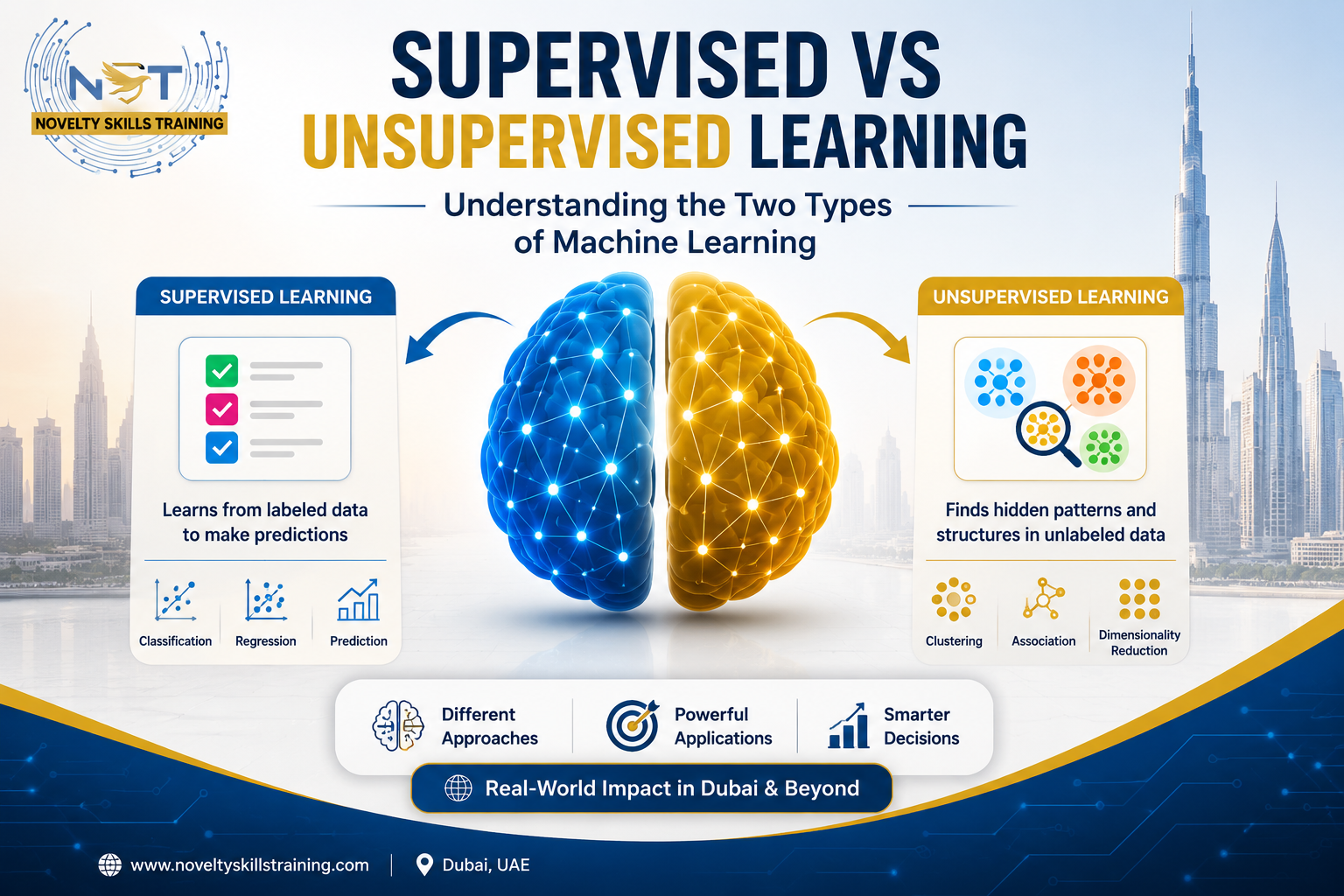
Supervised vs unsupervised learning powers real-world AI in Dubai. RTA used machine learning with Nol card data across 10 bus routes, saving 13.3% of wasted route time—showing how data can move from raw information to smarter decisions.
Ever wondered how Dubai is already using AI across more than 100 high-impact use cases spanning healthcare, finance, mobility and urban planning? Behind these systems lies a fundamental question: how do machines actually learn from data?
At its core, supervised vs unsupervised learning defines how machine learning algorithms process inputs to make decisions. When stepping into artificial intelligence, mastering supervised vs unsupervised learning is your first true milestone. These two machine learning types form the foundation of modern data science. Understanding supervised vs unsupervised learning isn’t just an academic exercise; it is the exact technical edge top tech employers across the GCC look for.
Why Does Supervised vs Unsupervised Learning Matter?
Machine learning is moving from a specialist skill to a broader workplace requirement in the UAE. PwC’s 2026 AI Jobs Barometer found that 12,200 UAE job postings required AI skills in 2025, up from 4,600 in 2021. As AI spreads across finance, healthcare, technology and other sectors, knowing how models learn helps you understand which approach fits a real business problem.
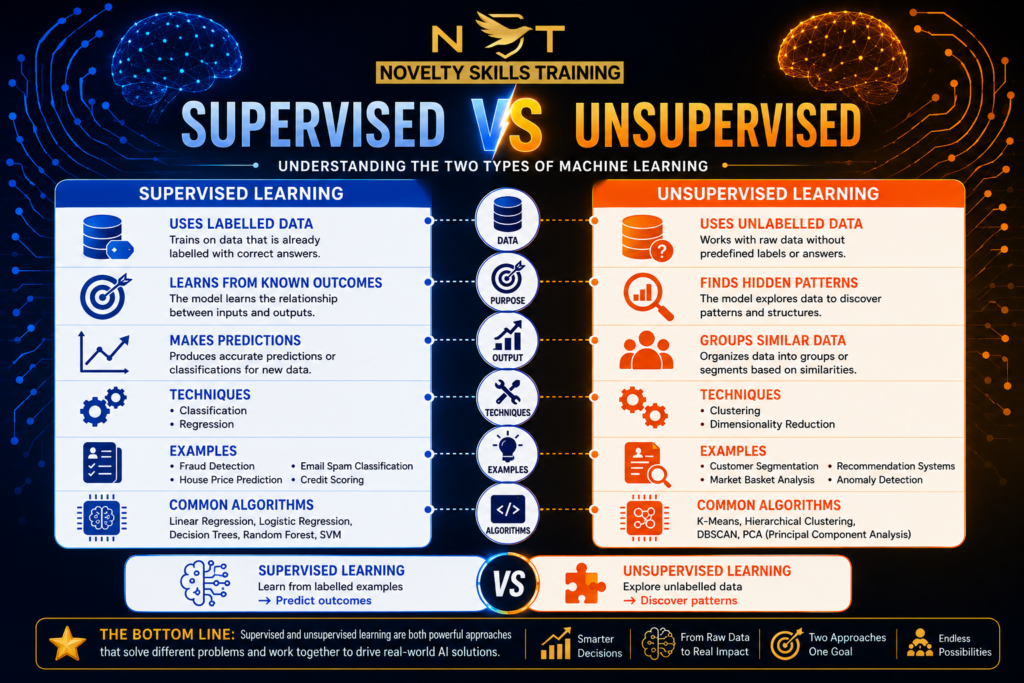
That is why supervised vs unsupervised learning matters. One helps machines predict known outcomes; the other helps uncover patterns when the answers are not already defined.
What is Supervised Learning?
In supervised learning, an algorithm learns under explicit guidance, similar to a student practicing with an answer key. The model is fed structured labelled data, where both the inputs and correct target outcomes are provided within the training data.
During this phase, the algorithm constructs predictive models by establishing accurate mathematical functions between variables.
Supervised learning primarily solves two core problem types:
- Classification: Categorizing data into predefined buckets
(e.g., filtering fraudulent card transactions at a Dubai bank or sorting customer support tickets).
- Regression: Forecasting continuous numerical values
(e.g., predicting villa prices along Sheikh Zayed Road based on square footage and location metrics).
Relatable supervised learning examples include credit scoring systems used by UAE financial institutions and predictive diagnostic tools in Dubai Healthcare City that analyze historical patient records to flag early health risks.
Case Study: Supervised Learning in Action
Consider DEWA, which uses AI and machine learning for fault detection and predictive maintenance. Historical operational data can contain known outcomes, such as equipment failures. A supervised model can learn these relationships and estimate the likelihood of future faults, helping teams act before a failure affects operations.
The takeaway: When the outcome is already known in historical data, supervised learning can turn those examples into useful predictions.
What is Unsupervised Learning?
Unlike its guided counterpart, unsupervised learning operates on raw, unlabeled data. There are no target labels or human supervisors. Instead, the algorithm autonomously scans complex datasets to uncover hidden structures, anomalies, and underlying pattern recognition.
Common unsupervised learning approaches include:
- Clustering: Grouping similar data points together based on inherent traits without prior tagging
(e.g., segmenting customer buying behaviors for regional e-commerce platforms).
- Dimensionality Reduction: Compressing massive datasets to remove noise while preserving critical insights.
Prominent unsupervised learning examples include recommendation engines on food delivery platforms that suggest restaurants based on latent user preferences or foot-traffic clustering models used by retail strategists inside Dubai Mall to analyze customer movement.
Case Study: Unsupervised Learning in Action
A 2026 UAE study used K-Means clustering to analyze consumer behaviour in the sustainable cosmetics market. Instead of assigning customers to predefined groups, the algorithm identified segments based on similarities in factors such as purchase motivations, awareness and perceived risk.
The takeaway: When groups are not predefined, unsupervised learning can uncover hidden customer patterns that businesses can use for better targeting.
Difference Between Supervised and Unsupervised Learning
Understanding the core difference between supervised and unsupervised learning comes down to dataset architecture, operational intent, and algorithmic logic:
| Feature / Dimension | Supervised Learning | Unsupervised Learning |
| Input Structure | Requires structured labelled data | Processes raw, unlabeled data |
| Primary Objective | Predict known target outcomes | Discover hidden patterns and clustering |
| Feedback Mechanism | Evaluates outputs against ground-truth targets | Self-directed discovery via statistical variance |
| Core Techniques | Classification & Regression | Dimensionality reduction & pattern recognition |
A direct comparison of supervised vs unsupervised learning reveals that leading engineers rarely use them in isolation. Instead, hybrid architectures power real-world, machine learning applications where unsupervised learning first cleans and clusters messy raw inputs before supervised learning generates precise predictive forecasts.
Why AI and Machine Learning Skills Matter for Your Career in Dubai
Dubai is expanding its AI ecosystem across finance, healthcare, mobility, retail and government services. The UAE’s AI Strategy 2031 also prioritizes developing AI-ready talent for future technology-driven jobs.
For aspiring professionals, AI and ML skills go beyond algorithms. Practical knowledge of Python, data analysis, machine learning algorithms and real-world projects can build a stronger foundation for technology careers in Dubai.
For students pursuing an Artificial Intelligence and Machine Learning Training in Dubai, Novelty Skills Training provides a practical learning environment focused on building data skills, applying machine learning algorithms and developing career ready capabiliti
Frequently Asked Questions (FAQs
Can I learn machine learning without knowing advanced mathematics?
Yes. You can start with basic statistics and gradually build the mathematical skills needed for machine learning models.
Which type of machine learning is better for beginners?
Supervised learning is often easier to start with because the labelled data provides a clear target for the model to learn.
How is machine learning used in Dubai businesses?
It supports applications such as fraud detection, customer segmentation, demand forecasting, recommendation systems and predictive analytics.
Do companies use supervised and unsupervised learning together?
Yes. Many real-world solutions combine both approaches to discover patterns and then make predictions from the resulting insights.
What skills should I learn alongside machine learning?
Focus on Python, statistics, data preprocessing, model evaluation, SQL and practical experience with machine learning algorithms.
Can machine learning skills help me build a career in Dubai?
Yes. Machine learning skills can support career paths in data science, AI, analytics, fintech, healthcare, retail and other technology-driven sectors.