Zero Trust Security is a cybersecurity framework that protects digital resources by continuously evaluating access based on identity, device security, and risk context. It uses principles such as least-privilege access, verification controls, and continuous monitoring to secure users, applications, networks, and data across modern cloud and enterprise environments.
As organizations increasingly operate across cloud environments, remote work models, and distributed digital infrastructures, Zero Trust Security has emerged as a solution for protecting critical resources. It is a cybersecurity framework that focuses on securing users, devices, applications, networks, and data through stronger access controls, continuous assessment, and risk-based security decisions.
Traditional perimeter-based security models were designed around the idea of protecting a defined network boundary. However, with expanding digital ecosystems, third-party access, cloud adoption, and evolving cyber threats, network boundaries are becoming less clear and internal trust assumptions can create security gaps. According to a global study by Gartner, 63% of organizations worldwide have already fully or partially implemented a Zero Trust strategy.
The Zero Trust Architecture helps organizations strengthen cybersecurity by securing users, applications, workloads, networks, and data across modern environments. In this guide, we will explore Zero Trust principles, architecture, network security, cloud information security, implementation approaches, business benefits, and real-world applications.
Gartner Prediction: By 2028, 50% of organizations will adopt Zero Trust practices for data governance to manage risks from unverified AI-generated data.
What is Zero-Trust Security?
Zero Trust Security is a cybersecurity framework based on the principle of “never trust, always verify.” Unlike traditional security models that automatically trust users and devices inside the network, Zero Trust treats every access request as potentially risky and continuously verifies users, devices, and applications before granting access.
Traditional security works like a residential community with a single security gate—once someone enters; they may move freely within the premises. Zero Trust is more like a high-security office campus where every person must verify their identity before accessing specific areas, with access continuously evaluated based on authorization, role, and security requirements.
McKinsey highlights that as remote and hybrid work models expand, traditional network perimeters are no longer effective, making Zero Trust Architecture essential for modern enterprise security and resilience.
Key Principles of Zero-Trust Security
Zero Trust Security is built on core principles that help organizations reduce security risks, control access effectively, and continuously evaluate trust across users, devices, applications, and data environments. Following are the principles of Zero Trust Security.
- Verify Explicitly: Authenticate and authorize every access request using multiple factors, including user identity, device security status, location, application, and current risk level.
- Apply Least-Privilege Access: Provide users with only the minimum permissions required to complete their tasks, reducing unnecessary access to sensitive systems and data.
- Assume Breach: Operate with the mindset that threats may already exist by continuously monitoring activities, detecting suspicious behavior, and preparing controls to minimize potential damage.
- Continuously Monitor and Validate: Regularly assess users, devices, and network activity to identify changes in security posture and adjust access decisions accordingly.
- Use Context and Risk-Based Decisions: Evaluate access requests based on real-time signals such as user behavior, device health, location, and resource sensitivity before granting or modifying access.
How Does Zero Trust Architecture Make Access Decisions?
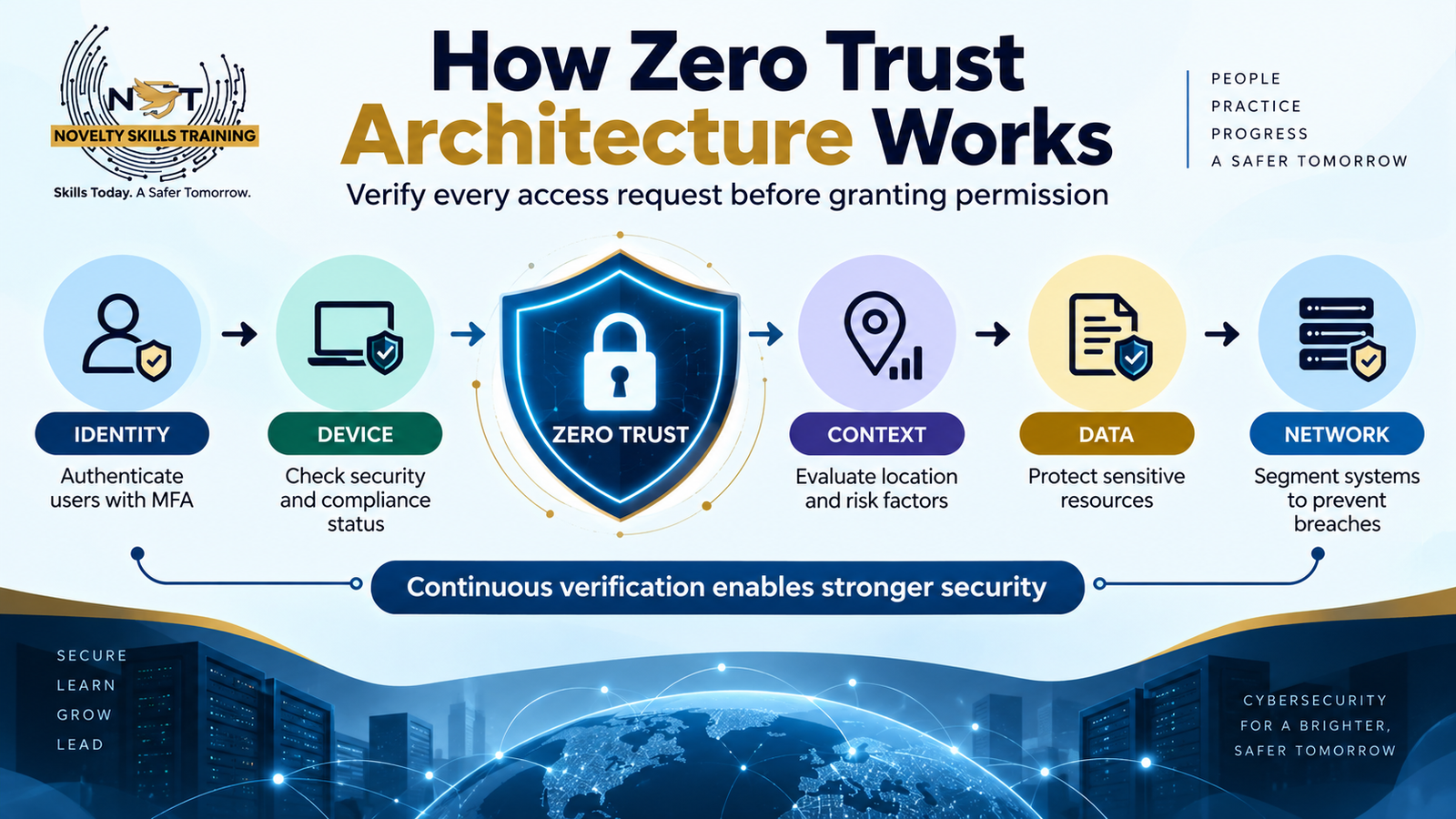
Behind every Zero Trust access decision is a structured framework that determines who can access what resources and under which conditions. The NIST SP 800-207 model explains this process through two essential components: the Policy Decision Point (PDP) and Policy Enforcement Point (PEP).
1. Policy Decision Point (PDP): Evaluating Access Requests
The PDP acts as the decision-making engine of Zero Trust Architecture. It analyzes access requests against security policies and contextual information to determine whether access should be allowed, restricted, or denied.
It evaluates factors such as:
- User identity and role
- Device security posture
- Location and access context
- Resource sensitivity
- Current risk level
2. Policy Enforcement Point (PEP): Enforcing Access Decisions
The PEP acts as the control point that executes the PDP’s decision. It manages the connection between users and resources by granting, monitoring, or blocking access based on approved policies.
It helps to:
- Enforce access controls
- Monitor user-resource interactions
- Block unauthorized connections
- Terminate access when risk increases
How Zero-Trust Architecture Works – Key Components
Instead of trusting a device based on its location, a Zero-Trust architecture functions by continuously analyzing real-time data before granting access. Every time a user or device attempts to connect to a corporate application or file, the system evaluates several core operational factors to determine if the request is safe:
- User Identity Verification: The system checks exactly who is making the request. It requires strong credentials, such as password protection coupled with mandatory multi-factor authentication (MFA), like a biometric fingerprint or a temporary code sent to a mobile phone.
- Device Health and Posture: The security framework looks closely at the specific laptop or phone being used. It evaluates whether the device is running the latest software updates, has an active firewall enabled, and is completely free of malware or viruses before letting it connect.
- Contextual Environment: Access decisions are judged based on real-time context. The system analyzes the user’s geographic location, the time of day, and the type of network connection being used (such as a secure home Wi-Fi versus an unencrypted public network) to flag unusual activity.
- Data and Application Classification: Not all data is treated equally. Zero-Trust categorizes corporate files based on sensitivity, ensuring that highly confidential financial records or customer databases require much stricter authentication layers than basic internal documentation.
- Network Micro Segmentation: Once inside, a user is not given free rein over the network. The digital infrastructure is broken up into tiny, isolated zones, which ensures that if a single account is ever compromised, the threat remains trapped within one small compartment.
How Is Zero Trust Applied Across Modern IT Environments?
Zero Trust principles can be applied across different areas of modern IT infrastructure, including networks, cloud environments, and security platforms. As organizations move beyond traditional security boundaries, Zero Trust helps protect users, applications, workloads, and data across increasingly distributed environments.
- Zero Trust Network: Securing Modern Network Environments
Modern enterprises operate across hybrid work environments, cloud platforms, and distributed infrastructure, making traditional perimeter-based security models less effective. A Zero Trust Network removes implicit trust by securing individual resources, controlling access, and protecting communication between users, devices, applications, and workloads.
Network Segmentation and Microsegmentation: Divides networks into smaller, isolated zones to limit unauthorized access, prevent lateral movement, and apply security policies closer to individual applications and workloads.
Zero Trust Network Access (ZTNA): Provides secure, application-level access instead of broad network access, replacing traditional VPN models and allowing users to access only the resources they are authorized to use.
Continuous Monitoring and Encryption: Tracks network activity, identifies unusual behavior, and secures communication through encryption across internal and external environments.
2026 Zero Trust Report (Cybersecurity Insiders & HPE): 82% view ZTNA as essential, but only 17% have fully implemented it.
Zero Trust for Cloud Security
As organizations increasingly rely on cloud platforms, protecting sensitive data and workloads requires a security model that goes beyond traditional network boundaries. Zero Trust strengthens cloud information security by applying identity-based access controls, protecting distributed resources, and continuously managing access across cloud environments.
- Cloud Identity and Access Protection: Zero Trust reduces cloud access risks by eliminating location-based trust and evaluating users, devices, and access requests using factors such as identity, device security, and contextual risk.
- Protecting Cloud Data and Workloads: By applying controls such as microsegmentation and encryption, Zero Trust helps isolate sensitive data, applications, and workloads while limiting unauthorized movement across cloud environments.
- Managing Permissions and Misconfigurations: Zero Trust applies least-privilege access to reduce excessive permissions and uses continuous monitoring to identify security gaps, configuration issues, and unauthorized access risks.
- Securing Hybrid and Multi-Cloud Environments: Zero Trust enables consistent security policies across different cloud platforms and on-premises environments, improving visibility and reducing risks caused by fragmented security controls.
Thales Cloud Security Study reports that 68% of organizations identify access-based attacks as a major concern, highlighting the need for stronger identity controls, least-privilege access, and continuous verification in cloud environments.
Benefits of Zero Trust Security
Adopting a Zero Trust framework goes beyond protecting a network perimeter. It helps modern businesses secure digital assets, support flexible work environments, and improve security operations by continuously controlling access based on risk.
Here are six compelling benefits of adopting a Zero-Trust security model:
- Stronger Protection Against Cyber Threats: Because every single access request is thoroughly vetted based on identity and device health, it helps the team to control the risk of data breaches. According to the Oloid Zero Trust Security Guide, stolen credentials lose their value when systems continuously demand multi-factor verification.
- Safer Remote and Hybrid Work: Employees can securely connect to work resources from anywhere in the world, whether at home or in a coffee shop. As explained in the Nordlayer Network Security Guide, security policies travel natively with the user, ensuring protection doesn’t depend on physical office walls.
- Minimized Damage from Breaches: If an intruder or malware does breach a device, the network’s micro-segmented compartments trap the threat instantly. Tech insights from Palo Alto Networks Cyberpedia point out that this isolated design prevents attackers from moving laterally through systems, keeping the overall fallout minimal.
- Full Visibility Across the Network: To verify requests accurately, Zero-Trust tracking tools maintain clear, continuous logs of user activities. The operational framework outlined on Microsoft Learn’s Zero Trust Foundation highlights how this centralized monitoring provides built-in detection, helping IT teams spot and remediate unusual behavior early.
- Smoother Compliance and Regulation: Many modern data privacy laws require strict control over who can view sensitive customer information. Financial and operational summaries from Warren Averett Insights show that Zero-Trust makes it much easier to align with stringent regulatory demands and pass security audits smoothly.
- Better User Experience with Single Sign-On: While it sounds like more security means more hassle, it often simplifies daily access for employees. Detailed end-user assessments by Fortinet’s Cyber Glossary note that by combining automated identity checks and smart conditional controls, workers can easily access cloud, on-premises, and hybrid tools through a single, heavily fortified entry point.
Zero-Trust Security Use Cases
1. Google: From Operation Aurora Attack to Zero Trust Security
The Problem:
In 2009, Google suffered “Operation Aurora,” a highly sophisticated cyberattack that targeted Google and several other major technology companies. Cyber attackers compromised systems through targeted attacks and gained access to sensitive information, including intellectual property. The incident exposed the weakness of traditional “castle-and-moat” perimeter security, where users and devices inside the corporate network were often considered trusted. Once attackers gained access, they could move laterally within internal systems, increasing the impact of the breach.
The Zero Trust Solution:
This major security incident pushed Google to rethink its approach to enterprise security, leading to the development of BeyondCorp, Google’s internal Zero Trust security model. Google moved away from relying on network location as a security factor and shifted toward identity-based access decisions. Instead of automatically trusting users connected to the corporate network, access was granted based on user identity, device security status, and contextual information.
Google’s BeyondCorp model eliminated the need for traditional VPN-based access by allowing employees to securely access internal applications from anywhere while continuously verifying users and devices before granting access.
Today, BeyondCorp is considered one of the earliest large-scale implementations of Zero Trust principles, demonstrating how organizations can replace network-based trust with identity-based security controls.
2. Clarity AI: Moving From VPN-Based Access to Zero Trust Network Access
The Problem:
Clarity AI, a global sustainability technology company, operates with a distributed workforce that requires secure access to cloud applications and internal systems across multiple locations. Like many modern organizations, traditional VPN-based access created challenges around managing remote users, maintaining visibility, and securely controlling access to critical resources.
As companies increasingly adopt cloud infrastructure and remote work environments, relying only on network-based security creates limitations because attackers can exploit compromised credentials or devices to gain unauthorized access.
The Zero-Trust Solution:
Clarity AI adopted a Zero Trust approach by moving from traditional network-based access toward identity-based security controls. The company implemented secure access policies that focused on verifying users, managing permissions, and improving visibility into application access rather than automatically trusting users based on their network location.
This approach reflects the broader adoption of Zero Trust Network Access (ZTNA), where access is continuously evaluated based on identity, authorization, and security conditions.
3. Cloudflare Zero Trust: An Example of Zero Trust Implementation
Cloudflare Zero Trust is a security platform that applies Zero Trust principles through identity-based access controls, verifying users, devices, and context before granting access. It combines capabilities such as ZTNA, secure web gateways, and device security checks to protect applications, users, and data across cloud, hybrid, and remote environments.
Real-World Example: Indeed’s Transition to Cloudflare Zero Trust
The Problem:
Global job platform Indeed relied on traditional VPN-based access to connect employees with internal systems. However, this approach created security and operational challenges, as authenticated users gained broader network access, increasing the risk of lateral movement if credentials or devices were compromised. Managing VPN infrastructure across a distributed workforce also impacted scalability and user experience.
The Zero Trust Solution:
Indeed transitioned to Cloudflare Zero Trust by implementing identity-based access controls through Cloudflare Access. Instead of trusting users based on network location, access decisions were based on identity verification and device security posture. The organization also used Cloudflare Tunnel to securely connect internal applications without exposing them directly to the public internet.
The Outcome:
This transition helped Indeed reduce reliance on traditional VPN infrastructure, eliminate implicit network trust, and provide secure application access for its global workforce. By adopting Zero Trust principles, Indeed improved security visibility while enabling faster and more flexible access to business resources.
Conclusion
As cyber threats continue to evolve, traditional security models are no longer enough to protect modern digital environments. Zero Trust Security provides a proactive cybersecurity approach by continuously verifying users, devices, and applications while reducing risks through identity-based security, least-privilege access, and network segmentation. From global enterprises adopting Zero Trust frameworks to organizations securing cloud and remote infrastructures, this model is becoming a critical strategy for building resilient and future-ready cybersecurity systems.
As businesses continue to invest in advanced security practices, the demand for skilled cybersecurity professionals with practical knowledge of modern frameworks, threat detection, ethical hacking, and security technologies is growing. Novelty Skills Training (NST) helps learners build industry-relevant cybersecurity expertise through hands-on training in areas such as ethical hacking, vulnerability assessment, network security, and emerging cybersecurity practices, preparing them to contribute effectively to the evolving digital security landscape.
Frequently Asked questions
What is Zero Trust Security and why is it important?
Zero Trust Security is a cybersecurity model that continuously verifies users, devices, and applications before granting resource access.
What is Zero Trust Architecture?
Zero Trust Architecture is a security framework that protects resources through identity verification, access controls, and continuous risk evaluation.
How does a Zero Trust Network improve security?
A Zero Trust Network limits unauthorized access, prevents lateral movement, and protects communication between users, devices, and workloads.
What is Cloudflare Zero Trust?
Cloudflare Zero Trust is a security platform providing identity-based access, ZTNA, and protection for modern digital environments.
How does Zero Trust support cloud information security?
Zero Trust strengthens cloud information security by protecting cloud data, managing permissions, and securing distributed workloads.
What technologies support Zero Trust implementation?
SOC network monitoring, security and event management, cloud access security brokers, and cloud security tools support Zero Trust strategies.