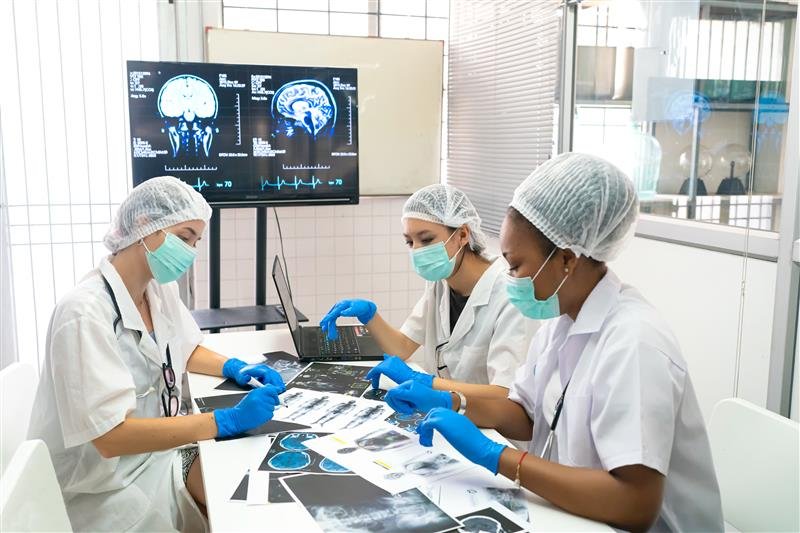
If you are a doctor or nurse working in Dubai right now, you already know what the pressure feels like. The shift does not slow down, the documentation never fully catches up, and the gap between the care you want to deliver and the time you actually have keeps growing wider.
For those finishing their degree or stepping into healthcare for the first time, this is the environment you are walking into.
AI in healthcare is fundamentally changing the operating model with which healthcare is functioning across Dubai and other gulf nations. Clinical workflow automation is already reducing the administrative burden that has weighed on doctors and nurses for years — and whether you are already working inside a hospital or just about to enter one, understanding what that means for your day, your role, and your career is exactly what this blog is for.
We will walk through exactly how AI reduces workload for doctors and nurses, what it genuinely cannot replace, and why this shift matters whether you are five years into your career or just starting out.
What Are the Workloads of a Doctor That AI Is Currently Reducing?
A doctor’s day is rarely just about medicine. Beneath every consultation and diagnosis sits a significant amount of administrative work that demands just as much time as the clinical work itself. Documentation, patient histories, imaging queues, billing, and prescriptions all run in parallel throughout the day. This is the part of the job that AI is actively and measurably changing.
Clinical Documentation
Every clinical note has to capture the patient’s history, examination findings, diagnostic reasoning, and treatment plan in a format that satisfies regulatory, legal, and billing requirements. For many physicians, this work stretches well beyond clinic hours.
Ambient AI scribes listen to a clinical conversation as it happens, convert it into a structured draft note, pull in relevant patient data, and flag anything incomplete before the note is finalized. The doctor reviews and confirms rather than building every note from a blank page.
Reviewing Patient Records
Patient histories span years, multiple care settings, and formats — often including scanned documents and data scattered across systems. Finding the most relevant information before a consultation can take longer than the consultation itself.
AI systems search across structured and unstructured records simultaneously, extract key clinical facts, identify abnormal trends in lab results, and deliver a concise pre-consultation summary before the doctor walks into the room.
Imaging and Diagnostic Prioritization
Diagnostic departments process large volumes of imaging every day. Without a prioritization system, critical findings can sit in a queue far longer than they should.
AI imaging tools analyze scans before physician review, flag high-risk findings, and organize the queue by urgency so the most critical cases are seen first. As of late 2024, the FDA had cleared approximately 1,000 clinical AI algorithms, with nearly 80% designed for imaging applications — a reflection of how validated this application has become.
Coding, Billing, and Compliance
Every clinical encounter has to be translated into standardized codes for billing and regulatory reporting. AI recognizes diagnostic terminology inside existing documentation, suggests appropriate classifications, flags compliance gaps, and populates structured fields where the information already exists. The doctor reviews what the system has organized rather than navigating coding systems manually.
Medication Safety and Prescribing Support
Every prescribing decision involves checking drug interactions, contraindications, allergies, organ function, and dosage simultaneously. AI platforms run all of these checks instantly against the patient’s current data, flag interaction risks, and recommend dose adjustments. The prescribing decision remains entirely the doctor’s, but the analytical groundwork is already done.
| Workload Area | What AI Does | Impact | Status |
|---|---|---|---|
| Clinical Documentation | Listens to consultations, generates structured draft notes, retrieves prior patient data | Reduces after-hours documentation, lowers burnout | Actively deployed in major health systems |
| Patient Record Review | Searches structured and unstructured records, extracts key clinical facts, generates pre-consultation summaries | Faster orientation before consultations, less manual chart digging | Actively deployed |
| Imaging & Diagnostic Prioritization | Pre-analyzes scans, flags high-risk findings, organizes review queue by urgency | Critical cases reach specialists faster, reduces backlog pressure | Actively deployed, FDA cleared ~1,000 imaging AI algorithms |
| Coding, Billing & Compliance | Recognizes diagnostic terminology, suggests coding classifications, flags documentation gaps | Reduces administrative time, lowers billing error risk | Actively deployed |
| Medication Safety & Prescribing | Cross-checks interactions, allergies, dosage parameters instantly against patient data | Faster prescribing decisions with an added safety layer | Actively deployed |
What Are the Workloads of a Nurse That AI Is Currently Reducing?
Nursing is one of the most demanding roles in any healthcare environment. The pressure builds across an entire shift through monitoring, medication administration, documentation, and care coordination — all happening simultaneously, all carrying consequences if something gets missed. A significant portion of this work is repetitive, administrative, and data-heavy. This is exactly where AI is stepping in.
Clinical Documentation and Charting
Nurses document throughout their entire shift. Medication administration, vital signs, care interventions, patient responses, and handover notes all need to be recorded accurately across multiple patients. The US Surgeon General’s 2022 advisory on healthcare worker burnout identified electronic health record interactions as a primary driver of nursing workload and fatigue.
AI documentation tools convert voice input into structured chart entries, auto-populate routine fields, and generate draft shift summaries. The nurse validates rather than composes from scratch. Clinical responsibility stays entirely with the nurse, but the repetitive mechanical work is significantly reduced.
Continuous Patient Monitoring and Early Warning
In any ward, nurses track how patients are doing across an entire shift. Detecting subtle deterioration early enough to intervene is genuinely difficult when managing multiple patients simultaneously.
An integrative review published in Frontiers in Digital Health, synthesizing 18 studies through November 2024, found that AI-powered monitoring systems enabled nurses to detect subtle physiological changes well before traditional methods would have, resulting in timely interventions that reduced complications, shortened hospital stays, and lowered readmission rates.
Nurses receive alerts when a patient’s data trends in a concerning direction. The nurse still assesses and responds — the system simply ensures nothing is silently missed in between.
Medication Administration Safety
Before administering any medication, a nurse must verify the order, check allergies, confirm dosing schedules, and rule out interactions. Done manually across multiple patients, this carries real risk when fatigue is a factor.
A systematic review published in ScienceDirect examining studies from 2013 to 2024 found that AI-driven clinical decision support systems reduced operating room medication errors by up to 95%, smart infusion pumps reduced IV medication errors by approximately 80%, and prescription validation tools led to a 55% reduction in prescribing errors.
The nurse remains the final human check before any medication reaches a patient. AI adds a structured verification layer that catches inconsistencies before they become errors.
Care Coordination and Scheduling
Nurses frequently manage referrals, follow-up appointments, discharge coordination, and inter-departmental communication. This back-and-forth interrupts clinical focus and adds to an already demanding shift.
Research published in PMC’s Nursing Open identifies AI as having significant potential to streamline care coordination through tools that analyze patient acuity, workload distribution, and staffing levels to ensure more efficient task assignments across nursing teams.
Post-Discharge Follow-Up and Patient Communication
Following up with patients after discharge is essential for continuity of care, but doing it manually across a large patient population is resource-intensive. AI-enabled platforms send structured follow-up messages, collect patient responses, identify clinical concerns, and escalate only the cases that need direct nursing attention. Nurses focus their time on the patients who genuinely need them.
| Workload Area | What AI Does | Impact | Status |
|---|---|---|---|
| Clinical Documentation & Charting | Converts voice input to structured entries, auto-populates routine fields, generates shift summaries | Reduces repetitive charting, lowers documentation-related fatigue | Actively deployed |
| Continuous Patient Monitoring | Tracks vital signs and physiological data in real time, triggers early warning alerts | Earlier detection of deterioration, fewer missed clinical changes between manual checks | Actively deployed across ICU and ward settings |
| Medication Administration Safety | Cross-checks orders, allergies, dosage, and interactions before administration | Up to 80% reduction in IV medication errors, 55% reduction in prescribing errors | Actively deployed |
| Care Coordination & Scheduling | Automates appointment confirmations, tracks referrals, maintains care pathways | Fewer manual coordination steps, more time for direct patient care | Actively deployed |
| Post-Discharge Follow-Up | Sends structured follow-up messages, collects patient responses, escalates concerns | Nurses focus only on patients who need direct attention | Actively deployed |
What Are the Benefits of AI-Integrated Workflows for Doctors and Nurses?
The benefits of AI in clinical workflows are no longer projections. They are being measured, published, and observed in active healthcare environments worldwide.
Measurable Reduction in Burnout
Burnout among healthcare professionals has direct consequences for patient safety, staff retention, and system functioning. Administrative and documentation overload has been one of its primary drivers for years — and this is precisely where AI is delivering its most documented impact.
A large multicenter study published in JAMA Network Open, drawing on data from over 1,400 physicians across Mass General Brigham and Emory Healthcare, found that ambient documentation AI was associated with a 21.2% absolute reduction in burnout prevalence at Mass General Brigham within 84 days, while Emory recorded a 30.7% improvement in documentation-related wellbeing.
A separate study published in PMC evaluating 263 physicians across six US health systems found that after just 30 days of using an ambient AI scribe, burnout dropped from 51.9% to 38.8%, with additional improvements in cognitive load, after-hours documentation time, and patient attention.
These are not marginal shifts. They represent a meaningful change in the daily experience of clinical work, observed consistently across different health systems and practice settings.
More Time With Patients
When documentation, data retrieval, and administrative coordination take less time, professionals have more of both available for the people in front of them. Researchers at Yale School of Medicine, evaluating AI scribes across six US health systems, noted that clinicians reported significantly less after-hours documentation time and greater focused attention on patients during consultations.
For a doctor or nurse in a busy Dubai hospital managing a full patient load, even a modest recovery of time and attention across a shift translates into consultations that feel less rushed, patients who feel more heard, and decisions made with greater clarity.
Earlier Detection and Safer Care
The Frontiers in Digital Health integrative review noted above found that AI-powered monitoring enabled nurses to detect physiological changes well before traditional methods would have, reducing complications, hospital stays, and readmission rates.
On medication safety, the evidence is equally compelling — IV medication errors reduced by approximately 80%, prescribing errors reduced by 55%, and operating room medication errors reduced by up to 95%, as documented in the ScienceDirect systematic review. Medication errors remain one of the most persistent sources of preventable harm in healthcare globally, and reducing them at this scale has real consequences for patient outcomes.
Improved Workflow Efficiency
A scoping review mapping 13 peer-reviewed studies from 2019 to 2024, conducted across CINAHL, Medline, and PubMed, found that AI demonstrated significant positive impact on operational efficiency including optimized resource allocation, reduced waiting times, and more proactive, patient-centred care.
A More Sustainable Career in Healthcare
A cross-sectional survey of 43 US health systems conducted in Fall 2024 found that the most commonly cited reasons for adopting AI were relieving caregiver burnout and improving workflow efficiency — a clear institutional recognition that retaining skilled clinicians requires improving the conditions they work in.
For doctors and nurses in Dubai and across the Gulf, where healthcare systems are expanding rapidly under the UAE National AI Strategy 2031 and the Dubai Health Authority’s ongoing digital transformation initiatives, this shift is not just operationally useful. It is strategically important.
| Benefit | What the Evidence Shows | Source |
|---|---|---|
| Reduced Burnout | Burnout dropped from 51.9% to 38.8% among clinicians after 30 days of AI scribe use | PMC, 2024 |
| Reduced Burnout | 21.2% absolute reduction in burnout at Mass General Brigham within 84 days | JAMA Network Open, 2024 |
| More Time With Patients | Clinicians reported significantly less after-hours documentation and greater patient focus | Yale School of Medicine, 2024 |
| Earlier Deterioration Detection | AI monitoring enabled earlier physiological detection, reducing complications and readmissions | Frontiers in Digital Health, 2024 |
| Medication Error Reduction | IV errors reduced ~80%, prescribing errors reduced 55%, OR errors reduced up to 95% | ScienceDirect, 2024 |
| Improved Operational Efficiency | Significant positive impact on resource allocation, wait times, and proactive care | PubMed Scoping Review, 2024 |
| Career Sustainability | Burnout relief and workflow efficiency were the top AI adoption drivers across 43 surveyed health systems | PMC Cross-Sectional Survey, 2024 |
Beyond individual tasks, AI in hospital operations is being embedded directly into the EHR systems doctors and nurses already use daily — making existing workflows smarter, faster, and better connected across departments rather than adding new steps to an already demanding day. This is what clinical workflow automation looks like in practice: not a separate system to learn, but intelligence built into the infrastructure clinicians already work inside.
How AI Fits Into Dubai’s Healthcare Landscape
This shift is not happening in a vacuum, and if you work in Dubai or are planning to, the local context matters directly to your career.
The Dubai Health Authority’s NABIDH platform has already unified over 9.47 million patient records across more than 1,300 healthcare facilities, with 81% of Dubai’s healthcare professionals actively connected to the system. AI has now been integrated into NABIDH to enhance data security and personalize care delivery across the emirate. In April 2025, DHA launched a comprehensive AI training programme for its workforce, recognizing that deploying the infrastructure is only half the equation — the professionals operating inside it need to be prepared.
At a national level, the UAE National AI Strategy 2031 has identified healthcare as a priority sector for AI deployment, with advanced diagnostic tools and AI-integrated clinical systems forming a core part of the country’s digital transformation agenda. Emirates Health Services is already deploying AI algorithms for early cancer detection, heart rate monitoring, and diabetes management.
The infrastructure is in place. The strategy is funded and active. The demand for healthcare professionals who understand how to work inside these systems is growing faster than institutions can train for it.
Where AI Cannot Help Doctors and Nurses Yet
Understanding where AI falls short is just as important as understanding what it can do. These are not minor technical footnotes. They are fundamental gaps that define why human judgment remains irreplaceable.
Final Clinical Decisions Remain Human
AI can organize information, flag risks, and suggest pathways. It cannot take responsibility for what happens next. PubMed Central notes that the physician remains ultimately accountable when an AI-based recommendation results in an incorrect diagnosis. The presence of AI in your workflow does not reduce your responsibility — it makes your judgment more important, because you are now the person deciding whether the system’s output is trustworthy and safe to act on.
AI Cannot Fully Explain Its Own Reasoning
Most AI systems currently function as black boxes — providing recommendations without easily interpretable reasoning. Research published in the Journal of Medical Internet Research found that clinicians expressed significant difficulty trusting AI outputs when they diverged from their own assessment, with one radiologist noting that accountability makes blind trust in the machine impossible.
This is not a reason to distrust AI. It is a reason to build the clinical foundation strong enough to evaluate it.
AI Cannot Read the Human Dimension of a Patient
A patient arrives with fears, family circumstances, financial constraints, and cultural beliefs that shape what treatment is realistic and acceptable for them. None of this lives inside an EHR. Research published by the National Institutes of Health found that while AI models perform well on structured clinical questions, they consistently miss the experiential and contextual dimensions that accurate diagnosis and appropriate care require.
For healthcare professionals working with Dubai’s multicultural patient population, this limitation requires constant awareness. An AI tool validated primarily on data from one population may not perform equally well across all patient groups.
AI Can Reflect Bias in Its Training Data
AI learns from historical data. If that data underrepresents certain patient populations, the system’s outputs will be less reliable for those groups. Peer-reviewed research in Frontiers in Digital Health identifies population shifts and data scarcity as significant threats to the generalizability of AI-based clinical decision support, with biases capable of emerging during training in ways that cause the system to underfit or overfit certain patient groups.
AI Cannot Replace Human Communication and Empathy
A patient who has just received a difficult diagnosis does not need a probability score. They need a human being who can explain what it means, answer questions honestly, and help them understand what comes next. Research published in NPJ Digital Medicine warns that overreliance on AI can erode clinical expertise and reinforce cognitive errors, with the most concerning outcome being a degradation in the quality of care delivered.
AI Still Struggles With Complex, Atypical Cases
AI performs best on patterns that resemble its training data. Clinical reality is frequently messier. A systematic review published in The Lancet Regional Health found that current AI decision-making systems provide limited insights into patient-relevant outcomes in complex or atypical cases, underscoring the need for rigorous evaluation before meaningful integration.
In precisely the cases where the stakes are highest, experienced human judgment remains the most reliable tool available.
How Can Doctors and Nurses Upskill in AI?
How can healthcare professionals upskill in AI?
Upskilling in AI does not require a programming background. It requires a clear understanding of how AI tools work within clinical environments, what their limitations are, and when to question their outputs. A systematic review published in JMIR Medical Education identified AI fundamentals as the essential starting point for healthcare professionals — the foundation on which more advanced clinical competencies are built.
What AI skills do doctors and nurses actually need?
The most useful training connects AI directly to real clinical workflows rather than teaching it in the abstract. Beyond technical basics, upskilling must cover the ethical dimensions — data bias, patient consent, algorithmic transparency, and professional accountability — because these are practical realities in modern clinical environments, not theoretical concerns.
Is AI upskilling a one-time exercise?
No. A 2023 survey from the American Health Information Management Association found that 75% of health IT professionals consider continuous upskilling necessary as AI tools grow in sophistication. For doctors and nurses, that expectation is moving in the same direction. Those who build this foundation now, before their organization requires it, will carry a genuine advantage from day one.
Conclusion
AI is not arriving in healthcare. It is already there, changing the daily reality of clinical work in ways that are measurable, documented, and growing. For doctors and nurses, it is reducing the administrative weight that has driven burnout for years, improving the speed and accuracy of monitoring, and creating more space for the human work that no algorithm can replicate. This is how AI reduces workload for doctors and nurses — not by replacing clinical judgment, but by removing the friction that surrounds it. For those entering the field, it is the environment they are walking into from day one.
In Dubai specifically, the infrastructure is already built. NABIDH connects over 9.47 million records, the UAE National AI Strategy 2031 has placed healthcare at the center of its agenda, and the DHA is actively training its workforce to work inside AI-integrated systems. The question is no longer whether this environment is coming. It is whether you are ready for it.
At Novelty Skills Training, we work with healthcare and life sciences professionals at every stage of their journey — from final-year students stepping into their first clinical role to experienced doctors and nurses who want to stay ahead of a rapidly shifting landscape. Our AI and ML in Healthcare training program delivers practical, workflow-grounded knowledge built for the realities of clinical practice in the UAE and across the Gulf region — not abstract concepts that stay on the page.
The professionals who thrive in AI-integrated healthcare environments will not be the ones who feared the technology or accepted it blindly. They will be the ones who understood it deeply enough to use it well.
FAQs
1. Is AI currently being used in hospitals in Dubai and the UAE?
Yes. The Dubai Health Authority’s NABIDH platform already connects over 9.47 million patient records across more than 1,300 healthcare facilities, with AI now integrated into the system for data security and personalized care. Emirates Health Services is deploying AI for early cancer detection, heart rate monitoring, and diabetes management. The infrastructure is active, not planned.
2. Does using AI in clinical settings require doctors and nurses to have a technology background?
No. The clinical competencies that matter most — critically evaluating AI outputs, recognizing bias, understanding when to override a recommendation — are built on medical knowledge and professional judgment, not programming or data science. The technology is designed to integrate into existing workflows, not replace the clinical foundation underneath them.
3. Who is legally responsible if an AI system makes a wrong clinical recommendation?
The clinician remains legally and professionally accountable for every decision made in a clinical setting, regardless of what an AI system recommends. AI tools currently function in an advisory capacity. Legal frameworks around AI liability in healthcare are still evolving globally, but current best practice is unambiguous: the final decision and its consequences belong to the human professional.
4. How do hospitals decide which AI tools to adopt?
Adoption decisions typically involve clinical leadership, IT departments, compliance teams, and increasingly, chief AI officers. Key evaluation criteria include regulatory clearance, evidence of clinical validation, compatibility with existing EHR systems, and data governance standards. In the UAE, alignment with DHA guidelines and the UAE National AI Strategy 2031 also plays a role in institutional procurement decisions.
5. Can AI tools integrated into one hospital system access patient data from another facility?
In Dubai, the NABIDH platform is specifically designed to enable secure, authorized data sharing across public and private healthcare facilities. Outside of integrated platforms like this, data access between systems depends entirely on interoperability agreements and regulatory frameworks. AI tools do not inherently have cross-facility access — that requires deliberate infrastructure and governance decisions.
6. What happens to patient data that AI systems process during clinical encounters?
Patient data processed by clinical AI tools is subject to the same data protection regulations as any other health information — including HIPAA in the US, GDPR in Europe, and DHA data governance standards in Dubai. Institutions deploying AI are required to ensure that data handling, storage, and access comply with applicable regulations. Transparency about how patient data is used in AI systems is an active area of regulatory development globally.
7. Are there specialties in healthcare where AI is advancing faster than others?
Yes. Radiology and medical imaging have seen the most mature AI adoption, with the FDA having cleared approximately 1,000 imaging AI algorithms as of late 2024. Pathology, cardiology, and ophthalmology are also seeing rapid AI integration. Administrative functions like clinical documentation and billing automation are now mainstream across most major health systems. Mental health and complex multi-system conditions remain areas where AI progress is significantly slower.
8. How does AI handle patients who speak different languages or come from different cultural backgrounds?
This is one of the more significant and underappreciated limitations of current clinical AI. Most AI systems are trained predominantly on data from English-speaking, Western patient populations. Performance can degrade meaningfully when applied to patients from different linguistic or cultural backgrounds. For healthcare professionals in Dubai managing one of the world’s most diverse patient populations, this is a practical clinical consideration, not a theoretical one.
9. What is the difference between AI making a suggestion and AI making a decision in healthcare?
In current clinical practice, AI makes suggestions — it flags, recommends, prioritizes, and alerts. The decision belongs to the clinician. This distinction is both clinical and legal. The moment a system moves from advisory to autonomous decision-making without human oversight, it enters significantly more complex regulatory and ethical territory. No current clinical AI system is authorized to make final treatment decisions independently.
10. How quickly is the demand for AI-literate healthcare professionals growing in the UAE and Gulf region?
Quickly enough that the gap is already visible in hiring patterns. The UAE National AI Strategy 2031 has placed healthcare at the center of its AI deployment agenda, DHA launched a formal AI training programme for its workforce in April 2025, and healthcare systems across the Gulf are investing in digital infrastructure at a pace that is outrunning the availability of professionals trained to work inside it. Professionals who build AI literacy now are entering a market where that preparation is still relatively rare — and therefore disproportionately valued.