
Preparing for a cybersecurity career in Dubai requires more than theoretical understanding. Interviews evaluate how candidates apply security concepts, analyze threats, handle incidents, and solve real-world challenges. Proper preparation helps freshers demonstrate practical skills, technical awareness, and readiness for cybersecurity opportunities in the UAE.
Preparing for cybersecurity interview questions in Dubai requires more than learning tools, earning certifications, or memorizing technical concepts. As the UAE accelerates digital transformation, cybersecurity has become a key priority. Dubai has achieved 99.5% digitization of government services, with 87% of government service transactions completed digitally in 2023, increasing the demand for professionals who can protect applications, systems, identities, and data.
For many candidates, the biggest challenge is converting theoretical knowledge into practical skills. Modern interviews assess how effectively candidates investigate incidents, analyze vulnerabilities, secure infrastructure, manage risks, and communicate security decisions. They may also evaluate awareness of regional frameworks such as UAE PDPL, NESA, and DESC.
This guide covers cybersecurity interview questions, technical concepts, and role-based scenarios across SOC operations, cloud security, GRC, network security, and incident response to help candidates prepare for Dubai’s evolving cybersecurity job market.
Cybersecurity Interview Realities Candidates Should Know
Cybersecurity interviews in Dubai focus on more than theoretical knowledge. Employers look for candidates who can apply security concepts, analyze threats, use industry tools, and handle real-world security challenges effectively.
Key Areas Candidates Should Prepare For:
- Practical Security Skills:
Develop hands-on knowledge of security tools, threat analysis, vulnerability management, SIEM platforms, and security operations practices.
- Role-Based Knowledge:
Prepare according to the target role, whether it is a SOC Analyst, Security Analyst, Penetration Tester, or Cloud Security Specialist, as each role requires specific technical skills.
- Incident Response Skills:
Understand how to detect, investigate, respond to, and recover from security incidents. The NIST Cybersecurity Framework highlights these core functions: Identify, Protect, Detect, Respond, and Recover.
- Security Fundamentals:
Strong knowledge of networking, operating systems, identity and access management, risk assessment, and security frameworks is essential for cybersecurity roles.
- Problem-Solving Ability:
Employers value candidates who can assess risks, explain their approach, and recommend practical security solutions.
Cybersecurity Interview Questions: Core Fundamentals
Most cybersecurity technical interviews begin by evaluating whether candidates can apply security concepts in practical scenarios. Interviewers focus on how well candidates understand security controls, identify risks, and explain approaches to protecting systems, networks, and sensitive data.
Candidates should be prepared to discuss:
- Applying Core Security Principles:
Explain how concepts such as the CIA Triad, least privilege, defense in depth, and Zero Trust help organizations reduce security risks and strengthen protection strategies.
- Securing Networks and Systems:
Demonstrate how networks, endpoints, firewalls, VPNs, and system configurations are protected against unauthorized access and cyber threats.
- Managing Identity and Data Protection:
Describe how authentication, authorization, MFA, access controls, encryption, and hashing help secure identities and sensitive information.
- Analyzing Threats and Vulnerabilities:
Explain how security teams identify threats, assess vulnerabilities, prioritize risks, and implement appropriate mitigation measures.
- Monitoring and Responding to Security Events:
Understand how logs, alerts, indicators of compromise (IOCs), and SIEM tools support threat detection, investigation, and incident response.
- Understanding Cloud and Application Security:
Explain how organizations secure cloud environments and applications through IAM, secure configurations, API protection, and data security practices.
How Cybersecurity Interview Questions Change by Role
| Role | Questions Interviewers Commonly Ask |
| SOC Analyst / Incident Responder | • How would you investigate a suspicious security alert? • Walk me through your approach to responding to a security incident. |
| Cloud Security Engineer | • How would you identify and fix security risks in a cloud environment? • Explain how you would secure cloud access, permissions, and sensitive data. |
| GRC Specialist / Compliance Analyst | • How do you identify and assess cybersecurity risks? • How would you verify whether security controls meet compliance requirements? |
| Network & Infrastructure Security Engineer | • How would you protect an enterprise network from cyber threats? • Explain how network segmentation improves security. |
| Application & API Security Engineer | • How would you identify and prevent common application vulnerabilities? • What steps would you take to secure an API? |
Cybersecurity fundamentals are shared across roles, but each position requires different problem-solving approaches. Focus on applying concepts, not just memorizing definitions.
UAE Cybersecurity and Compliance Interview Questions
Cybersecurity interview in the UAE are increasingly moving beyond basic security concepts. Employers want to understand whether candidates can investigate incidents, secure enterprise environments, and make risk-based decisions when systems, data and business operations are affected.
Most cybersecurity roles fall into three major hiring tracks:
| Cybersecurity Career Track | Common Roles | Key Areas Interviewers Evaluate |
| Security Operations & Threat Response | SOC Analyst, Incident Responder, Threat Analyst | Threat detection, alert investigation, log analysis, incident handling, threat intelligence, and response strategies |
| Cloud & Infrastructure Security | Cloud Security Engineer, Security Engineer, Network Security Engineer | Secure system design, identity and access management (IAM), cloud security controls, network protection, and security architecture |
| Governance, Risk & Compliance (GRC) | GRC Analyst, Compliance Specialist, Risk Analyst | Security frameworks, regulatory requirements, risk assessments, audits, policies, and compliance management |
The difference between candidates is rarely just technical knowledge. Interviewers look for how well you can analyze a situation, prioritise the risk and choose the right security action.
1. Security Operations Track: SOC Analyst & Incident Response
SOC interview questions based on roles sit closest to active threats. Interviewers test whether you can identify what happened, determine the impact and coordinate the right response.
| Sample Question | What a Strong Answer Covers |
| An endpoint is communicating with a known malicious C2 server over HTTPS. How would you investigate it? | Do not rely only on encrypted network traffic. Use the EDR platform to identify the process creating the connection, analyze process human behaviour, awarness execution activity, file reputation, and related endpoint events. If compromise is likely, isolate the endpoint, preserve evidence, and continue investigation. |
| Your SIEM is generating thousands of alerts every week. How would you reduce alert fatigue? | Review alert history, identify legitimate patterns and compare findings with confirmed incidents. Improve detection quality by tuning rules, adding context and adjusting thresholds while ensuring important threats are still detected. |
| A ransomware alert appears on a critical production server. What would you do first? | Validate the alert, determine affected systems, contain the threat, preserve forensic evidence, and follow the organization’s incident-response workflow for recovery and reporting. |
2. Cloud & Infrastructure Security Track: Cloud Security Engineer
Cloud security interviews focus on protecting modern infrastructure while maintaining business availability. Candidates are expected to understand security controls across cloud platforms, networks and enterprise systems.
| Sample Question | What a Strong Answer Covers |
| A cloud storage resource containing sensitive data is accidentally exposed publicly. How would you respond? | First remove unnecessary exposure and preserve evidence. Investigate the cause, review access activity, determine whether data was accessed and implement preventive measures such as least-privilege access, configuration monitoring and security policies. |
| A developer requests emergency production access to fix an issue. How would you provide access securely? | Avoid permanent privileged access. Use approved workflows, temporary permissions, role-based access control, activity monitoring and audit logging to provide only the required access for a limited duration. |
| A critical application becomes unavailable after a firewall policy update. How would you troubleshoot it? | Confirm the impact, review the change history, analyze firewall logs, verify traffic flow and determine whether the policy requires adjustment or rollback while maintaining security requirements. |
What this track tests: Cloud architecture, IAM, security controls, troubleshooting and operational resilience.
3. Governance & Risk Track: GRC Specialist & Compliance
GRC roles focus on the connection between cybersecurity, regulations and business decisions. In UAE organizations, interviewers often evaluate whether candidates can translate requirements into practical security controls.
| Sample Question | What a Strong Answer Covers |
| How would you prepare an organization for a cybersecurity audit? | Identify applicable requirements, review existing controls, collect evidence, perform gap analysis and create remediation plans. Audit readiness should be maintained continuously through regular control reviews. |
| A third-party vendor requires access to sensitive organizational data. What security checks would you perform? | Evaluate vendor security controls, access management, data protection practices, incident-response capability, compliance requirements and contractual security obligations before onboarding. |
| A business wants to launch a service before all security controls are completed. How would you handle it? | Assess the control gaps, business impact and available compensating controls. If risk remains, document the exception, obtain approval from the appropriate risk owner and define a remediation timeline. |
Core Technical Skills Every Cybersecurity Candidate Should Know
Cybersecurity interviews are not just about knowing definitions or tools. Interviewers evaluate how well you understand security principles, analyze threats, and apply solutions to protect real-world systems.
Focus on:
- Network & Cloud Security — Understand TCP/IP, DNS, firewalls, network segmentation, cloud security controls, encryption, and shared responsibility models.
- Identity, Access Management & Zero Trust — Know authentication, authorization, MFA, RBAC, privileged access, least privilege, and continuous verification principles.
- Threat Detection & Security Monitoring — Understand SIEM, EDR, threat intelligence, log analysis, indicators of compromise (IOCs), and security alert investigation.
- Attacker Behavior & Threat Analysis — Learn frameworks like MITRE ATT&CK and Cyber Kill Chain to understand attack paths, including initial access, privilege escalation, lateral movement, and data exfiltration.
- Vulnerability & Application Security — Be familiar with CVEs, CVSS scoring, vulnerability assessments, penetration testing, OWASP risks, API security, and secure coding practices.
- Data Protection & Cryptography — Understand protecting data at rest, in transit, and in use through encryption, hashing, key management, and Data Loss Prevention (DLP).
- Incident Response & Security Governance — Know incident detection, containment, recovery, evidence handling, risk management, and frameworks such as NIST and ISO 27001.
Cybersecurity Interview Preparation Checklist
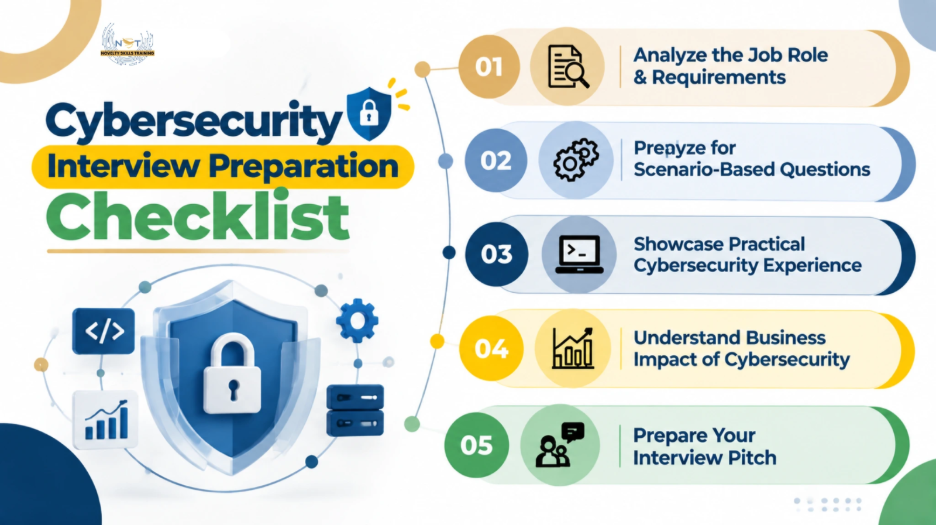
1. Analyze the Job Role & Requirements
✓ Carefully review the job description and understand the role expectations
✓ Identify the required cybersecurity skills, tools, and technologies
✓ Focus your preparation on role-specific areas such as SOC operations, threat detection, vulnerability management, cloud security, or GRC
2. Prepare for Scenario-Based Questions
✓ Practice explaining your approach to real-world security situations
✓ Follow a structured thought process: Identify → Investigate → Analyze → Respond
✓ Prepare for scenarios involving phishing attacks, malware incidents, security alerts, vulnerabilities, and data breaches
3. Showcase Practical Cybersecurity Experience
✓ Be ready to discuss cybersecurity projects, labs, certifications, and hands-on practice
✓ Prepare examples of vulnerability assessments, security investigations, or incident response exercises
✓ Explain the tools you used and how they helped solve security challenges
4. Understand Business Impact of Cybersecurity
✓ Learn how cyber threats affect business operations, customer data, and organizational reputation
✓ Understand key areas like risk management, compliance, security policies, and awareness
✓ Demonstrate how cybersecurity helps protect business continuity and reduce risks
5. Prepare Your Interview Pitch
✓ Create a concise introduction highlighting your skills and experience
✓ Clearly explain your cybersecurity journey, technical strengths, and projects
✓ Connect your knowledge with the company’s security goals and the role you applied for.
Conclusion
Cybersecurity interviews today demand more than theoretical knowledge. Employers look for candidates who can understand threats, analyze security incidents, apply the right tools, and make informed decisions in real-world situations. Developing strong fundamentals, building hands-on experience, and practicing scenario-based problem-solving are essential steps toward becoming interview-ready.
Novelty Skill Training helps aspiring cybersecurity professionals build these skills through practical labs, industry-relevant training, and role-focused learning designed to prepare them for modern cybersecurity careers.
Frequently Asked Questions
What are the most common cybersecurity interview questions?
Common cybersecurity interview questions cover networking, security fundamentals, SIEM, threat detection, incident response, vulnerability management, cloud security, and real-world security scenarios.
What topics are covered in security analyst interview questions?
Security analyst interview questions usually focus on monitoring alerts, investigating threats, analyzing vulnerabilities, handling incidents, and using tools like SIEM and EDR for security operations.
What can I expect in SOC interview questions?
SOC interview questions often test your ability to analyze security alerts, investigate suspicious activity, prioritize incidents, perform threat detection, and follow incident response procedures.
How should I prepare for a cybersecurity technical interview?
A cybersecurity technical interviews requires strong fundamentals in networking, access control, cloud security, vulnerability assessment, threat analysis, and hands-on problem-solving through practical scenarios.